





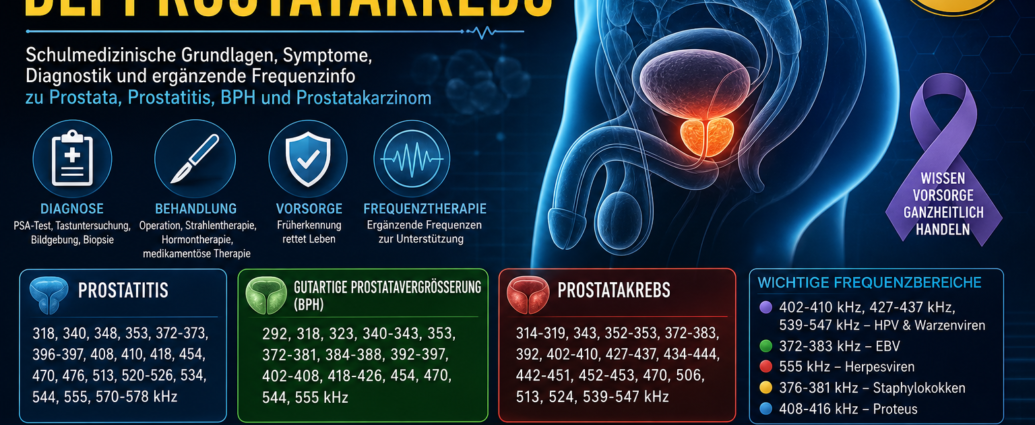
Conventional medical principles, symptoms, diagnostics and supplementary Frequency info on prostate, prostatitis, benign prostate enlargement and prostate carcinoma
Prostate cancer is one of the most common cancers in men. The prostate, also known as the prostate gland, is an important part of the male reproductive system. It produces part of the seminal fluid and is located below the bladder around the beginning of the urethra.
From a conventional medical point of view, prostate cancer develops when prostate cells change, multiply uncontrollably and eventually develop into a malignant tumor. Tumor form. In many cases, prostate cancer develops slowly. Nevertheless, at an advanced stage it can affect surrounding tissue and spread to other parts of the body via the blood or lymphatic system. Bones and lymph nodes are particularly frequently affected.
In the complementary view of the Frequency therapy certain resonance frequencies are also described which are associated in the literature with prostatitis, benign prostate enlargement and prostate cancer. These frequency lists are clearly presented at the end of this article under „Frequency info“.
Frequency therapy for prostate cancer: conventional medical overview
Prostate cancer is usually a so-called Adenocarcinoma. This means that the tumor develops from glandular cells. The prostate consists of numerous small glandular structures that produce fluid for the ejaculate. If these glandular cells lose their normal order and divide in an increasingly uncontrolled manner, a malignant process can develop.
This change often begins in the outer zone of the prostate, the so-called peripheral zone. This is where many prostate carcinomas develop, which is why the medical palpation examination via the rectum plays an important role in screening. Changes in this area can sometimes be felt as a hardening, lump or irregular structure.
Initially, small groups of cells may still be restricted to limited areas within the prostate glands. Prostatic intraepithelial neoplasia is described in the literature in this context. Particularly high-grade changes are considered a conspicuous finding that can be closely associated with prostate cancer.
Frequency therapy for prostate cancer and cell changes
The development of prostate cancer is a multi-stage process. Normal glandular cells can change in stages. In the process, typical characteristics of healthy prostate cells are lost. At the same time, cell nuclei can become larger and more irregular, division activity increases and the tissue structure changes.
As development progresses, the natural boundaries of the glandular structures can be broken. Degenerated cells then grow into the surrounding supporting tissue of the prostate. A limited cell change can thus develop into an invasive tumor.
As the tumor increases in size, it can reach neighbouring structures. These include the seminal vesicles, the bladder neck, the urethra or, in advanced cases, the rectum. The ability of malignant cells to detach themselves from the original tumor and spread to other parts of the body via lymph vessels or blood vessels is particularly significant.
Frequency and significance of prostate cancer
Prostate cancer mainly occurs in older men. With increasing age, the likelihood of changes being found in the prostate increases. Many men develop benign prostate enlargement in the course of their lives. The literature describes that tumorous changes can also be found more frequently in older men with prostate hyperplasia.
It is important to differentiate here: Benign prostate enlargement is not the same as prostate cancer. However, both diseases can cause similar symptoms because they can narrow the urethra or impair the flow of urine. This is why a precise medical examination is particularly important.
Regular screening plays an important role precisely because early symptoms are often unspecific. Prostate cancer can progress for a long time without any clear symptoms. Only when the tumor becomes larger or spreads do more severe symptoms often occur.
Frequency therapy for prostate cancer: possible symptoms
In the early stages, prostate cancer often causes no or only minor symptoms. When symptoms do occur, they are often similar to those of benign prostate enlargement or chronic prostatitis.
Typical complaints can be
- Difficult urination
- weak urine stream
- Frequent urination
- nocturnal urge to urinate
- Delayed onset of urination
- Feeling of incomplete bladder emptying
- Pain or burning sensation when urinating
- Feeling of pressure in the pelvic area
- Pain during ejaculation
- Erectile dysfunction
In advanced cases, blood in the urine, blood in the ejaculate, acute urinary retention or severe pain may occur. If the tumor has already Metastases has formed, bone pain can develop. The spine, pelvis and ribs are particularly frequently affected.
Rarely, prostate cancer can also spread to other parts of the body. If the brain is affected, neurological symptoms such as confusion, seizures or other abnormal symptoms may occur.
Prostatitis, benign prostate enlargement and prostate cancer
The prostate can be affected by various processes. These include inflammation, benign enlargement and malignant changes. These conditions can overlap in their symptoms, but have different causes and different therapeutic consequences.
Prostatitis is an inflammation of the prostate. It can be acute or chronic. Chronic forms can persist for a long time and be associated with pelvic pain, discomfort when urinating, sexual dysfunction or general malaise.
Benign prostate enlargement, also known as benign prostatic hyperplasia, is a common age-related change. Prostate tissue grows without being malignant. Nevertheless, this growth can constrict the urethra and cause significant discomfort.
Prostate cancer, on the other hand, is caused by malignant cell changes. Even if some symptoms appear similar, a precise differentiation is crucial. From a conventional medical point of view, this is done by physical examination, laboratory values, imaging procedures and, if necessary, tissue examination.
Frequency therapy for prostate cancer and possible microbial factors
Various microorganisms are mentioned in the literature in connection with prostate diseases. These include human papillomaviruses, herpes viruses, Epstein-Barr virus, cytomegalovirus, mycoplasma, ureaplasma, Proteus species, pseudomonads, chlamydia, trichomonads, Candida and other groups of pathogens.
In complementary frequency thinking, such microbial stresses are not considered in isolation, but as possible resonance patterns within a complex biological milieu. Particularly in the case of chronic inflammation of the prostate, long-lasting microbial stress is frequently discussed in the literature.
Sexually transmitted infections are also described in connection with chronic prostatitis and long-term stress on the urogenital tract. These include chlamydia, ureaplasma, herpes viruses, certain papillomaviruses and other pathogens. In a complementary approach, such indications may be of interest for frequency therapy testing and documentation.
Human papillomaviruses and prostate tissue
In the literature, human papillomaviruses are discussed in connection with certain tissue changes in the urogenital tract. Their significance in cell changes of the cervix is particularly well known. Complementary literature also describes links to prostate changes.
Different resonance ranges are mentioned in the literature for certain forms of prostate cancer. For ductal carcinoma of the prostate, human papillomaviruses with frequencies in the range of 315-319 kHz and 404-405 kHz are mentioned. For other HPV types, resonance ranges around 410-412 kHz or 427-438 kHz are described.
In acinar adenocarcinoma of the prostate, mycoplasmas are also mentioned in the literature, in particular Mycoplasma genitalium with frequency ranges of 307-308 kHz and 342-350 kHz. Other viral and bacterial concomitant strains are also described.
Frequency therapy for prostate cancer and diagnostics
The conventional medical diagnosis of prostate diseases usually begins with a detailed medical history and physical examination. A digital rectal examination, in which the prostate is palpated via the rectum, plays an important role. This can reveal size, consistency, tenderness or lumps.
Another key laboratory value is the prostate-specific antigen, or PSA for short. An elevated PSA value can have various causes. It can rise in the case of prostate cancer, but can also be elevated in the case of benign prostate enlargement, inflammation, mechanical irritation or after certain procedures.
Further examinations may follow in the event of abnormal findings. These include ultrasound, magnetic resonance imaging, targeted biopsies and histological examinations. If advanced disease is suspected, additional examinations can be carried out to search for metastases, such as bone scintigraphy, X-ray, computer tomography or other imaging procedures.
Conventional medical treatment options for prostate cancer
The treatment of prostate cancer depends heavily on the stage, the biological behavior of the tumor, the age of the patient, the general state of health and the personal therapy goals. Not every prostate cancer needs to be treated aggressively immediately. In the case of slow-growing tumors, close active monitoring can be carried out under certain conditions.
The most important conventional medical treatment options include
- Surgical removal of the prostate
- Radiotherapy
- Hormone therapy
- Systemic drug therapies
- Chemotherapy in selected cases
- Combination of different processes
- Symptomatic treatment for advanced disease
In the case of localized prostate cancer, surgery or radiotherapy may be the main treatment. In the case of advanced disease, hormonal control and systemic therapies play a greater role. In the case of bone metastases, additional measures to reduce pain and stabilize the skeleton may be necessary.
Frequency therapy for prostate cancer in a complementary context
Frequency therapy looks at biological processes from the point of view of vibration, Resonance and energetic regulation. In this context, certain frequency patterns are documented that are associated in the literature with prostate inflammation, benign prostate enlargement or prostate cancer.
Frequency therapy is not considered in isolation in the complementary field. It can be embedded in a comprehensive concept that takes into account conventional medical diagnostics, individual therapy planning, nutrition, relief, metabolic regulation, psychological stabilization and physical activity.
A responsible approach is particularly important in the case of cancer. Prostate cancer is a serious disease. The frequency lists serve as supplementary Information, documentation and individual frequency therapy orientation.
Frequency therapy and cancer in an expanded view
Cancers are not caused by a single factor. They are an expression of complex biological processes in which cell changes, immune reactions, tissue environment, inflammation, hormonal factors, ageing processes and genetic changes can interact.
This complexity is particularly evident in prostate cancer. A tumor can grow slowly over years, but in other cases it can also become more aggressive. Some tumors remain confined to the prostate, while others develop the ability to metastasize.
In complementary frequency therapy, the person is not only defined by the tumor. Regulatory capacity, energetic stress, possible microbial patterns, tissue environment and individual reactions are also considered. The frequency lists can provide an additional level of orientation here.
Frequency info: Prostatitis
The following frequencies are mentioned in the literature in connection with prostatitis. These are frequently found resonance frequencies that are considered in the complementary context of frequency therapy.
Frequency therapy for prostatitis
318 kHz,
340 kHz,
348 kHz,
353 kHz,
372-373 kHz,
396-397 kHz,
408 kHz,
410 kHz,
418 kHz,
454 kHz,
470 kHz,
476 kHz,
513 kHz,
520-526 kHz,
534 kHz,
544 kHz,
555 kHz,
570-578 kHz.
These frequencies are mentioned in the literature in connection with chronic inflammatory processes of the prostate. They can be documented and individually classified as part of a complementary frequency analysis.
Frequency information: benign prostate enlargement
Benign prostate enlargement, also known as benign prostatic hyperplasia, can cause symptoms similar to those of prostatitis or prostate cancer. The following resonance frequencies are mentioned in the literature.
Frequency therapy for benign prostate enlargement
292 kHz,
318 kHz,
323 kHz,
340-343 kHz,
353 kHz,
372-381 kHz,
384-388 kHz,
392-397 kHz,
402-408 kHz,
418-426 kHz,
454 kHz,
470 kHz,
544 kHz,
555 kHz.
These frequencies can serve as an orientation for benign prostate enlargement in complementary observation. The overlap with other prostate frequencies shows that different stress patterns are described in similar frequency ranges.
Frequency info: Prostate cancer
In the literature, certain resonance frequencies are mentioned particularly frequently for prostate cancer. These areas are considered in the complementary context of frequency therapy.
Frequency therapy for prostate cancer
314-319 kHz,
343 kHz,
352-353 kHz,
372-383 kHz,
392 kHz,
402-410 kHz,
427-437 kHz,
434-444 kHz,
442-451 kHz,
452-453 kHz,
470 kHz,
506 kHz,
513 kHz,
524 kHz,
539-547 kHz.
These frequencies are associated with prostate cancer in the literature. Particularly striking are overlaps with frequency ranges that are also described there in connection with human papillomaviruses, wart viruses, Epstein-Barr virus, herpes viruses, staphylococci and Proteus species.
Frequency information: mentioned exciters and resonance ranges
The literature also mentions individual microbial resonance areas that are considered in connection with prostate diseases and urogenital stress.
Frequency therapy and human papillomaviruses
For human papillomaviruses, the following resonance areas are mentioned in connection with prostate tissue:
315-319 kHz,
404-405 kHz,
410-412 kHz,
427-438 kHz.
These areas are associated with different types of HPV in the literature.
Frequency therapy and Mycoplasma genitalium
The following resonance ranges are mentioned in the literature for Mycoplasma genitalium:
307-308 kHz,
342-350 kHz.
These frequencies are mentioned in connection with urogenital stress and certain forms of prostate disease.
Frequency therapy and ureaplasma
The following resonance range is mentioned in the literature for ureaplasma:
384-388 kHz.
This area may be of interest in the complementary context of chronic urogenital complaints.
Frequency therapy and other frequently mentioned resonance ranges
372-383 kHz is described in the literature in connection with Epstein-Barr virus.
555 kHz is assigned to the herpes virus range.
376-381 kHz is mentioned in connection with staphylococci.
408-416 kHz is associated with Proteus species.
These frequency ranges partly overlap with the lists for prostatitis, benign prostate enlargement and prostate cancer.
Frequency therapy for prostate cancer: comparison of frequency patterns
When comparing the frequencies of prostatitis, benign prostate enlargement and prostate cancer, several overlaps are noticeable. The literature describes that the same frequency ranges can occur in different prostate conditions. This may indicate that similar resonance patterns or microbial loads occur in different stages or clinical pictures.
The frequency ranges are particularly striking in prostate cancer:
402-410 kHz,
427-437 kHz,
539-547 kHz.
These areas are associated in the literature with human papillomaviruses and other wart virus groups, among others.
The ranges 372-383 kHz, 555 kHz, 376-381 kHz and 408-416 kHz are also mentioned several times and can be regarded as important supplementary fields of observation in the context of frequency therapy.
Frequency therapy for prostate cancer: Summary
Prostate cancer is one of the most common cancers in men. It usually develops from glandular cells in the prostate and can progress for a long time without any clear symptoms. Initial symptoms often resemble benign prostate enlargement or chronic prostatitis.
Conventional medicine offers screening, palpation, PSA value, imaging diagnostics, Biopsy and histological examination. Treatment depends on the stage, tumor biology and individual situation. Surgery, radiotherapy, hormone therapy, medication and combination therapies are all possible.
Frequency therapy offers a complementary level of consideration. Numerous frequencies are mentioned in the literature that are associated with prostatitis, benign prostate enlargement, prostate cancer and possible microbial contamination. These frequency lists can be used for complementary documentation, resonance observation and individual frequency therapy work.

Comments are closed, but trackbacks and pingbacks are open.