





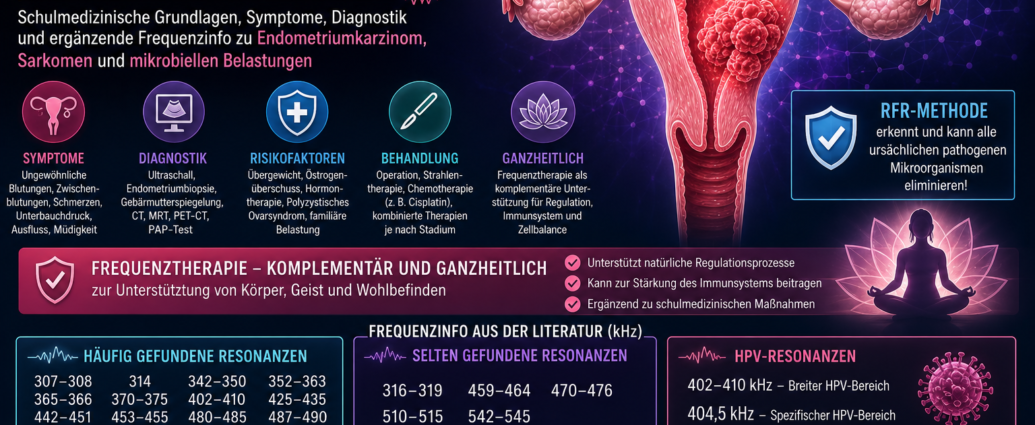
The Frequency therapy for uterine cancer is described in a complementary context as a supplementary consideration to conventional medical principles, symptoms, risk factors, diagnostics and possible microbial resonance patterns. Uterine cancer usually develops in the mucous membrane of the uterus, the so-called endometrium. The most common form is endometrial cancer, which mainly affects women during the menopause and after the menopause.
From a conventional medical point of view, uterine cancer is a serious malignant disease, the course of which depends heavily on the type of tumor, tumor grade, spread and accompanying factors. The literature also mentions certain resonance frequencies that can be used in frequency therapy as a supplementary treatment. Frequency info documented and complementary can be considered.
Frequency therapy for uterine cancer: conventional medical overview
Uterine cancer often begins in the inner lining of the uterus. This mucous membrane is called the endometrium and changes during the female cycle under the influence of hormones. If cells of this mucous membrane degenerate, multiply uncontrollably and invade surrounding tissue, endometrial cancer can develop.
Endometrial carcinoma is one of the most common malignant tumors of the female genital tract. It occurs particularly frequently between the ages of around 50 and 60. Some cases are diagnosed before the menopause, but younger women under the age of 40 are affected much less frequently.
Most endometrial carcinomas belong to the group of endometrioid carcinomas. Adenocarcinomas. These are malignant tumors that develop from gland-forming cells in the uterine lining. There are also rarer forms such as clear cell carcinomas, papillary serous carcinomas, adenoacanthomatous tumors and adenosquamous carcinomas.
Frequency therapy for uterine cancer and tumor forms
Uterine cancer is not a uniform clinical picture. Different cell types and growth patterns can lead to different tumor forms. For conventional medical assessment, it is important to know the exact type of tumor, as this has an impact on treatment and prognosis.
Endometrioid adenocarcinoma
Endometrioid adenocarcinoma is the most common form of endometrial carcinoma. It arises from glandular cells of the uterine lining and can degenerate to varying degrees. The degree of cell change plays an important role in assessing the course of the disease.
Low-grade tumors are even more similar to healthy mucosal cells. High-grade tumors show clearer deviations and can grow more aggressively. The assessment is carried out by means of histological examination.
Adenoacanthoma and adenosquamous carcinoma
The literature also describes tumors in which glandular and squamous cell components occur together. Benign squamous cell-like components are described in adenoacanthomas. In adenosquamous carcinoma, these components are malignantly altered.
The degree of the glandular tumor component is particularly important for the prognosis. If a malignant squamous cell-like part is present, a more de-differentiated glandular part is often also found.
Clear cell and papillary serous adenocarcinoma
Clear cell and papillary serous adenocarcinomas are rarer but significant forms of endometrial cancer. They make up only a small proportion of all uterine cancers, but can be more aggressive and require particularly careful clarification.
These tumors can arise within a polyp or develop over a large area and in multiple foci in the endometrium. Early tumor growth can be directed outwards and spread through the mucous membrane at the same time.
Frequency therapy for uterine cancer and uterine sarcomas
In addition to carcinomas of the mucous membrane, there are also malignant tumors that arise from muscular or connective tissue of the uterus. These are known as uterine sarcomas. These include leiomyosarcomas and mixed Müller tumors.
The distinction between a benign leiomyoma, i.e. a Myoma, and a leiomyosarcoma is carried out by conventional medicine using histological examination. Cell atypia, increased division activity and indications of malignant behavior are evaluated.
Mixed Müller tumors, also known as carcinosarcomas, consist of a carcinomatous and a sarcomatous part. They are described in the literature as high-grade, often undifferentiated tumors that appear early outside the uterus and can affect lymph nodes.
Common symptoms of uterine cancer
A typical leading symptom of endometrial cancer is unusual bleeding from the uterus. Bleeding after the menopause in particular is an important warning sign and should always be investigated.
Intermenstrual bleeding, very heavy periods, prolonged bleeding or irregular bleeding patterns can also be indications of changes in the uterine lining. As endometrial carcinomas often have a fragile tissue structure, spontaneous bleeding can occur even in the early stages.
Other possible symptoms include lower abdominal pain, a feeling of pressure in the pelvis, unusual discharge, pain during sexual intercourse or general symptoms such as tiredness and weight loss with advanced disease.
Spread of uterine cancer
As it progresses, endometrial cancer can grow into the muscle layer of the uterus. This muscle layer is called the myometrium. The deeper the Tumor the more important this is for the prognosis and treatment planning.
Further growth can occur in the direction of the cervix. The tumor can also spread locally or spread via lymphatic channels. Lymph nodes in the pelvic area and along the large abdominal vessels can be particularly affected. Inguinal lymph nodes are less frequently affected.
Via the bloodstream Metastases in the lungs, liver, bones and, in rare cases, in the brain. In individual cases, metastases via the fallopian tubes into the abdominal cavity have also been described.
Frequency therapy for uterine cancer and risk factors
Various risk factors can promote the development of endometrial cancer. One important factor is a long-term increase in the influence of oestrogen on the uterine lining. Oestrogens stimulate the growth of the endometrium. If this influence is not sufficiently balanced by progestogens, the risk of mucosal changes can increase.
Known risk factors include obesity, hormonal replacement therapies with a one-sided estrogen influence, certain ovarian tumors such as granulosa cell tumors and polycystic ovary syndrome. A family history of endometrial cancer may also indicate an increased risk.
The literature also describes a connection with other types of tumors. Breast cancer, colorectal cancer and ovarian cancer are more frequently mentioned in connection with endometrial cancer. Treatment with tamoxifen after breast cancer may also require special gynecological attention.
Some data suggest that smoking and combined hormonal contraceptives can reduce the risk of endometrial cancer. These correlations are part of the overall medical assessment and do not replace individual screening or clarification.
Frequency therapy for uterine cancer and early detection
According to conventional medicine, there is no generally recommended routine screening for uterine cancer for women without symptoms. Regular mucosal sampling or transvaginal ultrasound examinations for early detection in completely symptom-free women are not described in the literature as a general screening measure.
However, it is important to clarify any symptoms. Bleeding after the menopause, conspicuous intermenstrual bleeding or unusual bleeding patterns in particular should be examined by a doctor. In such cases, the diagnosis can often be made at an early stage.
An individual gynecological check-up can also be useful for women with known risk factors. The decisive factor is the combination of symptoms, clinical findings, ultrasound and, if necessary, tissue examination.
Conventional medical diagnostics for uterine cancer
The diagnosis usually begins with a gynecological examination and a precise assessment of the symptoms. An important step is the vaginal ultrasound examination. This allows the thickness of the uterine lining to be assessed.
In the event of abnormal findings, a tissue sample can be taken from the uterine lining. This endometrial biopsy enables a histological examination and precise classification of the cell changes.
Further diagnostic procedures can include hydroultrasound, uterine endoscopy with targeted Biopsy, The methods used include smear tests, computed tomography, magnetic resonance imaging and positron emission tomography. Which method is used depends on the findings, stage and clinical question.
Conventional medical treatment options
The treatment of uterine cancer depends on the tumor stage, tumor type, tumor grade, age, general condition and spread. The aim is to remove the tumor, avoid complications, reduce symptoms and lower the risk of recurrence.
The focus is often on surgery. The uterus, fallopian tubes and ovaries can be removed. Depending on the findings, lymph nodes may also be examined or removed. If the disease is advanced, an extended operation may be necessary.
Radiotherapy, chemotherapy or combined treatment concepts can also be used. Cisplatin is one example of a chemotherapeutic substance mentioned in the literature. The exact treatment is determined individually according to the tumor stage and risk profile.
Frequency therapy for uterine cancer and possible pathogen patterns
Various microbial strains are described in the literature in connection with uterine cancer. Particular mention is made of human papillomaviruses, human lymphotropic Viruses, human B-lymphotropic virus, Mycoplasma genitalium, Mycoplasma fermentans, genital herpes and, in rare cases, sarcoma viruses in carcinosarcomas.
In the literature, human papillomaviruses are often associated with frequency ranges around 402-410 kHz. Vaccination concepts against certain HPV groups are also mentioned in connection with prevention. A single HPV range around 404.5 kHz and a broader range of 402-410 kHz are described in the literature.
In complementary frequency thinking, such pathogen patterns are viewed as possible resonance fields. They are not seen in isolation, but in connection with the mucosal environment, immune situation, hormonal situation and individual regulatory capacity.
Frequency therapy for uterine cancer in a complementary context
Frequency therapy looks at biological processes from the point of view of vibration, Resonance and regulation. In the case of uterine cancer, the complementary focus is on the uterine lining, hormonal influences, possible microbial resonance patterns, the immune system and the energetic balance of the pelvic cavity.
The literature often mentions certain frequency ranges for uterine cancer that are associated with pathogen groups and tumor processes. These frequencies can be used as part of frequency therapy for documentation, orientation and individual observation.
The frequency lists are understood as supplementary frequency information. They are related to a holistic view of the body, metabolism, immune system, hormonal regulation, mucosal health and mental stability.
Frequency therapy and cancer in an expanded view
Cancers are caused by complex changes in cell control, tissue architecture, immune regulation and biological communication. Hormonal factors also play a major role in uterine cancer. In particular, the balance between oestrogens and progestins influences the uterine lining.
Frequency therapy views cancer in a broader sense as an expression of disorder and altered resonance in the organism. Not only the tumor itself is considered, but also the surrounding environment, possible chronic stress, microbial patterns and regulatory processes.
In endometrial cancer in particular, the combination of hormonal control, mucosal changes, immune status and possible microbial contamination is an important field of complementary observation. The frequencies listed at the end can serve as a structured orientation.
Frequency info: frequently found resonances
The following frequencies are frequently mentioned in the literature in connection with uterine cancer. They are regarded as complementary resonance ranges in the complementary context of frequency therapy.
Frequency therapy for uterine cancer
307-308 kHz,
314 kHz,
342-350 kHz,
352-363 kHz,
365-366 kHz,
370-375 kHz,
402-410 kHz,
425-435 kHz,
442-451 kHz,
453-455 kHz,
480-485 kHz,
487-490 kHz,
493-495 kHz,
517-521 kHz,
525-527 kHz,
536 kHz.
These frequency ranges are frequently described in the literature in connection with uterine cancer. In the context of frequency therapy, they can be used as complementary frequency information for documentation, resonance observation and individual work.
Frequency info: rarely found resonances
In addition to the frequently mentioned frequencies, rarer resonance ranges are also described in the literature.
Frequency therapy for rare resonances
316-319 kHz,
459-464 kHz,
470-476 kHz,
510-515 kHz,
542-545 kHz.
These frequencies are rarely mentioned in connection with uterine cancer. Nevertheless, they can play a complementary role in complementary frequency observation, especially if individual resonance patterns or accompanying stresses indicate this.
Frequency info: HPV and uterine cancer
Human papillomaviruses are repeatedly mentioned in the literature in connection with tumor processes of the female genital tract. Resonance ranges around 402-410 kHz are mentioned particularly frequently.
Frequency therapy for HPV resonances
402-410 kHz,
404.5 kHz.
The range 402-410 kHz is associated with various HPV groups in the literature. The single value 404.5 kHz is mentioned there in connection with a specific HPV group. In frequency therapy, these frequencies can be used as additional indications when looking at viral resonance patterns.
Frequency info: Mycoplasma and uterine cancer
In the literature, Mycoplasma genitalium and Mycoplasma fermentans are mentioned as possible concomitant strains in connection with uterine cancer. Mycoplasmas are often associated with chronic mucosal and urogenital infections in the complementary frequency analysis.
Frequency therapy for mycoplasma
307-308 kHz,
342-350 kHz,
442-451 kHz,
493-495 kHz.
These frequency ranges overlap with the general frequency list for uterine cancer. In the complementary view, they can be taken into account in chronic stress patterns of the urogenital tract.
Frequency info: viral accompanying patterns
In addition to HPV, other viral groups are mentioned in the literature. These include human lymphotropic viruses, human B-lymphotropic virus and genital herpes. Rare sarcoma virus references are also mentioned in carcinosarcomas.
Frequency therapy for viral concomitant patterns
352-363 kHz,
365-366 kHz,
370-375 kHz,
425-435 kHz,
453-455 kHz,
480-485 kHz,
487-490 kHz,
517-521 kHz,
525-527 kHz,
536 kHz.
These areas can be regarded as supplementary resonance fields in frequency therapy. They can be documented particularly in connection with mucosal changes, immune stress and tumorous processes of the female genital tract.
Frequency therapy for uterine cancer: comparison of frequency patterns
When comparing the frequency lists, it is noticeable that several ranges are repeatedly mentioned in connection with viral and mycoplasmal contamination. The ranges 307-308 kHz, 342-350 kHz, 402-410 kHz, 425-435 kHz, 442-451 kHz, 493-495 kHz and 517-527 kHz are particularly striking.
The 402-410 kHz range is frequently associated with human papillomaviruses in the literature. The ranges 307-308 kHz and 342-350 kHz are often mentioned in connection with mycoplasmas. The higher ranges around 517-527 kHz can be considered as additional resonance fields in the complementary documentation.
This results in a structured picture for frequency therapy: uterine cancer is not only viewed as a local cell change, but also in connection with the mucosal environment, hormonal regulation, immune status, viral patterns and possible accompanying bacterial or mycoplasmal contamination.
Frequency therapy for uterine cancer: Summary
Uterine cancer usually develops in the lining of the uterus. The most common form is endometrial carcinoma, in particular endometrioid adenocarcinoma. Other forms are clear cell, papillary-serous, adenoacanthomatous and adenosquamous carcinomas. There are also rare uterine sarcomas and mixed Müller tumors.
An important warning sign is unusual bleeding, especially after the menopause. The conventional medical diagnosis is carried out by means of a gynecological examination, ultrasound, endometrial biopsy, uterine endoscopy, tissue examination and, if necessary, by CT, MRI or PET examination. Treatment depends on the stage and can include surgery, radiotherapy, chemotherapy or combinations.
Frequency therapy offers a supplementary level of observation. Numerous resonance frequencies are mentioned in the literature that are associated with uterine cancer, HPV, mycoplasma, viral accompanying patterns and rare resonances. These frequency lists can be used in a complementary context for documentation, resonance observation and individual frequency therapy work.

Comments are closed, but trackbacks and pingbacks are open.