





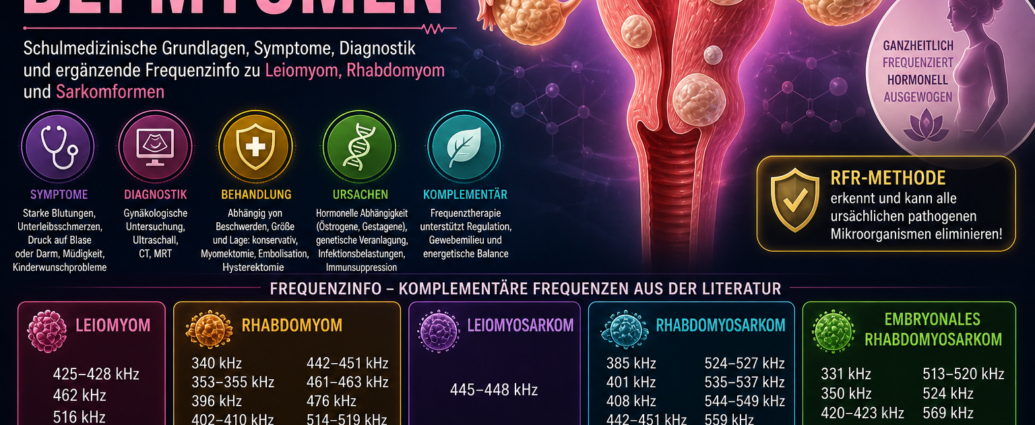
The Frequency therapy for fibroids is described in a complementary context as a supplement to conventional medical principles, hormonal influences, symptoms, diagnostics and treatment options. Myomas of the uterus, also known as uterine fibroids or myoma uteri, are benign tumors that can develop from the muscle layer of the uterus. They are among the most common benign changes in the female genital tract.
From a conventional medical point of view, uterine fibroids are usually leiomyomas. These develop from smooth muscle and connective tissue parts of the uterus. Certain resonance frequencies are also described in the literature, which can be used as a complementary treatment in the context of frequency therapy. Frequency info can be considered. These frequencies are clearly displayed at the end of this article.
Frequency therapy for fibroids: conventional medical overview
Myomas are benign mesenchymal tumors. This means that they develop from tissue types that belong to the supporting, muscle or connective tissue. In the uterus, they mainly develop from the smooth muscles of the uterine wall.
The most common form is the leiomyoma. It consists of smooth muscle cells and connective tissue structures. Leiomyomas can occur individually or in large numbers. They can remain small, but can also reach considerable sizes and thus exert pressure on surrounding organs.
A rarer form of tumor is rhabdomyoma. This develops from striated muscle and is described in the literature primarily as a rare muscle tumor of childhood. While leiomyomas of the uterus are generally benign, certain muscular tumor forms can develop malignant characteristics in rare cases or be confused with forms of sarcoma.
Frequency therapy for fibroids and leiomyomas
Leiomyomas are caused by an excessive proliferation of smooth muscle cells and connective tissue within the uterus. Histologically, a so-called monoclonal cell proliferation is often described. This means that many cells of a myoma can originate from one originally altered cell.
Hormonal dependence plays an important role. Leiomyomas often have receptors for oestrogens and gestagens. This enables them to react to hormonal changes. Many fibroids grow more strongly during the fertile phase of life and partially recede after the menopause when hormonal stimulation decreases.
A genetic predisposition is also described in the literature. Myomas can run in families. In addition to hormonal and genetic factors, the complementary literature also considers chronic stress, infection patterns and regulatory disorders as possible accompanying factors.
Leiomyoma and possible degeneration
Leiomyomas are usually benign. Malignant degeneration into a leiomyosarcoma is described as rare in the literature. The actual frequency of such a transformation is difficult to determine because leiomyomas are very common, while leiomyosarcomas are rare.
In addition, leiomyosarcomas can also develop independently of a pre-existing fibroid. It is therefore important from a conventional medical point of view to carefully clarify any unusually fast-growing, painful or conspicuous tumors.
Especially after the menopause, a newly growing or rapidly increasing uterine tumor is assessed more closely. Imaging, clinical progression and, if necessary, tissue examination help to differentiate between benign and malignant changes.
Frequency therapy for fibroids and hormonal influences
Hormonal regulation plays a central role in fibroids. Oestrogens and gestagens can influence the growth of leiomyomas. This is why fibroids mainly occur in phases of life when the ovaries are actively producing hormones.
During pregnancy, fibroids can grow or cause discomfort due to hormonal changes. After the menopause, many women experience a reduction in size because hormonal stimulation decreases.
In the complementary view of frequency therapy, the hormonal level is not seen in isolation. Instead, it is linked to the tissue environment, blood circulation, inflammatory tendencies, individual regulatory capacity and possible resonance patterns. This creates a holistic view of the uterus as a hormonally sensitive, muscular and energetically active organ.
Possible causes and accompanying factors of fibroids
The exact development of fibroids is complex. Conventional medicine mainly discusses genetic factors, hormonal influences, growth factors and local tissue reactions. A single trigger cannot usually be determined.
Certain infectious and microbial stresses are also mentioned in the literature. It is described that certain tumor viruses, immunosuppressive stress patterns and concomitant bacterial infections can play a role in the tumor process with a corresponding predisposition. Among other things, a frequency range of 440-452 kHz is mentioned in connection with immunosuppressive pathogen patterns.
From the point of view of frequency therapy, such indications are regarded as possible resonance fields. They can be documented and individually examined in complementary work. However, conventional medical clarification of the structure, size, location and growth tendency of the fibroid remains decisive.
Frequency therapy for fibroids: common complaints
Many women with uterine fibroids have no symptoms. Fibroids are then discovered by chance during a gynecological examination or ultrasound. Whether symptoms occur depends on the size, number and location of the fibroids.
Possible symptoms include cramp-like lower abdominal pain, a feeling of pressure in the pelvis, increased menstrual bleeding, prolonged bleeding or bleeding between periods. Particularly heavy bleeding can lead to iron deficiency and anaemia. The women affected often feel tired, weak and less resilient.
Pain often occurs in connection with menstruation. Some women report a pulling sensation in the lower abdomen, back pain or a general feeling of heaviness in the pelvis. Large fibroids can also press on neighboring organs and cause additional discomfort.
Pressure complaints due to fibroids
Depending on their location, fibroids can press on the bladder, bowel or other pelvic structures. If the bladder is affected, frequent urination, sudden urination, nocturnal urination or, in rare cases, incontinence may occur.
If a fibroid presses on the bowel, it can cause constipation, difficult defecation or pain in the rectum. Such symptoms occur less frequently, but can be very distressing in the case of large or unfavorably located fibroids.
General discomfort in the lower abdomen, a bloated abdomen, a feeling of pressure or pain in the small pelvis can also be associated with fibroids. The literature also describes that calcifications can occur within fibroids. In complementary contexts, nanobacteria are also mentioned as possible accompanying factors.
Fibroids and pregnancy
Myomas can have a special significance during pregnancy. Not every fibroid causes problems, but complications can occur depending on their size and location. Some fibroids grow more strongly due to the hormonal situation during pregnancy.
The literature describes possible complications such as miscarriage, growth retardation of the unborn child, premature labor, premature birth, disturbed labor activity, obstruction of the birth canal, increased bleeding after birth and urinary retention.
A water sac kidney due to obstruction of the outflow can also occur in certain situations if a large fibroid presses on the urinary tract. It is therefore important to have a careful gynecological check-up during pregnancy if fibroids are known.
Frequency therapy for fibroids and diagnostics
The conventional medical diagnosis begins with a gynecological examination. Enlarged or irregularly shaped uterine structures can sometimes already be detected by palpation.
Ultrasound is the most important imaging procedure for assessing fibroids. The size, position, number and structure of the fibroids can usually be visualized well. The relationship to the uterine cavity and uterine wall can also be assessed.
In certain cases, other procedures such as computer tomography or magnetic resonance imaging can be used. Magnetic resonance imaging is particularly helpful if there are many fibroids, the location is complex or precise surgical planning is required.
Conventional medical treatment options for fibroids
The treatment of fibroids depends on the symptoms, size, location, growth, age, desire to have children and general state of health. Not every fibroid needs to be treated immediately. If there are no symptoms and the findings are unremarkable, regular check-ups may be sufficient.
Various treatment approaches can be considered for symptoms. Conservative measures can be aimed at regulating bleeding, reducing pain or influencing hormones. Drug therapies can be used depending on the situation.
Surgical options include the targeted removal of individual fibroids, also known as myomectomy, or the removal of the uterus if family planning is complete and symptoms are severe. Procedures such as embolization of the uterine arteries or targeted myoma embolization can also be used. This reduces the blood supply to the fibroid, allowing it to shrink.
Frequency therapy for fibroids in a complementary context
Frequency therapy looks at biological processes from the point of view of vibration, Resonance and regulation. In the case of fibroids, the complementary focus is on the uterus as a hormonally controlled muscle organ, the tissue environment, blood circulation, possible chronic stress and individual resonance patterns.
In the literature, the terms leiomyoma, rhabdomyoma, and leiomyosarcoma are used for, Rhabdomyosarcoma and embryonal rhabdomyosarcoma are associated with different frequency ranges. These frequencies are not considered in isolation, but rather in the context of the patient’s overall symptoms, the conventional medical diagnosis, and the individual’s regulatory state.
Frequency lists can be used in complementary work for documentation, orientation and individual testing. A holistic approach that takes into account the body, metabolism, pelvic area, cycle, stress load and immune system is particularly useful for hormonally influenced tumors.
Frequency therapy for fibroids and cancer in an expanded view
Although uterine fibroids are usually benign, the literature also refers to rare malignant muscular tumor forms. These include leiomyosarcomas and rhabdomyosarcomas. These tumors differ significantly from ordinary fibroids and require careful medical clarification.
In connection with cancer, it has been shown that cell changes, the tissue environment, the immune system, hormonal influences and possible microbial contamination can interact. Frequency therapy views such processes in a broader sense as an expression of altered biological order and disturbed regulation.
In the case of conspicuous findings, rapid growth, heavy bleeding, pain or unusual changes, a precise conventional medical examination is particularly important. Complementary frequency therapy can also document which resonance ranges are mentioned in the literature and how they can be incorporated into an individual overall concept.
Frequency info: Leiomyoma
The following frequencies are mentioned in the literature in connection with leiomyomas. They are regarded as resonance ranges in the complementary context of frequency therapy.
Frequency therapy for leiomyoma
425-428 kHz,
462 kHz,
516 kHz.
These frequencies are described in the literature as frequent resonances in leiomyomas. As part of frequency therapy, they can be documented as an additional orientation for benign uterine fibroids.
Frequency info: Rhabdomyoma
Rhabdomyoma is a rare Tumor of the musculature. Several resonance ranges are described in the literature.
Frequency therapy for rhabdomyoma
340 kHz,
353-355 kHz,
396 kHz,
402-410 kHz,
425-432 kHz,
442-451 kHz,
461-463 kHz,
476 kHz,
514-519 kHz,
544-545 kHz.
These frequencies are considered in a complementary context as supplementary frequency information to the rhabdomyoma. The breadth of the frequency ranges shows that different resonance patterns are described in the literature.
Frequency info: Leiomyosarcoma
Leiomyosarcoma is a rare malignant tumor of the smooth muscles. It differs significantly from ordinary leiomyomas and is assessed separately by conventional medicine.
Frequency therapy for leiomyosarcoma
445-448 kHz.
This frequency range is mentioned in the literature in connection with leiomyosarcoma and can be taken into account in complementary frequency therapy as additional documentary information.
Frequency info: Rhabdomyosarcoma
Rhabdomyosarcoma is a malignant form of tumor that originates from muscular precursor cells. It can progress differently depending on its form, age and location.
Frequency therapy for rhabdomyosarcoma
385 kHz,
401 kHz,
408 kHz,
442-451 kHz,
512-517 kHz,
524-527 kHz,
535-537 kHz,
544-549 kHz,
559 kHz,
567 kHz.
These frequencies are described in the literature as resonance ranges in rhabdomyosarcoma. In frequency therapy, they can be documented as part of a supplementary examination.
Frequency info: embryonal rhabdomyosarcoma
Embryonal rhabdomyosarcoma is a special form of rhabdomyosarcoma. It is mainly described in connection with childhood tumor forms.
Frequency therapy for embryonal rhabdomyosarcoma
331 kHz,
350 kHz,
420-423 kHz,
513-520 kHz,
524 kHz,
569 kHz.
These frequencies are mentioned in the literature in connection with embryonal rhabdomyosarcoma. In the complementary frequency context, they serve as supplementary resonance information.
Frequency therapy for fibroids: comparison of frequency patterns
When comparing the frequency lists, several areas are noticeable that repeat or are close to each other. Frequency fields around 425-432 kHz, 442-451 kHz, 512-520 kHz and 544-549 kHz are particularly striking. These ranges are mentioned in the literature for different types of muscular tumors.
This overlap is interesting for complementary frequency therapy because it can indicate recurring resonance patterns in the area of muscular tissue changes. Comparative documentation of these frequencies can be particularly useful for leiomyomas, rhabdomyomas and forms of sarcoma.
The frequency lists are always considered in connection with the respective findings. A benign leiomyoma differs clearly from malignant forms of sarcoma. Therefore, conventional medical diagnosis, course and imaging are the basis for any further consideration.
Frequency therapy for fibroids: Summary
Myomas of the uterus are usually benign tumors that arise from the muscle layer of the uterus. The most common form is the leiomyoma. It is influenced by hormonal factors, genetic predisposition and local tissue reactions. Many women remain symptom-free, others suffer from heavy bleeding, pain, a feeling of pressure, a frequent urge to urinate or discomfort in the bowel area.
In conventional medicine, the diagnosis is made by gynecological examination, palpation, ultrasound and, if necessary, computer tomography or magnetic resonance imaging. Treatment depends on the symptoms, size, location, growth and desire to have children. Control, conservative measures, myomectomy, embolization or hysterectomy are possible.
Frequency therapy offers a supplementary level of consideration. Resonance frequencies for leiomyoma, rhabdomyoma, leiomyosarcoma, rhabdomyosarcoma and embryonal rhabdomyosarcoma are mentioned in the literature. These frequency lists can be used in a complementary context for documentation, resonance observation and individual frequency therapy work.

Comments are closed, but trackbacks and pingbacks are open.