





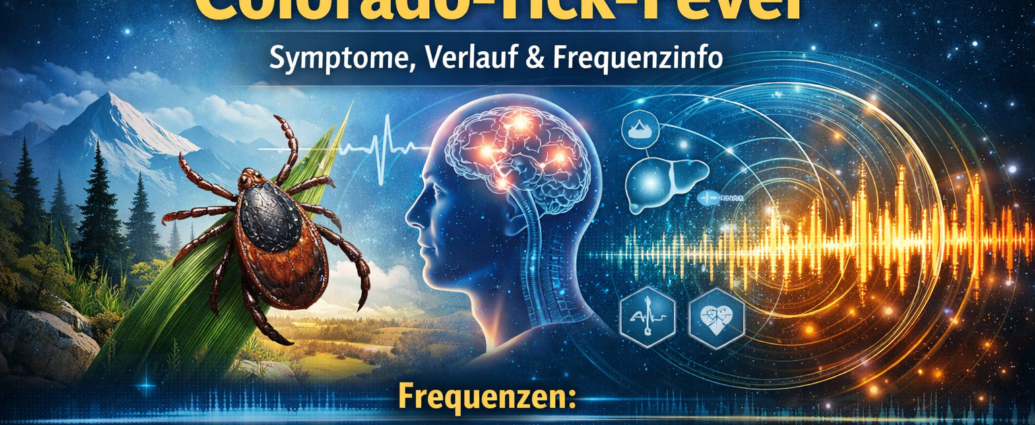
Symptoms, progression and frequency information
Colorado tick fever is a viral infection caused by a coltivirus that can be transmitted to humans via ticks. In the literature, the disease is usually described as rather mild, with a comparatively favorable prognosis and only rarely severe courses. Despite the predominantly benign course, Colorado tick fever is of medical interest because the pathogen is transmitted via a vector, shows seasonal clusters and can also affect the nervous system in individual cases.
What is Colorado-Tick-Fever?
Colorado tick fever, also described as tick fever 5, is an infection that is transmitted to mammals and also to humans primarily through the bite of infected ticks. The adult Rocky Mountain tick plays a particularly important role here. The literature describes that cases of disease peak between May and July. This underlines the seasonal nature of this infection.
The pathogen belongs to the group of coltiviruses. One remarkable aspect is that human erythrocytes contain the Virus can carry. This peculiarity makes it clear that the infection is not only limited locally to the injection site, but can also manifest itself systemically in the organism. Nevertheless, the course is considered benign in most cases, with an overall favorable prognosis.
Transmission and seasonal correlation
Transmission occurs primarily via ticks as vectors. In contrast to a direct droplet or contact infection, the bite of an infected carrier is the main route. This makes Colorado tick fever a typical vector-borne viral disease.
The seasonal correlation is particularly important for conventional medicine. If cases of illness occur more frequently in the warmer months, a clear epidemiological pattern emerges. This fact helps to better classify typical periods of increased exposure and to take a more differentiated view of possible symptoms associated with spending time in tick-infested areas.
Typical symptoms of Colorado Tick Fever
A triad of symptoms is described in the literature, which is considered typical but not completely specific. These include high fever, pronounced muscle pain and severe headaches. This combination in particular makes it clear that this is a systemic viral load that can affect the entire organism.
In contrast to other infectious diseases with skin involvement, Colorado tick fever is usually described without a characteristic rash. Although fever may occur, the disease is generally considered mild. Nevertheless, the symptoms can be subjectively very distressing, especially if myalgias and headaches are severe.
How does the disease progress?
The course is predominantly described in the literature as benign and rarely fatal. Many cases remain in the context of an acute but recoverable viral infection. It is precisely this favorable prognosis that is an important feature of the conventional medical classification.
Nevertheless, a benign course does not automatically mean that the illness is inconsequential. Even a usually mild viral infection can put the body under considerable strain, especially if fever, muscle pain and headaches occur at the same time. The strain on the general condition can be particularly noticeable in the acute phase.
Possible involvement of the nervous system
In some cases, the central nervous system can also be affected. Clouding of consciousness, neck stiffness and vomiting are described in the literature. More rarely, encephalitis, aseptic meningitis and bleeding events have also been mentioned. Although these more severe courses are rare, they make it clear that Colorado tick fever should not be understood medically as just a banal fever.
The clinical significance of the disease changes particularly when neurological symptoms are added. The transition from a rather benign infection to a more complex systemic involvement shows how important it is to observe the course of the disease in a differentiated manner. Rare complications also deserve special attention in conventional medicine.
Conventional medical classification and prognosis
From a conventional medical point of view, Colorado tick fever is primarily characterized by its transmission via ticks, its mostly benign course and the typical constellation of symptoms. The absence of a rash, which is emphasized in the literature, distinguishes the disease from other infections with similar general symptoms. The overall prognosis is described as excellent.
The conventional medical classification therefore primarily takes into account the time of exposure, seasonality, clinical symptoms and possible neurological signs. This structured approach in particular helps to correctly identify the disease and differentiate it from other febrile infections following contact with ticks.
Holistic view of the organism
From a holistic perspective, Colorado Tick Fever shows how strongly an infection can affect the entire organism despite a generally favorable prognosis. Fever, muscle pain and headaches indicate systemic stress that goes beyond individual local symptoms. The body reacts as a whole system and has to regulate on various levels.
This is precisely why a complementary approach focuses not only on the acute symptoms, but also on resilience, vegetative stability, ability to regenerate and the individual reaction situation. Even in illnesses with a generally good prognosis, the phase of acute stress can be perceived intensively. A holistic perspective attempts to include this level of systemic reaction to a greater extent.
Complementary perspective on frequency therapy
Around the Frequency therapy is often associated with terms such as oscillation, Resonance and regulation. In a complementary understanding, the aim is to consider biological stress not only on a material level, but also in connection with functional and regulatory patterns. The organism is understood as a dynamic system that reacts individually to stress.
Particularly in the case of infections with systemic symptoms, such models attempt not only to view fever or pain in isolation, but also to consider the interplay between the reaction situation, internal order and regulatory capacity. In this context, frequency therapy and frequencies are seen as supplementary literature references within an expanded understanding of resonance and system dynamics.
Frequency info
The following frequency ranges are mentioned in the literature for the Colorado tick fever virus:
295-296, 311-323, 354, 381, 384, 388, 403, 407-408, 427, 432-433, 441, 452, 465, 479, 482, 489, 511, 524 kHz
In the complementary context of frequency therapy and frequencies, these frequency data are understood as supplementary literature references. Within complementary approaches, they are placed in a larger context of resonance, system dynamics and individual reactions.
Conclusion
Colorado tick fever is a tick-borne viral infection that usually has a benign course and a favorable prognosis. Typical symptoms include high fever, severe muscle pain and headaches, while a skin rash is usually absent. In rare cases, the central nervous system may also be involved. Conventional medicine is therefore the starting point for any well-founded classification, as it clearly describes the transmission, symptoms, course and possible complications.
In the complementary environment, the view of frequency therapy and frequencies can also be understood as a thematic extension. The frequency ranges mentioned in the literature are referred to as Frequency info into a larger context.


Comments are closed, but trackbacks and pingbacks are open.