





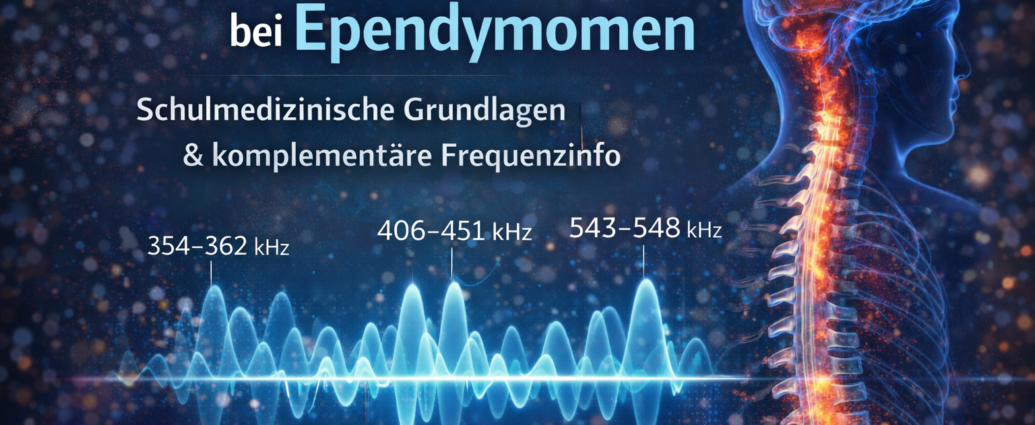
Symptoms, treatment and complementary frequency information
Author: NLS Information medicine Ltd, Herbert Eder
Introduction
Ependymomas belong to the group of neuroepithelial tumors and arise from the ependymal lining cells of the brain ventricles. In the literature, they are described as tumors that can occur both inside the skull and in the area of the spinal cord. While intracranial ependymomas occur more frequently in children, spinal forms are more common in adults. It is precisely this different localization that makes it clear how complex this tumour is and how strongly symptoms, course and therapeutic requirements can differ.
For conventional medicine, the main focus with ependymomas is on the exact localization, the histological grade, the neurological findings and the surgical accessibility. At the same time, the topic is also important for Frequency therapy and information medicine, because in addition to genetic influences, viral stress and complementary resonance areas are also described in the literature. This results in a comprehensive approach that combines structural, functional and frequency-related aspects.
In the following, the conventional medical basics of ependymoma are presented first. Only at the end is the Frequency info with the complementary resonance frequencies mentioned in the literature.
What is an ependymoma?
An ependymoma is a Tumor, which originates from the ependymal cells. These cells line the ventricles of the brain and are closely associated with the ventricular system and the cerebrospinal fluid space. Intracranial ependymomas typically appear in the literature as intraventricular tumor masses. Spinal ependymomas, on the other hand, can be either intramedullary arise from the central canal of the spinal cord or develop as exophytic tumors in the area of the cauda equina.
Ependymoblastomas are distinguished from these and described as primitive neuroectodermal tumors. This makes it clear that not every ependymal tumor form can be classified in the same way biologically. This precise differentiation is particularly important in modern tumor classification, as it results in different prognoses and treatment strategies.
Histological classification of ependymomas
The literature describes a subdivision according to histological features, which comprises several grades.
Grade I
The low-grade forms include
- Myxopapillary ependymoma
- Subependymoma
These forms occur particularly in the area of Cauda equina and are usually regarded as slower-growing varieties.
Grade II
This includes the classic Ependymoma with different variants, including:
- cellular form
- papillary form
- Clear cell variant
This group forms the typical middle range of ependymoma diseases.
Grade III
This is the higher-grade form:
- anaplastic ependymoma
This variant exhibits more aggressive biological behavior and usually requires a more intensive therapeutic strategy.
Origin and biological background
The development of an ependymoma is described in the literature as oncogenetic events associated with the disease. It is described that viral strains such as HPV and/or SV-40 can be involved in transformation processes of normal ependymal cells. In combination with genetic changes, a tumor-like cell phenotype can develop.
At the same time, a considerable molecular heterogeneity is pointed out. This means that histologically similar looking tumors can be very different at the molecular level. Genetic abnormalities mentioned in the literature include:
- Loss of an area on Chromosome 22
- p53 mutations for malignant ependymomas
- recurring breakpoint for 11q13
- abnormal karyotypes involving Chromosome 6 and/or 16
- NF2 mutations
- Indication of a familial clustering with suspected loss of a tumor suppressor gene in the area of 22pter-22q11.2
These correlations suggest that genetic disposition and viral loads can be jointly involved in the development of an ependymoma. It is precisely this combination of genetic basis and additional biological factor that makes the topic particularly interesting for frequency therapy.
Intracranial ependymomas - symptoms and progression
The symptoms of an intracranial ependymoma depend greatly on the age of the patient and the exact location of the tumor. The literature describes that there is often a period of three to six months is located.
Ependymomas of the fourth ventricle in children
In children, tumors in the area of the fourth ventricle often lead to:
- Headache
- increasing tiredness or lethargy
- Nausea
- Vomiting
These symptoms are often caused by a secondary obstructive hydrocephalus, This is an obstruction of the outflow of cerebrospinal fluid with increased pressure inside the skull.
This can also occur:
- Cranial nerve palsies in the area of VI to X
- cerebellar disorders
- Changes in mood, concentration and personality
Infratentorial ependymomas
Typical signs are
- Papilledema
- Nystagmus
- Ataxia
Supratentorial lesions
This may include the following symptoms:
- Hemiparesis
- Loss of sensitivity
- Loss of vision
- Aphasia
- cognitive impairments
This range in particular shows that ependymomas can cause very different neurological deficits depending on their location.
Spinal ependymomas - complaints along the spinal cord
Spinal ependymomas often cause pain and progressive neurological damage along ascending and descending nerve tracts. The symptoms depend on the level of the spinal cord or nerve root region at which the tumor is located.
Cervical and thoracic ependymomas
Tumors in the neck and breast marrow area can cause
- Pain and paraesthesia in the occipital and cervical area
- Stiffness
- Loss of strength
- Atrophy of the neck muscles
- Spastic quadriplegia or hemiplegia below the tumor
Thoracic ependymomas are sometimes more difficult to detect clinically, as testing of the intercostal muscles, for example, is only possible to a limited extent.
Lumbar ependymomas
They often lead to:
- Radicular pain
- Weakness
- Signs of compression on nerve roots
Tumors of the conus medullaris and cauda equina
This localization is particularly relevant, as early autonomic and sensory disorders can occur here. Described are:
- Pain in the back
- Pain in the rectal area
- Pain in the legs
- Bladder dysfunction
- Impotence
Conus lesions rarely cause spontaneous pain, whereas cauda equina lesions are often accompanied by severe pain in the perineum, thighs and legs. Motor deficits are usually symmetrical in conus lesions, but tend to be asymmetrical in cauda equina lesions.
Diagnostics for ependymomas
Ependymoma is diagnosed by conventional medicine on the basis of symptoms, neurological examination and imaging. The literature mentions the following in particular:
CT
The Computer tomography is used for the initial detection of intracranial or spinal masses and can provide important information on tumor location and concomitant changes.
MRI with and without contrast agent
The Magnetic resonance imaging is the central method for precise visualization of the ependymoma. It shows the extent, positional relationship, cerebrospinal fluid influence, edema and the relationship to surrounding structures with particular precision.
Biopsy and histology
Histological examination is of crucial importance for a reliable diagnosis. Only histological analysis can reliably determine the tumor grade and exact shape.
Differential diagnosis
In the literature, the differentiation from the Astrocytoma emphasized. As some clinical and imaging features may overlap, histological confirmation is essential. The exact differentiation is therapeutically decisive because prognosis and treatment differ significantly depending on the type of tumor.
Conventional medical treatment of ependymomas
The treatment of an ependymoma depends on the tumor location, extent, tumor grade and the general neurological condition of the patient. Several conventional medical treatment options are described in the literature.
Operation
Surgical resection plays a central role. The extent of resection is considered to be one of the most important prognostic factors. The more completely a tumor can be removed, the better the long-term outlook in many cases.
Radiotherapy and radiosurgery
These procedures are mainly used when tumor remnants remain, the tumor is of a higher grade or surgical removal was only partially possible.
Chemotherapy
Depending on the situation, chemotherapeutic strategies can be used in addition. Combination therapies are used in complex cases.
Accompanying drug treatment
Additionally may be necessary:
- Corticosteroids for peritumoral edema
- Anticonvulsants for supratentorial ependymomas with corresponding seizure problems
Ideally, treatment is carried out in close cooperation between:
- Neurologist
- Neurosurgeon
- Neuro-oncologist
- Radiotherapist
coordinated in order to develop the most suitable overall strategy.
Prognosis and long-term course
The literature mentions several factors that may be associated with a more favorable course. These include
- Surgical resection as complete as possible
- Low residual tumor mass after surgery
- Low tumor grade
- infratentorial situation in childhood
- No ingrowth into the brain stem
- none Metastases
- better general condition
- older age in the children's area
At the same time, it is emphasized that not all of these factors correlate reliably with long-term survival. This shows how complex the biology of ependymoma is. This is precisely why long-term follow-up remains of great importance.
Why ependymomas are particularly interesting for frequency therapy
Ependymomas are interesting for frequency therapy for several reasons. Firstly, they affect structures that are closely connected to the cerebrospinal fluid system, the spinal cord and central regulatory axes. Secondly, in the literature viral loads such as HPV and SV-40 in connection with tumor development. Thirdly, ependymomas show very different neurological patterns depending on their location, which also makes them relevant to information medicine.
In the context of frequency therapy, this provides a broader picture: Not only the tumor itself, but also the surrounding regulatory field, any additional viral stressors, and the respective resonance pattern are complementary considered. This is exactly where the Frequency info to.
Frequency info - complementary resonance frequencies for ependymomas
In the literature Ependymomas following Complementary resonant frequencies called:
338-339, 344, 354-362, 370-373, 379, 388-393, 406-408, 425-435, 437-439, 442-451, 543-548 kHz
These resonance ranges are referred to within frequency therapy as complementary frequency info understood. Several clear clusters are noticeable, which can be organized into larger resonance fields.
Early resonance zone
- 338-339 kHz
- 344 kHz
These values mark the lower range of the literature references.
Medium resonance field
- 354-362 kHz
- 370-373 kHz
- 379 kHz
- 388-393 kHz
This shows a dense range of medium frequency data, which is particularly interesting in complementary terms.
Central upper resonance zone
- 406-408 kHz
- 425-435 kHz
- 437-439 kHz
- 442-451 kHz
This broad upper field is the focus of the literature. It is precisely this concentration within frequency therapy that indicates a pronounced resonance pattern.
Upper finishing area
- 543-548 kHz
This frequency block forms the upper resonance range of the ependymoma.
Frequency info compact
Ependymoma - complementary resonance frequencies:
338-339, 344, 354-362, 370-373, 379, 388-393, 406-408, 425-435, 437-439, 442-451, 543-548 kHz
Complementary classification of the frequency ranges
For frequency therapy, the condensed zones between 354 and 393 kHz, 406 and 451 kHz and 543 to 548 kHz particularly conspicuous. Within information medicine, such clusters are understood not only as individual values, but also as resonance spaces.
This complementary approach is particularly interesting in the case of ependymoma because the interplay between the ventricular system, cerebrospinal fluid dynamics, spinal cord, nerve pathways and possible viral factors plays a special role here. The literature thus describes not only a tumor image, but also an extended resonance pattern that can be considered in the context of frequency therapy.
Significance of viral loads in a complementary context
Since HPV and SV-40 are mentioned in the literature in connection with ependymomas, the idea that additional biological components should be taken into account in addition to the tumor itself also becomes relevant. Within frequency therapy, this means that complementary frequency lists are not seen in isolation, but always in the overall context.
Especially after conventional medical treatment, the question of how complementary frequency patterns can be considered is important for many users of information medicine. The literature suggests that the risk of a new process is also taken into account in the case of residual biological stress. This is precisely where the particular importance of structured complementary frequency information arises.
Conclusion
Ependymomas are complex neuroepithelial tumors that can occur both intracranially and spinal. For conventional medicine, the localization, tumour grade, neurological deficits, surgical resectability and differentiated follow-up treatment are decisive. The spectrum ranges from slower forms in the area of the cauda equina to more aggressive anaplastic variants.
The topic of ependymoma also opens up a complementary perspective for frequency therapy. The resonance frequencies described in the literature form a structured frequency information that can be considered in a complementary way within information medicine. The clusters in the range of 354 to 393 kHz, 406 to 451 kHz and 543 to 548 kHz.



Comments are closed, but trackbacks and pingbacks are open.