





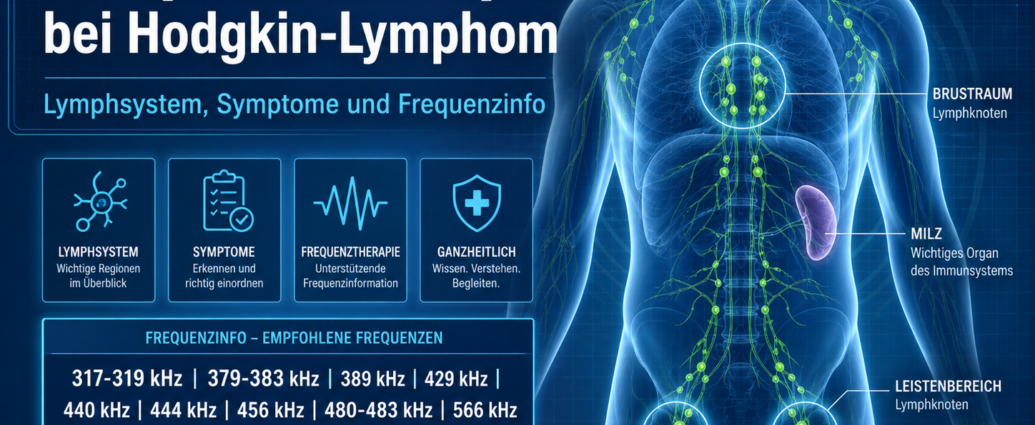
The Frequency therapy in Hodgkin's lymphoma is described in the complementary context as a supplementary perspective on conventional medical principles, symptoms, diagnostics, therapy, and possible resonance patterns. Hodgkin lymphoma, formerly often referred to as Hodgkin’s disease, is a malignant disease of the lymphatic system. It is characterized by specific tumor cells known as Reed-Sternberg cells.
From a conventional medical perspective, Hodgkin’s lymphoma is classified as a type of lymphoma. It arises from abnormal lymphocytes and often initially affects the lymph nodes. As the disease progresses, other lymph node regions, the spleen, bone marrow, or other organs may be involved. The literature also describes specific resonance frequencies that are used as complementary therapies within the context of frequency therapy. Frequency info can be documented and examined.
Frequency Therapy for Hodgkin's Lymphoma: An Overview from Conventional Medicine
Hodgkin's lymphoma is a malignant disease of the lymphatic system. The lymphatic system is an important part of the immune system and consists of lymph nodes, lymphatic vessels, the spleen, the tonsils, the thymus, and other lymphatic tissues.
Lymphocytes are a type of white blood cell and play a central role in the immune system. In Hodgkin lymphoma, abnormal lymphocytes develop and accumulate in the lymph nodes, where they can displace normal tissue.
A key characteristic of Hodgkin lymphoma is the presence of Reed-Sternberg cells. These large, distinctive tumor cells are visible under a microscope and are crucial for diagnosis. They distinguish Hodgkin lymphoma from many other types of lymphoma.
Frequency therapy for Hodgkin's lymphoma and the lymphatic system
The lymphatic system performs several functions. It transports lymph fluid, supports the immune system, and helps control pathogens. Lymph nodes act as filtering stations where immune cells are activated.
In Hodgkin's lymphoma, lymph nodes may gradually enlarge. This enlargement is often painless. Many people first notice a lump that can be felt in the neck, armpit, or groin.
The disease may initially be confined to a single lymph node region. Later, other regions may be affected. The spleen may also be enlarged, as it is an important lymphatic organ.
Reed-Sternberg cells in Hodgkin's lymphoma
Reed-Sternberg cells are large, degenerated lymphocytes. They are considered a characteristic feature of Hodgkin's lymphoma. In histological examination, they are identified by their distinctive appearance.
These cells are often found in an inflamed environment. This means that, in addition to the actual tumor cells, many other immune cells may also be present in the affected tissue. This creates a complex tumor microenvironment.
The detection of these cells is crucial for a conventional medical diagnosis. Only a microscopic examination of a lymph node or tissue sample can definitively confirm the diagnosis.
Possible causes and contributing factors
The exact cause of Hodgkin's lymphoma is complex. The literature describes an infectious component. One unspecified Virus as well as certain species from the Chlamydia family.
In complementary frequency-based thinking, such data are viewed as potential resonance patterns. The focus is not on a single factor in isolation, but rather on the interaction between the immune system, the lymphatic system, pathogen exposure, the tissue environment, and individual regulatory capacity.
Hodgkin's lymphoma clearly illustrates just how closely immune regulation, lymph node response, and tumor formation can be linked.
Common symptoms of Hodgkin lymphoma
The first noticeable symptom is often swollen lymph nodes. This can occur in a single area, such as the neck or groin. In other cases, multiple lymph node regions are affected.
Typically, the lymph nodes gradually enlarge and are usually painless. The spleen may also enlarge. Enlarged lymph nodes near the tonsils can occasionally cause difficulty swallowing.
Possible symptoms are
- painless lymph node swelling
- swollen lymph nodes in the neck
- enlarged lymph nodes in the groin
- swollen lymph nodes in the armpit
- Enlarged spleen
- Difficulty swallowing due to tonsil infection
- Fever
- Night sweats
- Tiredness
- Anemia
- Weight loss
- Loss of appetite
- Breathing difficulties
- Stomachache
- Constipation
- Swelling in the legs
Symptoms can vary widely and depend largely on which lymph node regions are affected.
Enlarged lymph nodes in the chest
If lymph nodes deep within the chest are enlarged, they can press on surrounding structures. This can cause difficulty breathing, a feeling of pressure, coughing, or a sensation of tightness.
Sometimes such enlarged lymph nodes are discovered by chance, for example during a chest X-ray. Those affected may not yet experience any noticeable symptoms.
Depending on their location, enlarged lymph nodes in the chest can also affect blood vessels, airways, or other organs. That is why accurate diagnostic imaging is important.
Enlarged lymph nodes in the abdomen
Lymph nodes in the abdomen may also be enlarged. If they press on organs or sections of the intestine, this can lead to loss of appetite, abdominal pain, bloating, or severe constipation.
Increased swelling of the legs may also occur if enlarged lymph nodes obstruct lymphatic or blood flow. Such symptoms indicate that Hodgkin’s lymphoma can affect more than just superficial lymph nodes.
The exact extent is assessed in conventional medicine using imaging techniques. Computed tomography plays an important role in this process.
General symptoms of Hodgkin's lymphoma
In addition to local symptoms, general symptoms may occur. These include fever, night sweats, fatigue, anemia, and weight loss.
These symptoms are often interpreted as systemic signs. They indicate that the disease can affect the entire body. Night sweats, unintentional weight loss, and recurrent fever are particularly important indicators of the disease’s progression.
Anemia can cause fatigue, paleness, and a decline in performance. It is caused by changes in the immune system, in the bone marrow, or by the overall burden of the tumor.
Frequency Therapy for Hodgkin's Lymphoma and Diagnosis
The conventional medical diagnosis is made by examining blood and lymph nodes. An enlarged lymph node is usually removed or biopsied and then examined under a microscope.
A tissue biopsy is crucial because it allows for the detection of Reed-Sternberg cells. In addition, other cellular features are evaluated to distinguish Hodgkin’s lymphoma from other types of lymphoma or inflammatory lymphadenopathy.
Blood tests can provide evidence of inflammatory activity, anemia, or other changes. Imaging techniques such as computed tomography help determine the extent of the disease in the body.
Computed Tomography and Staging
Computed tomography can detect enlarged lymph nodes in the chest, abdomen, and pelvis. This makes it possible to see which areas are affected.
Staging is particularly important for treatment planning. It takes into account whether only one lymph node region is affected, whether multiple regions are involved, whether the disease is present above or below the diaphragm, or whether organs outside the lymphatic system are involved.
General symptoms such as fever, night sweats, and weight loss are also taken into account in the diagnosis. This information helps in developing a personalized treatment plan.
Conventional medical treatment of Hodgkin's lymphoma
In conventional medicine, treatment often involves combination chemotherapy. Treatment regimens such as MOPP and ABVD are mentioned in the literature. These regimens combine multiple active ingredients to target tumor cells as effectively as possible.
Depending on the stage, risk profile, and course of the disease, radiation therapy may also be used. The specific treatment plan depends on the extent of the disease, the patient’s age, overall health, laboratory test results, and response to treatment.
Hodgkin's lymphoma is one of those malignant diseases for which conventional medical treatment options are well established in many cases. Treatment is tailored to the individual and closely monitored.
Frequency Therapy for Hodgkin's Lymphoma in a Complementary Care Setting
Frequency therapy looks at biological processes from the point of view of vibration, Resonance and regulation. In Hodgkin’s lymphoma, the complementary approach focuses on the lymphatic system, the immune system, the lymph nodes, the spleen, potential viral resonance patterns, the Chlamydia family, and the individual’s regulatory status.
The literature cites specific resonance frequencies associated with Hodgkin's lymphoma. These frequencies can be documented as supplementary frequency information in the context of frequency therapy.
In this context, the frequencies are not considered in isolation, but are analyzed in relation to the lymphatic system, the tumor microenvironment, the immune response, and any accompanying infectious patterns.
Frequency Therapy and the Lymphatic System: A Broader Perspective
The lymphatic system is a key network involved in immune regulation. It recognizes foreign substances, transports immune cells, and plays a role in defending against pathogens. In Hodgkin lymphoma, a malignant change occurs within this system.
Frequency therapy views the lymphatic system as a dynamic resonance field. Lymph nodes, the spleen, blood, interstitial fluid, and the immune system are closely interconnected. Changes in one area can affect the entire regulatory system.
A holistic approach is therefore particularly valuable in the case of lymphomas: tumor cells, immune responses, pathogen resonances, lymph flow, and overall resilience can all be documented together.
Frequency Therapy for Hodgkin's Lymphoma and Cancer: A Broader Perspective
Cancers of the lymphatic system differ from solid tumors. They affect cells that naturally travel throughout the body and are part of the immune system. As a result, lymphoma can spread through the lymphatic system, the bloodstream, and organs.
Hodgkin lymphoma is characterized by the malignant transformation of certain lymphocytes. At the same time, the tumor tissue often shows significant involvement of other immune cells. This makes the disease particularly complex from a biological standpoint.
Frequency therapy can take this complexity into account in a complementary way: lymphocytes, Reed–Sternberg cells, the lymph node environment, the spleen, the immune response, and potential microbial resonance patterns are all integrated into a comprehensive picture.
Frequency Information: Hodgkin's Lymphoma
The following frequencies are cited in the literature in connection with Hodgkin's lymphoma. In the complementary context of frequency therapy, they are regarded as supplementary resonance ranges.
Frequency therapy for Hodgkin's lymphoma
317–319 kHz,
379–383 kHz,
389 kHz,
429 kHz,
440 kHz,
444 kHz,
456 kHz,
480–483 kHz,
566 kHz.
These frequencies are frequently described in the literature as common resonances in Hodgkin’s lymphoma. In the context of frequency therapy, they can be used as a supplementary guide for documentation, resonance analysis, and individualized treatment.
Frequency Information: Potential Viral Resonance Fields
The literature describes the possible involvement of an unspecified virus in Hodgkin’s lymphoma. The following frequencies can be documented as potential viral resonance fields in a complementary context.
Frequency therapy for viral resonances
317–319 kHz,
379–383 kHz,
389 kHz,
429 kHz,
480–483 kHz,
566 kHz.
These frequency ranges are considered in conjunction with lymph nodes, the spleen, the immune system, and the tumor microenvironment.
Prevalence data: Chlamydia family
The literature also mentions certain species from the Chlamydia family as possible contributing factors. In the context of complementary frequency analysis, such findings can be documented as additional resonance patterns.
Frequency therapy for symptoms associated with chlamydia
440 kHz,
444 kHz,
456 kHz.
In frequency therapy, these frequencies can be viewed as complementary resonance fields associated with potential accompanying bacterial patterns.
Frequency Therapy for Hodgkin's Lymphoma: A Comparison of Frequency Patterns
When comparing the frequencies, it is noticeable that both lower and higher resonance ranges are mentioned. Particularly notable are the groups 317–319 kHz, 379–383 kHz, and 480–483 kHz. Individual values such as 389 kHz, 429 kHz, 440 kHz, 444 kHz, 456 kHz, and 566 kHz round out the frequency picture.
In complementary frequency therapy, this combination can be viewed as a multi-layered resonance pattern. It links the lymphatic system, potential viral infection, possible accompanying chlamydia patterns, and the individual’s regulatory state.
The frequencies are always considered in conjunction with the conventional medical diagnosis, the stage of the disease, lymph node involvement, general symptoms, and the course of treatment.
Frequency Therapy for Hodgkin's Lymphoma: Summary
Hodgkin's lymphoma is a malignant disease of the lymphatic system. It is characterized by the presence of Reed-Sternberg cells—large, abnormal lymphocytes—which are detected during microscopic examination. The disease often begins with painless swelling of the lymph nodes in the neck, groin, or other parts of the body.
Other symptoms may include fever, night sweats, fatigue, anemia, weight loss, an enlarged spleen, shortness of breath, abdominal pain, constipation, or swelling in the legs. In conventional medicine, diagnosis is made through blood tests, lymph node examination, microscopy, and computed tomography. Treatment often involves combination chemotherapy regimens such as MOPP or ABVD, along with additional procedures depending on the stage of the disease.
Frequency therapy offers a complementary perspective. In the literature, resonance frequencies such as 317–319 kHz, 379–383 kHz, 389 kHz, 429 kHz, 440 kHz, 444 kHz, 456 kHz, 480–483 kHz, and 566 kHz. These frequency lists can be used in a complementary context for documentation, resonance analysis, and individualized frequency therapy work.


Comments are closed, but trackbacks and pingbacks are open.