





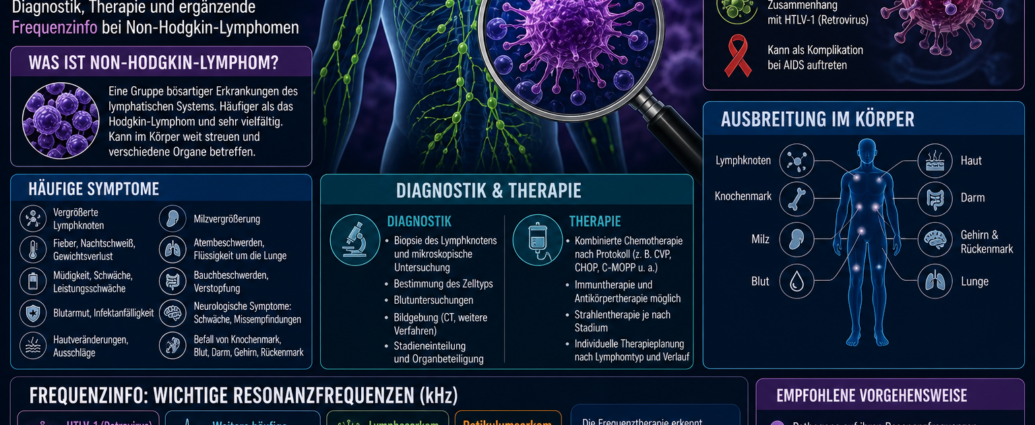
The Frequency therapy in non-Hodgkin's lymphoma is described in the complementary context as a supplementary perspective on conventional medical principles, symptoms, diagnostics, therapy, and possible resonance patterns. Non-Hodgkin lymphomas are a group of malignant diseases of the lymphatic system. They arise from lymphocytes and can spread throughout the body in a variety of ways.
From a conventional medical perspective, non-Hodgkin lymphomas are not a single disease but a diverse group of related cancers of the lymph nodes. They occur more frequently than Hodgkin's lymphoma and can affect the lymph nodes, bone marrow, spleen, blood, skin, intestines, brain, and spinal cord. The literature also mentions specific resonance frequencies that are used as a complementary treatment in frequency therapy Frequency info can be documented and examined.
Frequency Therapy for Non-Hodgkin Lymphoma: An Overview from Conventional Medicine
Non-Hodgkin lymphomas develop in the lymphatic system. This system is a key component of the immune system and includes lymph nodes, lymphatic vessels, the spleen, the tonsils, bone marrow, and other lymphatic tissues.
The disease usually begins with a malignant lymphocyte cell line. These cells multiply uncontrollably and can spread through the lymphatic system, the bloodstream, and the tissues. As a result, non-Hodgkin lymphomas are often not confined to a single area but can affect the entire body.
Unlike Hodgkin lymphoma, it does not contain the characteristic Reed-Sternberg cells. Instead, it is classified based on cell type, growth rate, spread, and biological behavior.
Frequency Therapy for Non-Hodgkin Lymphoma and the Lymphatic System
The lymphatic system is closely linked to the immune system. It transports lymph, filters out pathogens and foreign substances, and coordinates immune responses. Lymphocytes play a central role as immune cells in this process.
In non-Hodgkin lymphoma, certain lymphocytes undergo malignant changes. These cells can accumulate in the lymph nodes, causing them to swell. However, they can also infiltrate other organs, leading to a wide variety of symptoms.
It is particularly important to note that non-Hodgkin lymphomas can arise at various stages of lymphocyte maturation and development. As a result, they vary greatly in terms of disease progression, prognosis, and response to treatment.
Abundance and biodiversity
Non-Hodgkin lymphomas are more common than Hodgkin lymphomas. They constitute a highly heterogeneous group of diseases. Some forms grow slowly and remain stable for long periods of time. Others are aggressive, spread rapidly, and require intensive treatment.
The literature describes this group of lymphomas as being extremely variable. Cytogenetic and morphological findings suggest that various elements of stem cell development may be involved.
The tumor process can also lead to dedifferentiation. In this process, cells increasingly lose their original characteristics and may transform into lymphosarcoma or reticulosarcoma.
Possible causes and infectious factors
The exact cause of non-Hodgkin lymphoma is complex. The literature cites an unspecified Virus has been cited as a possible factor. The disease is not considered contagious.
A rare progressive form of non-Hodgkin lymphoma is associated with an infection caused by HTLV-1 associated with. HTLV-1 is a human T-cell lymphotropic virus and belongs to the Retroviruses. In the literature, its mode of action is compared to other retroviral mechanisms.
Non-Hodgkin lymphomas can also occur in association with a severely compromised immune system. The literature notes that they can occur as a complication of AIDS. This demonstrates the close connection between the lymphatic system, the immune system, and tumor development.
Frequency Therapy for Non-Hodgkin's Lymphoma and the Immune System
Because non-Hodgkin lymphomas arise from immune cells, the state of the immune system is particularly important. When normal antibody production is reduced, susceptibility to severe bacterial infections increases.
The invasion of lymphoma cells into the bone marrow and lymph nodes can further weaken normal immune function. This makes the body more susceptible to infections and other stressors.
In the complementary context of frequency therapy, non-Hodgkin's lymphoma is therefore not only considered as Tumor not only as a disorder of the lymphatic system, but also as a disruption in the interaction between the lymphatic system, bone marrow, antibody production, spleen, blood, and a possible viral Resonance.
Classification by cell type and aggressiveness
The prognosis for non-Hodgkin lymphomas depends heavily on the cell type. Classification systems categorize these diseases based on the origin of the cells, their appearance under a microscope, their growth behavior, and their biological activity.
In the literature, lymphomas are classified into low-grade, intermediate-grade, and high-grade forms. Low-grade lymphomas usually grow more slowly but can have a chronic course. Intermediate-grade forms are more aggressive. High-grade lymphomas often grow rapidly and have a poorer prognosis if not treated in a timely manner.
An accurate diagnosis is crucial from a conventional medical perspective, as treatment and prognosis depend heavily on it.
Spread throughout the body
Non-Hodgkin lymphomas can affect many organs. Lymphoma cells can invade the bone marrow and disrupt normal blood production there. They can cause the spleen to enlarge, appear in the blood, cause skin changes, or affect the intestines.
The brain and spinal cord may also be affected. In such cases, neurological symptoms may develop. These include weakness, sensory disturbances, coordination problems, or other abnormalities of the nervous system.
If lymph vessels in the chest become blocked, fluid can accumulate around the lungs. This can lead to shortness of breath, a feeling of pressure, or reduced physical performance.
Common symptoms of non-Hodgkin lymphoma
Symptoms depend largely on which organs are affected and how aggressively the lymphoma is growing. Some forms initially cause only swollen lymph nodes, while others quickly lead to systemic symptoms and organ dysfunction.
Possible symptoms are
- swollen lymph nodes
- Tiredness
- Weakness
- Anemia
- Susceptibility to infection
- Fever
- Night sweats
- Weight loss
- Skin rashes
- neurological symptoms
- feeling of weakness
- Sensory disturbances
- Abdominal discomfort
- Enlarged spleen
- Breathing difficulties
- Fluid around the lungs
- Changes in blood counts
If the bone marrow is affected, normal blood production can be disrupted. This can lead to anemia, increased susceptibility to infections, or a tendency to bleed.
Bone marrow involvement and anemia
When lymphoma cells invade the bone marrow, they displace normal blood-forming cells there. This can impair the production of red blood cells, white blood cells, and platelets.
Anemia causes paleness, fatigue, weakness, and shortness of breath. If white blood cell function is impaired, the risk of infection increases. If there is a shortage of platelets, bleeding or bruising may occur.
The literature also describes how an enlarged and overactive spleen can break down red blood cells at an increased rate. Abnormal antibodies can also destroy red blood cells and cause hemolytic anemia.
The spleen, blood, and antibody production
The spleen is an important lymphatic organ. It filters blood, breaks down old blood cells, and supports the immune response. In non-Hodgkin lymphoma, it may be enlarged and overactive.
An overactive spleen can break down red blood cells at an increased rate. At the same time, impaired antibody production can weaken the immune system. This can increase the risk of serious bacterial infections.
From the complementary perspective of frequency therapy, the spleen, bone marrow, lymph nodes, and antibody production are considered as a unified whole. These organs and functions form a closely interconnected regulatory system.
Neurological symptoms and organ involvement
If lymphoma cells spread to the brain or spinal cord, neurological symptoms may develop. These include weakness, numbness, unusual sensations, movement disorders, or other impairments.
If the intestines are affected, symptoms may include abdominal pain, digestive problems, bleeding, or weight loss. Skin involvement can cause rashes, lumps, or inflammatory lesions.
This diversity explains why non-Hodgkin lymphomas can present in such a wide variety of ways. The disease may start locally but have systemic effects.
Frequency Therapy for Non-Hodgkin Lymphoma and Diagnosis
The conventional medical diagnosis is made by Biopsy from an affected lymph node or tissue. Microscopic examination is crucial for determining the type of lymphoma.
The cell type is analyzed in detail. Tests are conducted to determine whether the cancer is a B-cell lymphoma, a T-cell lymphoma, or another subtype. In addition, immunohistochemical, cytogenetic, and molecular tests may be used.
The diagnosis involves not only identifying lymphoma but also determining its specific subtype. This determines the prognosis, treatment, and follow-up care.
Staging and further tests
After the diagnosis, the extent of the disease is assessed. This may include blood tests, imaging, bone marrow tests, and other organ-specific tests.
The goal is to determine whether lymph node regions, bone marrow, the spleen, blood, skin, intestines, the brain, the spinal cord, or other organs are affected.
Accurate staging helps in selecting the appropriate treatment and monitoring the course of the disease.
Conventional medical treatment of non-Hodgkin lymphoma
Treatment depends on the type of lymphoma, stage, rate of growth, age, general health, and organ involvement. The literature mentions combination chemotherapy regimens such as CVP, CHOP, and C-MOPP.
Low-grade lymphomas are treated differently from high-grade lymphomas. Some slow-growing forms are initially monitored, while aggressive forms require prompt treatment.
Treatment may include chemotherapy, immunotherapy, antibody therapy, radiation therapy, or a combination of these approaches. The specific treatment plan is tailored to each individual.
Frequency Therapy for Non-Hodgkin's Lymphoma in a Complementary Care Setting
Frequency therapy examines biological processes from the perspective of vibration, resonance, and regulation. In the case of non-Hodgkin lymphoma, the complementary approach focuses on the lymphatic system, bone marrow, spleen, blood, antibody production, immune status, potential viral resonance patterns, and systemic stressors.
The literature cites specific resonance frequencies, including those associated with HTLV-1 as well as other commonly observed frequencies. In addition, resonances associated with lymphosarcoma and reticulosarcoma are described.
These frequencies can be documented as supplementary frequency data within the context of frequency therapy and incorporated into a holistic approach.
Frequency Therapy and Lymphomas: A Broader Perspective
Lymphomas are a special type of cancer because they originate in cells of the immune system. These cells are mobile, travel throughout the body, and can affect various organs. This is why lymphomas differ from many solid tumors.
Non-Hodgkin lymphomas exhibit a wide variety of forms. Some forms remain slow-growing over a long period of time, while others develop rapidly and aggressively. Frequency therapy views this diversity as a reflection of different resonance and regulatory patterns.
Lymph nodes, the spleen, bone marrow, blood, antibody production, and potential pathogen interactions are all considered together in this context.
Frequency information: HTLV-1
The following frequencies are cited in the literature in connection with human T-cell lymphotropic virus 1. In the context of complementary frequency therapy, they are regarded as supplementary resonance ranges.
Frequency therapy for HTLV-1
311–314 kHz,
330–331 kHz,
370-376 kHz,
406 kHz,
432–435 kHz,
496–504 kHz.
These frequencies are described in the literature as the resonance frequencies of HTLV-1. In the context of frequency therapy, they can be used as a supplementary guide for documentation, resonance analysis, and individualized treatment.
Frequency Information: Other Common Resonances
In addition to HTLV-1, the literature cites other common associations with non-Hodgkin lymphoma.
Frequency therapy for non-Hodgkin lymphoma
340 kHz,
353 kHz,
402-410 kHz,
420 kHz,
426 kHz,
442–452 kHz,
513 kHz,
536 kHz,
544-545 kHz.
In a complementary context, these frequencies can be documented as additional resonance ranges in non-Hodgkin lymphoma.
Frequency Info: Lymphosarcoma
The literature describes how non-Hodgkin lymphomas can transform into lymphosarcoma. Specific resonance frequencies are cited in this context.
Frequency therapy for lymphosarcoma
493–500 kHz.
This frequency range is described in connection with lymphosarcoma and can be considered a complementary factor in the complementary frequency analysis Information be taken into account.
Frequency Information: Reticular Sarcoma
The literature also mentions transformation into reticulosarcoma. The following resonance frequencies are cited in this regard.
Frequency therapy for reticulosarcoma
496–514 kHz.
This frequency range can be documented as a complementary resonance field in the context of frequency therapy, particularly when the focus is on undifferentiated or progressive lymphoma processes.
Frequency Therapy for Non-Hodgkin Lymphoma: A Comparison of Frequency Patterns
When comparing the frequency lists, it is noticeable that several resonance ranges are close together or overlap. Particularly notable are the ranges 496–504 kHz, 493–500 kHz, and 496–514 kHz. These ranges are associated with HTLV-1, lymphosarcoma, and reticulosarcoma.
The frequency ranges 402–410 kHz, 432–435 kHz, and 442–452 kHz also appear to be important. In a complementary context, they can be considered in conjunction with the lymphatic system, immune status, bone marrow, and potential viral load.
The frequency lists are always considered in conjunction with the conventional medical diagnosis, the type of lymphoma, the extent of the disease, the cell type, the symptoms, and the individual’s regulatory status.
Frequency Therapy for Non-Hodgkin Lymphoma: Summary
Non-Hodgkin lymphomas are a diverse group of malignant diseases of the lymphatic system. They arise from lymphocytes and can spread widely throughout the body. They can affect the lymph nodes, bone marrow, spleen, blood, skin, intestines, brain, and spinal cord.
In conventional medicine, the diagnosis is made through a lymph node biopsy, microscopic examination, cell typing, and staging. Treatment depends on the type of lymphoma, its stage, and its course, and may include combination chemotherapy regimens such as CVP, CHOP, or C-MOPP, as well as other procedures.
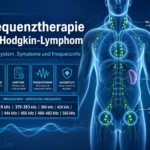
Frequency therapy offers a complementary approach. The literature cites HTLV-1 frequencies such as 311–314 kHz, 330–331 kHz, 370–376 kHz, 406 kHz, 432–435 kHz, and 496–504 kHz. Other common resonances include 340 kHz, 353 kHz, 402–410 kHz, 420 kHz, 426 kHz, 442–452 kHz, 513 kHz, 536 kHz, and 544–545 kHz. In addition, 493–500 kHz is described for lymphosarcoma and 496–514 kHz for reticulosarcoma. These frequency lists can be used in a complementary context for documentation, resonance analysis, and individualized frequency therapy work.

Comments are closed, but trackbacks and pingbacks are open.