





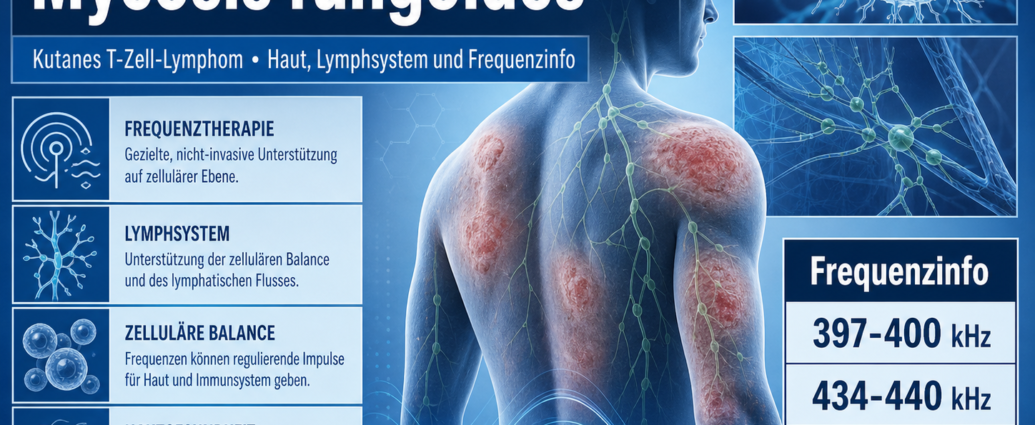
The Frequency therapy in mycosis fungoides is described in the complementary context as a supplementary consideration to conventional medical principles, skin changes, the lymphatic system, symptoms, diagnosis, treatment, and possible resonance patterns. Mycosis fungoides is a rare, chronic form of non-Hodgkin lymphoma that originates from mature T lymphocytes and primarily affects the skin.
From a conventional medical perspective, mycosis fungoides is a cutaneous T-cell lymphoma. The disease usually progresses slowly and may remain confined to the skin for a long time. In advanced stages, however, lymph nodes, blood, and internal organs may also be involved. The literature also mentions specific resonance frequencies that are used as complementary therapies within the context of frequency therapy. Frequency info can be documented and examined.
Frequency Therapy for Mycosis Fungoides: An Overview from Conventional Medicine
Mycosis fungoides is a type of cutaneous T-cell lymphoma. This means that the disease originates in specific T-lymphocytes that accumulate primarily in the skin. T-lymphocytes are important cells of the immune system and play a central role in the defense, regulation, and control of immune responses.
In mycosis fungoides, these T lymphocytes undergo malignant transformation. They migrate into the skin, where they multiply slowly and cause chronic skin lesions. The disease can persist for years and is often initially mistaken for other chronic skin conditions.
The condition typically progresses slowly. Many people initially experience persistent, itchy, scaly, or reddened patches of skin. Plaques, nodules, or tumor-like skin lesions may develop only later.
Frequency therapy for mycosis fungoides and cutaneous lymphoma
The skin is not only an outer protective layer, but also an active immune organ. It contains numerous immune cells, including T lymphocytes. These cells monitor the tissue and respond to external and internal stressors.
In mycosis fungoides, the disease originates from mature T-lymphocytes that settle in the skin. As a result, the symptoms initially resemble those of a chronic skin condition. The skin may appear red, dry, itchy, scaly, or thickened.
Because the changes develop gradually, the condition is often not clearly diagnosed until some time has passed. It can be difficult to distinguish it from eczema, psoriasis, fungal infections, or other inflammatory skin conditions.
Mycosis fungoides as a type of non-Hodgkin lymphoma
Mycosis fungoides is a type of non-Hodgkin lymphoma. This group includes various malignant diseases of the lymphatic system. Unlike many other non-Hodgkin lymphomas, however, mycosis fungoides usually originates in the skin.
The disease originates in T lymphocytes. For this reason, it is classified as a T-cell lymphoma. Although the skin is primarily affected, the lymphatic system may become involved as the disease progresses. Lymph nodes may be enlarged, and in advanced stages, internal organs may be affected.
This connection between the skin and the lymphatic system is particularly important for medical evaluation. Mycosis fungoides is not merely a superficial skin disorder, but a lymphatic disease with a primary cutaneous manifestation.
Stages and Course of Mycosis Fungoides
The condition usually progresses slowly and can develop over years or decades. In the early stages, patchy skin changes often appear. These may be reddish, brownish, scaly, or itchy.
Later, raised plaques may form. These areas of skin appear thickened, more clearly defined, and often more intensely colored. In later stages, nodules or tumor-like skin lesions may develop.
In advanced cases, the disease can spread beyond the skin. In such cases, lymph nodes, the bloodstream, or internal organs may be affected. That is why regular checkups are important, especially if skin changes are spreading or becoming more pronounced.
Common symptoms of mycosis fungoides
The main symptom is long-lasting skin changes accompanied by itching. The symptoms may be mild at first and persist for an extended period. Many areas of the skin appear dry, irritated, or inflamed.
Possible symptoms are
- chronic itching
- long-lasting rashes
- reddened areas of skin
- areas of flaky skin
- patchy skin lesions
- thickened plaques
- Skin lump
- gradual spread
- dry skin
- Burning sensation or tightness
- enlarged lymph nodes in later stages
- Involvement of the blood in Sézary syndrome
Itching can be particularly distressing and can interfere with sleep, well-being, and quality of life.
Skin rashes and plaques
Early skin changes can look very atypical. They may resemble eczema, atopic dermatitis, or psoriasis. They often appear on parts of the body that are not constantly exposed to the sun, such as the torso, buttocks, thighs, or other covered areas of skin.
Over time, the patches may become more defined, thicker, and more noticeable. These are referred to as plaques. They may itch, flake, or become inflamed.
In advanced stages of the disease, nodular skin lesions may develop. These tumor stages are characterized by a greater accumulation of malignant T cells in the skin.
Sézary syndrome
Some patients may develop Sézary syndrome. In this condition, abnormal lymphocytes are found in the blood. Sézary syndrome is considered a leukemic variant of cutaneous T-cell lymphoma.
Typical symptoms may include widespread skin redness, severe itching, swollen lymph nodes, and the presence of abnormal T-lymphocytes in the blood. The skin may be affected over a large area and may flake heavily.
Because Sézary syndrome affects not only the skin but also the blood, the disease becomes systemic. Diagnosis and treatment then differ from those used in the early, localized stages.
Frequency therapy for mycosis fungoides and lymph nodes
Mycosis fungoides can affect the lymph nodes as the disease progresses. Lymph nodes act as the immune system’s filtering stations and respond to inflammation, infections, and tumor growth.
In advanced stages of the disease, lymph nodes may be enlarged. A lymph node biopsy may be necessary to determine whether the lymphoma has spread to that area or whether the swelling is reactive.
The connection between the skin, blood, and lymph nodes indicates that mycosis fungoides must be considered a systemic disease, even though it often remains confined to the skin for a long time.
Conventional medical diagnosis of mycosis fungoides
Diagnosis can be challenging, as the early skin changes resemble those of many other skin conditions. Repeated skin biopsies are often necessary to confirm the diagnosis.
Key diagnostic steps include:
- clinical skin examination
- Skin biopsy
- microscopic tissue examination
- Blood tests
- Examination of enlarged lymph nodes
- Lymph node biopsy when involvement is suspected
- Immunohistochemistry
- Assessment of T-cell characteristics
The literature identifies blood tests and lymph node biopsies as important diagnostic tools. Blood tests are particularly important when Sézary syndrome is suspected.
Differentiation from other skin conditions
Mycosis fungoides may initially appear to be a chronic inflammatory skin condition. That is why it is important to distinguish it from other skin conditions.
Possible sources of confusion include:
- Eczema
- Atopic dermatitis
- Psoriasis
- Fungal infections
- Drug reactions
- chronic dermatitis
- other cutaneous lymphomas
Histological examination and immunological analysis of T cells help confirm the diagnosis. Sometimes the disease is not diagnosed until after prolonged observation and several Biopsies clearly recognized.
Conventional medical treatment of mycosis fungoides
Treatment depends on the stage, extent of the disease, skin involvement, blood involvement, lymph node status, and the patient’s overall condition. In early stages, treatment often focuses on skin-based procedures. In advanced disease, systemic therapies may be necessary.
The literature mentions chemotherapy and PUVA. PUVA combines a photosensitizing agent with UVA light and is used to treat certain skin conditions.
Depending on the findings, other skin-targeted therapies may include topical medications, light therapy, or localized radiation. If the condition affects the entire body, more potent drug treatments may be necessary.
PUVA therapy for mycosis fungoides
PUVA stands for psoralen plus UVA. In this treatment, an active ingredient is used to make the skin more sensitive to light, after which it is treated with UVA light. This procedure can be used for certain stages of mycosis fungoides.
The goal is to reduce abnormal T-cell clusters in the skin and improve skin lesions. The treatment is administered in a controlled manner and tailored to the patient’s skin type, disease stage, and tolerance.
PUVA highlights the unique role of the skin in this disease: Since tumor cells are primarily confined to the skin in the early stages, local or skin-targeted treatments can be particularly important.
Frequency Therapy for Mycosis Fungoides in a Complementary Care Setting
Frequency therapy looks at biological processes from the point of view of vibration, Resonance and regulation. In the case of mycosis fungoides, the complementary approach focuses on the skin, T lymphocytes, the lymphatic system, blood, itching, the immune status, and possible resonance patterns.
The literature cites specific resonance frequencies associated with mycosis fungoides. These frequencies can be documented as supplementary frequency information in the context of frequency therapy.
The focus is not only on the skin, but also on the lymphatic system. The disease involves skin changes, immune regulation, T-cell activity, and potential systemic spread.
Frequency Therapy and Cutaneous Lymphomas: A Broader Perspective
Cutaneous lymphomas differ from classic skin diseases. They do not originate primarily from skin cells, but rather from immune cells that become active in the skin. As a result, the disease lies at the intersection of dermatology, hematology, and immunology.
Frequency therapy views this connection as a resonance field comprising the skin, lymphatic system, blood, immune cells, and tissue microenvironment. It allows for the simultaneous consideration of itching, inflammation, the skin barrier, lymphatic flow, and T-cell regulation.
Particularly in the case of chronic cutaneous lymphoma, this complementary perspective can help us understand the disease not merely as a skin rash, but as a systemic immune process.
Frequency therapy and cancer in an expanded view
Mycosis fungoides is a cancer of the lymphatic system that primarily affects the skin. From a broader perspective, the focus is not only on the visible skin changes but also on the malignant transformation of mature T lymphocytes.
Frequency therapy views cancer as a manifestation of disrupted biological order and altered Cell communication. In mycosis fungoides, this particularly affects immune cells, the skin environment, lymphatic vessels, blood, and potential resonance patterns.
The frequencies cited in the literature can be used in this context as a supplementary guide for documentation, resonance analysis, and individual frequency therapy work.
Frequency information: Mycosis fungoides
The following frequencies are cited in the literature in connection with mycosis fungoides. In the complementary context of frequency therapy, they are regarded as supplementary resonance ranges.
Frequency therapy for mycosis fungoides
397-400 kHz,
434–440 kHz,
442-451 kHz,
570–580 kHz.
These frequencies are described in the literature as resonance frequencies associated with mycosis fungoides. In the context of frequency therapy, they can be used as a supplementary guide for documentation, resonance analysis, and individualized treatment.
Frequency Info: Skin and T-Cell Lymphoma
In a complementary context, these frequency ranges can be considered particularly in relation to the skin, T lymphocytes, and lymphatic regulation.
Frequency Therapy for Skin Lymphoma Resonances
397-400 kHz,
434–440 kHz,
442–451 kHz.
These frequencies can be documented as key resonance fields in cutaneous T-cell lymphomas. They are evaluated in conjunction with skin findings, itching, plaques, lymph node status, and blood test results.
Frequency information: higher resonance ranges
In addition to the mid-frequency ranges, the literature also mentions a higher range.
Frequency therapy for higher resonances
570–580 kHz.
In a complementary context, this frequency range can be considered an additional resonance range in mycosis fungoides. It complements the mid-frequencies and expands the documented frequency profile.
Frequency Therapy for Mycosis Fungoides: A Comparison of Frequency Patterns
When comparing the frequency list, it is noticeable that three frequency ranges are closely clustered: 397–400 kHz, 434–440 kHz, and 442–451 kHz. These ranges form a mid-frequency resonance field that can be considered in the context of cutaneous lymphoma and T-cell regulation.
The 570–580 kHz range is significantly higher and complements the frequency pattern as an additional resonance level. In complementary frequency therapy, this combination can be understood as a multilayered resonance pattern.
The frequencies are always considered in conjunction with the conventional medical diagnosis, the stage of the skin lesion, the status of the lymph nodes, any changes in the blood, and the individual’s regulatory state.
Frequency Therapy for Mycosis Fungoides: Summary
Mycosis fungoides is a rare, slow-growing form of non-Hodgkin lymphoma. It arises from mature T lymphocytes and primarily affects the skin. Typical symptoms include long-lasting itchy rashes, followed by plaques and nodules, and in some cases, involvement of the lymph nodes, blood, or internal organs.
Some patients may develop Sézary syndrome, in which abnormal lymphocytes are detectable in the blood. In conventional medicine, the diagnosis is made through skin examination, blood tests, skin biopsy, lymph node biopsy, and microscopic or immunological analysis. Treatment may include PUVA, chemotherapy, and other stage-dependent procedures.
Frequency therapy offers a complementary perspective. The literature cites resonance frequencies for mycosis fungoides such as 397–400 kHz, 434–440 kHz, 442–451 kHz, and 570–580 kHz. These frequency lists can be used in a complementary context for documentation, resonance analysis, and individualized frequency therapy work.

Comments are closed, but trackbacks and pingbacks are open.