





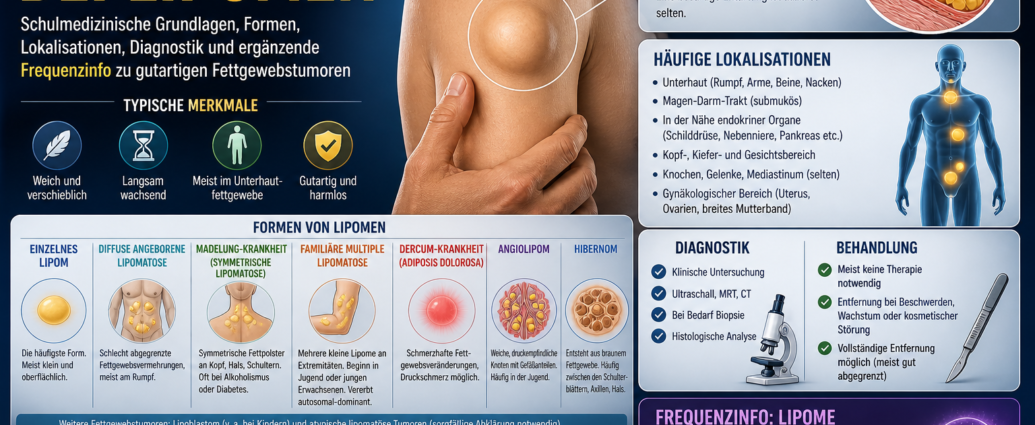
The Frequency therapy for lipomas In a complementary context, it is described as a supplementary perspective on the fundamentals, etiology, forms, locations, diagnosis, and possible regulatory patterns of conventional medicine. Lipomas are benign tumors of adipose tissue and consist of mature fat cells. They are among the most common benign mesenchymal tumors and occur particularly frequently in the subcutaneous adipose tissue.
From a conventional medical perspective, lipomas usually grow slowly, are soft, movable, and in many cases harmless. Nevertheless, depending on their location, size, and number, they can cause discomfort or be bothersome for cosmetic reasons. The literature describes various forms of lipomas and related adipose tissue tumors. In the complementary context of frequency therapy, particular emphasis is placed on the tissue microenvironment, connective tissue, metabolism, fat cell regulation, and individual resonance frequency.
Frequency Therapy for Lipomas: An Overview from Conventional Medicine
Lipomas are benign growths composed of fat cells. They usually develop in the subcutaneous fat tissue and typically feel soft, elastic, and easily movable. Many lipomas remain small and cause no symptoms at all. Others may slowly grow larger and become noticeable due to pressure on surrounding structures.
Lipomas are surrounded by a thin, connective-tissue capsule. Their structure is usually lobulated, which is why they can sometimes be felt under the skin as soft, nodular masses. The cells within a lipoma resemble mature fat cells but differ from normal adipose tissue in certain metabolic characteristics.
Although lipomas are very common, they are generally benign. Malignant transformation of a common lipoma is described in the literature as extremely rare and has not been convincingly demonstrated as a typical course of the disease. Nevertheless, in cases of rapidly growing, painful, deep-seated, or unusually firm masses, a thorough evaluation is important to reliably rule out other soft tissue tumors.
Frequency Therapy for Lipomas and Adipose Tissue
Adipose tissue is not merely a store of energy. It is an active tissue involved in metabolic processes, hormone regulation, inflammatory responses, and the organization of connective tissue. Lipomas develop from fat cells but exhibit biochemical differences compared to normal adipose tissue.
The literature describes that lipomas may exhibit elevated levels of certain enzymes, such as lipoprotein lipase. In addition, an increased number of precursor cells has been reported. These findings indicate that a lipoma is not simply normal adipose tissue, but rather a locally confined neoplasm with its own biological activity.
In the complementary understanding of frequency therapy, this distinctive feature can be viewed from the perspective of cellular information, tissue regulation, and Resonance be considered. The focus here is less on individual symptoms and more on the interplay between adipose tissue, connective tissue, metabolism, blood circulation, and an individual’s regulatory capacity.
Common Locations of Lipomas
Most lipomas develop in the subcutaneous fatty tissue. Common sites include the trunk, shoulders, neck, upper arms, back, abdominal wall, and thighs. They can occur individually or in larger numbers.
Lipomas are less commonly found in internal organs or deeper tissue layers. The literature describes lipomas in the gastrointestinal tract, near endocrine organs, in the maxillofacial region, in the mediastinum, in joints, in bone, and in the gynecological region.
The location plays a key role in determining whether a lipoma causes symptoms. A small, superficial lipoma is usually not a problem. A lipoma in the intestine, near a joint, or in deeper parts of the body, on the other hand, may cause symptoms due to pressure, displacement, or constriction.
Lipomas in the Gastrointestinal Tract
In the gastrointestinal tract, lipomas usually develop beneath the mucosa. These are referred to as submucosal adipose tissue tumors. Common sites include the esophagus, stomach, and small intestine.
Such lipomas can go unnoticed for a long time. Symptoms usually occur when they narrow the intestinal lumen or cause bleeding. A lipoma can act as an obstruction and interfere with the passage of food or intestinal contents.
Duodenal lipomas are usually small, but they can grow on a stalk. If they protrude into the intestinal lumen, they can cause a narrowing. Depending on their size and location, they may cause bloating, abdominal pain, bleeding, or digestive problems.
Lipomas near internal organs
Lipomas can also occur near hormonally active organs. The literature mentions, among others, the thyroid, adrenal glands, pancreas, and parathyroid glands. Such lipomas are rare, but their location can make them diagnostically significant.
Lipomas can also occur in the maxillofacial region. There, they may be noticeable as soft, slowly growing masses and, depending on their location, may cause cosmetic or functional problems.
Rare locations include bones, joints, and the chest cavity. Intraosseous lipomas develop within the bone, intra-articular lipomas within the joint, and mediastinal lipomas in the space between the lungs. These types require precise imaging to distinguish them from other space-occupying lesions.
Gynecological Lipomas
Lipomas can also occur in the gynecological area. The literature describes lipomas of the uterus, the ovaries, and the broad ligament. These types are rare and are often discovered incidentally.
Depending on their location, they can cause a feeling of pressure, lower abdominal discomfort, or be mistaken for other tumors. Clear differentiation is particularly important in the pelvic region, as various benign and malignant space-occupying lesions can occur there.
In the context of cancer, it is particularly important to distinguish lipomas from other soft-tissue tumors, sarcomas, or atypical lipomatous tumors. A typical lipoma is benign, but any unusual findings should be evaluated by a physician.
Frequency Therapy for Lipomas and Classification
Lipomas are classified into various clinical types. These differ in terms of number, distribution, familial clustering, associated symptoms, and tissue structure.
The forms described in the literature include:
- isolated lipomas
- diffuse congenital lipomatosis
- benign symmetrical lipomatosis
- familial multiple lipomatosis
- Dercum's disease
- Angiolipomas
- Hibernome
- Lipoblastomas
- Atypical lipomatous tumors
This classification is important because not all types of adipose tissue tumors should be evaluated in the same way. Some forms are benign and localized, while others occur multiple times or are associated with metabolic and systemic diseases.
Single lipomas
Single lipomas are the most common type. They usually occur near the skin's surface and remain small. Many people notice them as soft, slowly growing lumps under the skin.
A solitary lipoma may appear larger in connection with weight gain. However, it usually does not shrink accordingly after weight loss. This indicates that it is not simply ordinary stored fat, but rather a distinct new tissue formation.
Such lipomas are often simply monitored as long as they do not cause any symptoms. Removal may be considered if they are painful, growing, causing discomfort, or of unclear origin.
Diffuse Congenital Lipomatosis
Diffuse congenital lipomatosis is characterized by poorly defined accumulations of adipose tissue. These often occur on the trunk. In contrast to a well-encapsulated solitary lipoma, these lesions are less clearly defined.
This type can become apparent early in life. Because it grows diffusely, surgical removal may be more difficult than with a single, well-encapsulated lipoma.
In the complementary context of frequency therapy, particular attention can be paid here to general tissue regulation, the connective tissue environment, and individual metabolic control.
Benign symmetrical lipomatosis
Benign symmetrical lipomatosis is also known as Madelung's disease. It is typically characterized by accumulations of fatty tissue in the head, neck, shoulders, and upper arms.
In the literature, this condition is often associated with alcohol use or diabetes. Other contributing factors mentioned include obesity, elevated uric acid levels, liver disease, peripheral neuropathy, renal tubular acidosis, and tumors of the upper respiratory tract.
This form differs significantly from a typical single lipoma. It affects larger areas of the body, may occur symmetrically, and is often associated with metabolic or systemic stress.
Familial multiple lipomatosis
Familial multiple lipomatosis is characterized by several to many small, well-defined, and encapsulated lipomas. These occur particularly frequently on the extremities.
The condition typically begins during or shortly after adolescence. The neck and shoulders are usually not mentioned in the literature. There is often a family history of the condition, with several affected individuals.
The inheritance pattern is described as autosomal dominant. This means that a genetic predisposition can be passed down within a family. In a complementary context, this pattern can be viewed in terms of inherited tissue predisposition, metabolic patterns, and individual regulatory status.
Dercum's disease
Dercum's disease is also known as adiposis dolorosa. It is characterized by painful changes in adipose tissue. Symptoms may be diffuse and may include tenderness, soft nodules, and general symptoms related to physical exertion.
This type differs from ordinary, painless lipomas. Pain may occur spontaneously or be triggered by pressure. Accurate classification is complex and requires a careful medical evaluation.
From the perspective of frequency therapy, the interplay between the nervous system, inflammation, lymphatic flow, metabolism, and tissue tension can also be considered in cases of painful changes in adipose tissue.
Angiolipomas
Angiolipomas are a less common type of lipoma. In addition to fatty tissue, they also contain vascular components. They typically present as soft, tender, subcutaneous, and often multilobed nodules.
They are particularly common in adolescents. Unlike many common lipomas, angiolipomas can be painful. The pain is often vague, dull, or pressure-related.
Because angiolipomas contain vascular components, they differ structurally from classic lipomas. If necessary, a precise diagnosis is made through imaging and histological examination.
Hibernome
Hibernomas are rare adipose tissue tumors that arise from brown adipose tissue. In the literature, they are described primarily in the region between the shoulder blades, in the armpits, on the neck, and in the mediastinum.
Histologically, they consist of embryonic brown lipoblasts. These cells are described as mulberry-like. Brown adipose tissue differs from white adipose tissue in its unique metabolic activity.
Hibernomas are usually benign, but may be noticeable due to their location, size, or heat production. They should be distinguished from other soft-tissue tumors.
Other Adipose Tissue Tumors
In addition to classic lipomas, the literature describes other adipose tissue tumors, such as lipoblastomas, hibernomas, and atypical lipomatous tumors. These lesions differ in age, tissue structure, growth, and biological behavior.
Lipoblastomas occur primarily in children and consist of immature fat cell precursors. Atypical lipomatous tumors have more distinctive cellular features and must be distinguished with particular care from benign lipomas.
This distinction is also important in the context of cancer. While ordinary lipomas are benign, atypical lipomatous tumors or Liposarcomas exhibit different behaviors and require a thorough diagnosis.
Genetic Factors in Lipomas
The exact cause of lipomas is not fully understood. However, the literature describes a link between isolated lipomas and abnormalities on chromosome 12. Particular mention is made of an abnormality associated with the HMGA2-LPP fusion gene.
Such genetic changes can influence cellular regulation and contribute to the development of a well-defined adipose tissue tumor. This explains why lipomas can develop even independently of overall body weight.
In familial multiple lipomatosis, a genetic predisposition also plays a role. In these families, multiple lipomas occur with increased frequency.
Symptoms of Lipomas
Many lipomas do not cause any symptoms. They are often discovered by chance when a soft lump becomes palpable under the skin. Typically, they grow slowly, are elastic, movable, and painless.
Possible complaints are
- a palpable, soft lump
- slow growth
- Feeling of pressure
- cosmetic issue
- Pain when pressure is applied
- Restricted movement due to an unfavorable position
- Nerve irritation when the position is low
- Digestive Problems Associated with Gastrointestinal Lipomas
- Bleeding or constriction associated with internal lipomas
Pain is more likely to occur with angiolipomas, deep-seated lipomas, or lipomas located near nerves, blood vessels, or joints.
Frequency Therapy for Lipomas and Diagnosis
A superficial lipoma can often be suspected based on a physical examination and clinical presentation. Typical features include soft, movable, and slowly growing lumps under the skin.
Imaging tests may be necessary for masses that are unclear, deep-seated, rapidly growing, painful, or unusually firm. Ultrasound, magnetic resonance imaging, or computed tomography can help better assess the size, location, and tissue characteristics of the mass.
If necessary, a definitive diagnosis is made through excision and histological examination. This allows a common lipoma to be distinguished from other adipose tissue tumors, soft tissue tumors, or rare malignant lesions.
Conventional Medical Treatment of Lipomas
Small, asymptomatic lipomas often do not require treatment. Regular monitoring may be sufficient if the findings are typical and the lipoma does not cause any symptoms.
Surgical removal may be considered if a lipoma is growing, causing pain, is cosmetically bothersome, is pressing on nerves or blood vessels, or is of uncertain origin. In most cases, a well-defined lipoma can be completely removed because it is surrounded by a thin capsule.
Treatment may be more complex in cases of diffuse forms, multiple lipomas, or deep-seated lesions. In such cases, the approach depends on the symptoms, location, and individual circumstances.
Frequency Therapy for Lipomas in a Complementary Context
Frequency therapy examines biological processes from the perspective of vibration, resonance, and regulation. In the case of lipomas, this complementary approach focuses on adipose tissue, connective tissue, metabolism, lymphatic flow, Cell communication and individual regulatory capacity.
Since lipomas are usually benign tumors composed of adipose tissue, the focus is not on aggressive tumor biology but rather on local tissue regeneration. In this context, frequency therapy can serve as a complementary approach to document the tissue microenvironment, adipocyte regulation, and potential metabolic patterns.
The literature does not provide a specific numerical frequency list for lipomas in this section. Therefore, the Frequency info In this article, this is understood as complementary structural information: Lipomas are considered in the context of adipose tissue, connective tissue, metabolic regulation, lymphatic flow, and individual resonance.
Frequency Therapy and Benign Tumors: A Broader Perspective
Benign tumors, such as lipomas, are fundamentally different from malignant cancers. They usually grow slowly and do not form Metastases and remain localized. Nevertheless, they show that tissue can grow out of its normal order locally.
Frequency therapy views such changes as an expression of altered tissue information and regulatory dynamics. It takes into account local factors such as blood flow, connective tissue tension, metabolism, lymphatic flow, and cell communication.
Unlike cancer, the primary concern with lipomas is not metastasis, but rather the question of why fatty tissue accumulates in a specific location. The complementary approach can therefore focus on regulation, stress relief, tissue balance, and individual resonance patterns.
Frequency Information: Lipomas
The available literature does not provide specific numerical frequencies for lipomas. Nevertheless, complementary frequency therapy can classify lipomas within the framework of a holistic resonance approach.
Frequency therapy for lipomas
- Adipose tissue,
- Connective tissue,
- Lymphatic flow,
- Metabolic regulation,
- Tissue environment,
- Cell communication,
- individual resonance frequency.
These areas can serve as a supplementary guide in the context of frequency therapy. The focus is on examining the local tissue environment and the regulation of adipose and connective tissue.
Frequency Information: Related Adipose Tissue Tumors
In addition to classic lipomas, the literature also mentions other adipose tissue tumors and lipomatous changes. These can be considered separately in a complementary context.
Frequency Therapy for Lipomatous Changes
- Single lipoma,
- diffuse congenital lipomatosis,
- benign symmetrical lipomatosis,
- familial multiple lipomatosis,
- Dercum's disease,
- Angiolipoma,
- Hibernom,
- Lipoblastoma,
- atypical lipomatous Tumor.
This classification can be used in frequency therapy for structured documentation. Each type has its own key characteristics: single lipomas tend to indicate localized tissue formation, multiple lipomas tend to indicate a predisposition and systemic patterns, and painful lipomas tend to indicate nerve and inflammatory involvement.
Frequency Information: Tissue Regulation in Lipomas
Since lipomas consist of mature fat cells, the complementary frequency analysis focuses specifically on the regulation of adipose tissue.
Frequency Therapy for Adipose Tissue Regulation
- Adipocyte metabolism,
- Connective tissue capsule,
- Collagen structure,
- Lymphatic drainage,
- Microcirculation,
- local tissue tension,
- Metabolic balance.
These aspects can be taken into account in a holistic frequency-based approach. Considering the overall environment can be particularly helpful in cases of recurrent, multiple, or painful lipomas.
Frequency Therapy for Lipomas: A Comparison of Patterns
Lipomas present in various forms. A single lipoma is usually localized, soft, and easily movable. Multiple lipomas may indicate a familial or systemic pattern. Painful angiolipomas and Dercum’s disease-associated lesions are also more strongly associated with pain, nerve irritation, and vascular components.
In frequency therapy, this leads to a more nuanced approach:
Single lipomas represent localized new growth of adipose tissue.
Multiple lipomas are more likely to indicate constitutional or familial patterns.
Painful lipomas draw attention to nerves, blood vessels, and the regulation of inflammation.
Internal lipomas require special attention due to the risk of obstruction or bleeding.
Atypical lipomatous tumors must be carefully distinguished from ordinary lipomas.
These patterns can be documented in a complementary context and examined individually.
Frequency Therapy for Lipomas: Summary
Lipomas are benign tumors composed of mature fat cells and are among the most common benign mesenchymal tumors. They usually occur in the subcutaneous fatty tissue, but can also be found in internal organs, the gastrointestinal tract, near hormonally active organs, in the maxillofacial region, in joints, in bone, in the chest, or in the gynecological region.
Conventional medicine distinguishes between various forms, including solitary lipomas, diffuse congenital lipomatosis, benign symmetrical lipomatosis, familial multiple lipomatosis, Dercum’s disease, angiolipomas, and hibernomas. Diagnosis is made through clinical examination, imaging, and, if necessary, histological analysis. If symptoms are present or the findings are unclear, treatment usually consists of surgical removal.
Frequency therapy offers a complementary perspective. Since the available literature does not provide a specific list of numerical frequencies for lipomas, the focus is on complementary frequency information regarding adipose tissue, connective tissue, lymphatic flow, metabolic regulation, the tissue microenvironment, and individual resonance frequencies. These aspects can be used for documentation, resonance analysis, and individualized frequency therapy work.

Comments are closed, but trackbacks and pingbacks are open.