





Conventional medical principles and complementary frequency information
Author: NLS Information medicine Ltd, Herbert Eder
Introduction
Rare tumors pose a particular challenge in medicine. They occur comparatively rarely, are often diagnostically demanding and require precise clarification by specialized departments. In this context, the Simian Vacuolating Virus 40, in short SV-40, mentioned. This is a polyomavirus that was originally described in monkeys and has also been discussed in connection with human diseases in the course of medical research.
In the context of conventional medicine, the focus is primarily on virological, molecular biological and oncological issues. At the same time, many people from the field of Frequency therapy and information medicine for complementary resonance models and frequency-related correlations. Particularly in the case of rare tumors, there is growing interest in expanded perspectives that combine conventional medical findings with energetic and biophysical approaches.
This article first looks at the basic principles of conventional medicine in relation to SV-40 and then goes on to discuss complementary medicine. Frequency info which can play a complementary role within frequency therapy.
What is SV-40?
SV-40 is a Polyomavirus, which was originally described in monkeys, but has also been discussed in the scientific literature on humans. It is a DNA virus, which can persist in biological systems over a long period of time. SV-40 has become particularly relevant in the medical History by the observation that it was discussed in connection with certain vaccine batches between the 1950s and early 1960s, when cell cultures from rhesus monkey kidneys were used for production.
From today's perspective, the main focus is on historical and virological classification. Modern vaccine standards and significantly more advanced manufacturing processes have long since left this problem behind. Nevertheless, SV-40 remains interesting from a medical point of view because the virus is repeatedly mentioned in the literature in connection with cell changes, latent infections and rare forms of tumors.
Conventional medical view of SV-40 and tumor development
In conventional medical oncology, the question of possible virus-related influences on tumor processes has long been of great importance. It is known that certain Viruses can be associated with tumor development in individual cases. However, this does not mean that a virus automatically leads to cancer. Rather, several factors usually play a role in the development of tumors, including genetic changes, environmental factors, immunological processes, inflammation and disturbances in cell regulation.
In the case of SV-40, the literature describes that the virus can attach to receptor structures on the cell surface and be taken up into the cell. There, viral mechanisms intervene in cellular processes. This can lead to changes in cell function as the process progresses. It is also described that viral particles can be released again, which in certain contexts is associated with cell damage and cell death.
For conventional medical research, the key question is whether and to what extent such viral processes actually contribute to tumor development. It is precisely at this point that SV-40 remains a topic of particular research interest, because the relationships are complex and not all evidence automatically means a clear cause-and-effect relationship.
Which rare tumors are associated with SV-40 in the literature?
In the literature, SV-40 is mentioned in connection with some rare tumor forms. These include, among others:
- Ependymomas
- Mesothelioma
- Non-Hodgkin's lymphomas
- Osteosarcomas
- Choroid plexus carcinomas
These mentions make it clear that SV-40 is primarily discussed in the area of rare and specialized tumor entities. For conventional medicine Practice This means that if a virological connection is suspected in a tumor disease, the classification is not made on a general basis, but on the basis of diagnostics, histology, molecular biology and the overall clinical picture.
Precise differentiation is particularly important for rare tumors. This is because tumors with a similar appearance can be very different biologically. Precise classification is therefore a central component of any oncological assessment.
Diagnostics from a conventional medical perspective
If a viral connection is to be clarified, modern medicine primarily uses laboratory diagnostic and molecular biological methods. In the literature, the following in particular are used in relation to SV-40 PCR-based tests and other virological test procedures.
Conventional medical diagnostics pursue several objectives:
Detection of viral genetic material
Molecular biological methods can be used to check whether viral DNA is detectable in tissue samples or other test materials.
Differentiation from other causes
Not every cell change is viral. A distinction must therefore always be made between different possible causes.
Classification in the tumor process
Even if viral components are detected, the question of what biological relevance this finding actually has for the specific tumor process remains important.
Therapy planning
The diagnosis also serves to determine the further course of treatment and to target the conventional medical measures.
Treatment options in conventional medicine
No specific standard antiviral therapy is described in the literature for SV-40 that has been specifically established as a classic virus-killing procedure. In conventional medical practice, treatment is therefore primarily based on the respective tumour type, the stage of the disease, the location and the overall condition of the patient.
Depending on the diagnosis, the following measures may play a role:
- surgical procedures
- Radiotherapy
- Chemotherapy
- Targeted therapies
- Immunological treatment approaches
- Close monitoring of progress
This makes it clear that conventional medicine does not focus on the virus alone, but on the entire oncological clinical picture. The aim is to precisely identify the disease and treat it according to the appropriate medical standards.
Why SV-40 is interesting for frequency therapy
Interest in complementary biophysical and information medicine models is often growing, especially where complex or rare correlations exist in conventional medicine. Frequency therapy deals with the question of whether biological systems exhibit characteristic vibration and resonance patterns and whether complementary approaches can be derived from this.
In connection with SV-40, this question is particularly exciting because not only tumor tissue but also viral processes are considered here. From the point of view of frequency therapy, this creates an expanded field: on the one hand, the focus is on tissue changes and, on the other, on the possible resonance level of the virus itself.
Many users of frequency therapy are therefore interested in frequency ranges that are associated with certain pathogens or tumor forms in the literature. Such information within a complementary model is used to look at relationships on an energetic and information-related level.
Frequency therapy and rare tumors - an extended thinking model
Rare tumors almost always require a particularly differentiated approach. From a conventional medical perspective, this means specialization, precise diagnostics and individualized therapy planning. From the point of view of frequency therapy, there is a further aspect: the idea that the organism's regulatory processes are also triggered by vibrations, Resonance and frequency-related Information can be described.
In this extended model, not only structural changes but also functional stress patterns are taken into account. For many therapists and users, the question of whether complementary resonance information can also be taken into account alongside classical medicine is particularly interesting in the case of complicated processes.
This is where the frequency information comes in. It should be understood as supplementary and describes those resonance ranges that are associated with SV-40 in the literature.
Frequency information: Complementary resonance frequencies of SV-40
In the literature SV-40 following Complementary resonant frequencies called:
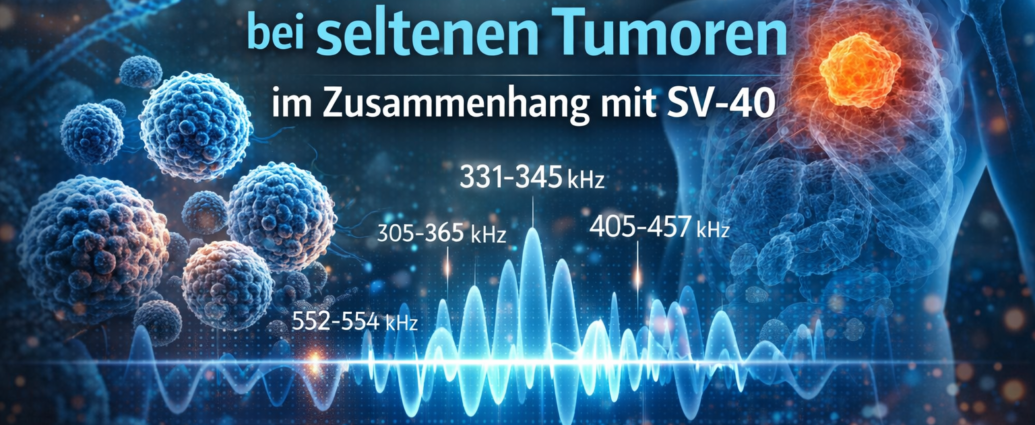
331-332 kHz, 338-339 kHz, 343-345 kHz, 360-362 kHz, 379-380 kHz, 385-387 kHz, 405-407 kHz, 425-426 kHz, 440-443 kHz, 447 kHz, 450-451 kHz, 453-457 kHz, 480-481 kHz, 467-489 kHz, 494-498 kHz, 552-554 kHz
These frequency ranges are used within frequency therapy as complementary frequency info is considered. It is noticeable that several resonance windows are concentrated in the middle and higher kilohertz ranges. The clusters in the range around are particularly interesting:
- 331-345 kHz
- 360-387 kHz
- 405-457 kHz
- 467-498 kHz
- 552-554 kHz
Such clusters are important for frequency therapy because they not only represent individual isolated values, but resonance spaces within which biophysical reaction patterns are assumed to exist.
How these frequency ranges are considered within frequency therapy
In practical frequency therapy, frequencies are not usually understood as rigid individual frequencies, but as parts of a larger resonance field. This means that not only the exact value, but also the surrounding frequency window is taken into account.
Several interesting focal points can be derived from the literature for the complementary consideration of SV-40:
Lower resonance ranges
The zones around 331 to 345 kHz can be regarded as early resonance windows within the frequency information. They mark a first complementary range in which, according to the literature, an assignment to SV-40 can be found.
Medium resonance window
The section from 360 to 387 kHz shows a further compression. Such areas are often particularly interesting for users of frequency therapy because several closely neighboring values coincide here.
Higher activity areas
The large block between 405 and 457 kHz indicates a broader complementary resonance space. In frequency therapy, such dense frequency fields are often of particular interest because they can indicate more complex vibration patterns.
Wide upper frequency zone
With 467 to 498 kHz another central area is described in the literature. This densification also indicates a larger resonance field and not just isolated individual frequencies.
Closing area
The frequencies 552 to 554 kHz form an upper complementary termination area within the SV-40 frequency information mentioned.
Connection between tumor processes, viruses and frequency therapy
The question of the interplay between viral loads, cell changes and tumor processes is one of the most complex topics in modern medicine. Conventional medicine investigates these relationships using molecular biological, histological and clinical methods. Frequency therapy supplements this view by asking whether such processes can also be described using resonance and information patterns.
This combined approach is of great interest to many people, especially in the case of rare tumors, which are mentioned in the literature with SV-40. While conventional medicine focuses on precise diagnosis and targeted treatment, frequency therapy looks for complementary resonance levels that can be taken into account in a complementary context.
This results in a broader view of the disease process: structural, functional, biophysical and information-related.
Conclusion
SV-40 is one of the viruses described in the literature in connection with rare forms of tumor. From a conventional medical perspective, the main focus is on virology, molecular diagnostics and differentiated oncological classification. Particularly relevant are rare tumor types such as ependymomas, mesotheliomas, non-Hodgkin's lymphomas, osteosarcomas and choroid plexus carcinomas.
SV-40 is also interesting for frequency therapy because a number of complementary resonance frequencies are described in the literature. Within information medicine, this frequency information opens up a complementary view of possible resonance spaces of the virus and of biophysical relationships in the environment of rare tumor processes.
It is precisely the interplay between conventional medical precision and complementary frequency observation that creates a space for further thought, which is of particular interest to many users of frequency therapy.
Frequency info compact
SV-40 - complementary resonance frequencies:
331-332 kHz, 338-339 kHz, 343-345 kHz, 360-362 kHz, 379-380 kHz, 385-387 kHz, 405-407 kHz, 425-426 kHz, 440-443 kHz, 447 kHz, 450-451 kHz, 453-457 kHz, 480-481 kHz, 467-489 kHz, 494-498 kHz, 552-554 kHz
Comments are closed, but trackbacks and pingbacks are open.