





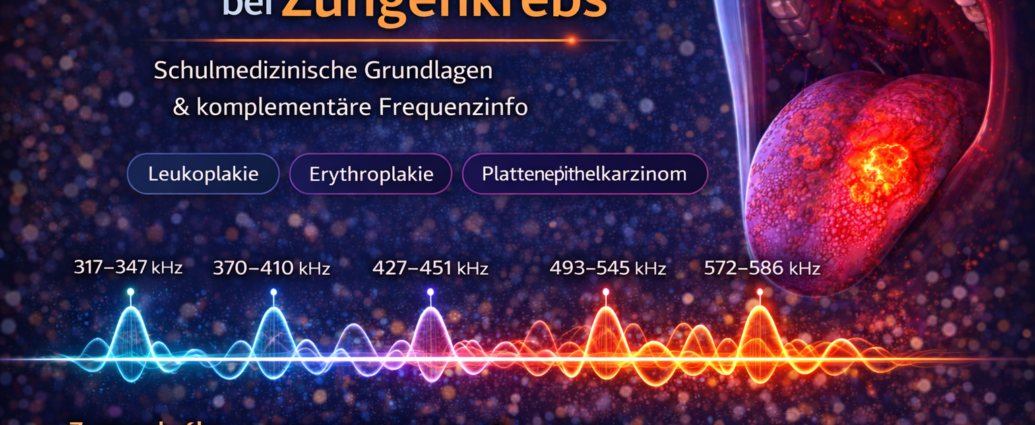
Conventional medical principles and complementary frequency information
Author: NLS Information medicine Ltd, Herbert Eder
Introduction
Tongue cancer is one of the most important malignant diseases within the oral cavity. In the literature, the tongue is described as the most common intraoral site of cancer development. Precisely because the tongue plays a central role in speech, swallowing, taste and mobility within the oral cavity, tumors in this area often have far-reaching functional consequences.
The incidence of oral tumors varies significantly around the world. Nevertheless, tongue cancer remains a serious health problem with considerable morbidity and mortality. For conventional medicine, the main focus is on early detection, clarification of precursors, histological confirmation and therapeutic planning. At the same time, the topic is also of great importance for Frequency therapy of great interest because, in addition to classic risk factors, the literature also describes complementary resonance patterns and accompanying biological stresses.
The following WordPress article focuses first on the conventional medical aspects of tongue cancer. Only at the end follows the Frequency info with the complementary resonance frequencies mentioned in the literature.
What is tongue cancer?
Tongue cancer is a malignant tumor disease of the tongue that predominantly arises from the mucosal epithelium. The literature emphasizes that more than 90 percent of malignant tumours of the oral cavity Squamous cell carcinomas are. The tongue is therefore also dominated by the squamous cell carcinoma clearly.
Other forms of tumor can also occur less frequently, including
- Tumors of small salivary glands
- Lymphomas
- Melanomas
- Sarcomas
The tongue is particularly susceptible to chronic irritation as it is constantly exposed to mechanical, chemical and microbial influences. It is precisely this constant exposure that plays an important role in the development of malignant changes.
Risk factors for tongue cancer
Smoking is cited in the literature as one of the most important risk factors. The incidence of cancer of the oral cavity is about six times higher in smokers. Exposure to tobacco leads to progressive histological changes in the oral mucosa. These can develop over a long period of time and eventually progress to neoplastic transformation.
Important risk factors include
- Tobacco consumption
- Chronic irritation of the mucous membranes
- Alcohol consumption
- Immunosuppression
- Syphilis
- Plummer-Vinson syndrome
- Chronic candidiasis
- Genetic and family burden
- Acquired increased vulnerability
The literature emphasizes that some people are more sensitive to such irritants than others. This increased susceptibility can be genetic, familial or acquired.
Why tobacco is so important
Tobacco contains numerous carcinogenic substances. The following are particularly emphasized Nitrosamines, which are among the most important carcinogens in tobacco. These substances can cause DNA damage and trigger point mutations. Such genetic changes can downregulate tumor suppressor genes and thus promote the development of malignant processes.
A key example is the TP53 gene Changes in this area are among the best-described genetic abnormalities in tumors of the oral cavity. The literature also mentions other oncogenes associated with oral squamous cell carcinomas, including:
- c-myc
- erb-b1
These molecular changes in particular show that tongue cancer does not just arise from local irritation, but from a complex interplay between environmental stress, cell damage and impaired cell control.
Deficiencies and mucosal changes
In addition to chemical and genetic factors, the literature also mentions Riboflavin deficiency and Iron deficiency as possible contributory causes of dysplastic changes in the oral mucosa. These correlations may partly explain why oral cancer can be associated with alcoholism, as chronic alcohol consumption can promote deficiency states.
Such deficits can make the mucous membrane more vulnerable and, together with other irritating factors, promote the development of pathological changes.
Viral and microbial contamination
In addition to classic risk factors, the literature also describes various viral and microbial strains in connection with tongue cancer. These are mentioned in particular:
- CMV
- EBV
- HPV
- Mycoplasma species
- HTLV
HPV is described as an epitheliotropic DNA virus that can change cells towards a malignant phenotype. The literature indicates that human papillomavirus has been detected in varying frequencies in people with oral dysplasia, leukoplakia and malignant changes.
In addition Mycoplasma species and/or HTLV as frequent co-infectors. This combination of epithelial stimulation factors and additional biological stresses is also particularly interesting for frequency therapy.
Precursors: Leukoplakia and erythroplakia
In the literature Leukoplakia and Erythroplakia are described as the lesions most prone to malignant transformation.
Leukoplakia
Leukoplakia is defined as a clinically white mucosal spot that cannot be clearly assigned clinically or pathologically to any other disease. It is considered a premalignant change caused by chronic irritation of the mucous membranes. This leads to increased proliferation of the epithelium and connective tissue.
Erythroplakia
Erythroplakia is also one of the most transformative mucosal changes and is clinically highly relevant.
These precursors in particular are crucial for early detection in conventional medicine, as it is possible to detect changes before they become invasive carcinomas.
Squamous cell carcinoma of the tongue
The Squamous cell carcinoma is by far the most common malignant Tumor of the tongue. Three morphological growth patterns are described in the literature:
- exophytic
- ulcerative
- infiltrative
Especially on the tongue, the ulcerative and the infiltrative form is frequently observed. Early carcinomas with a size of less than one centimeter can often only be detected during careful routine examinations.
Typical signs of symptomatic tumors are
- Indurated ulcerated areas
- rough hardening
- Deep extension into the tongue muscles
- Involvement of the base of the tongue
- Regional lymph node enlargement
The literature also describes a correlation between tumor size, lymph node involvement, metastasis and prognosis.
Other types of tumors in the tongue area
In addition to the predominant squamous cell carcinoma, tumors of small salivary glands can also occur in the area of the tongue. In this context, the literature particularly mentions pleomorphic adenoma mentioned.
The pleomorphic adenoma is a benign neoplastic tumor with a dual origin of epithelial and myoepithelial parts. It is considered the most common benign salivary gland tumor, especially of the parotid gland, but can also occur in smaller salivary glands. Described are:
- squamous metaplasia
- epithelial pearls
- a fibrous pseudocapsule of varying thickness
- finger-like pseudopodia in the normal glandular tissue
According to the literature, these finger-like extensions are not automatically considered a sign of malignant transformation. Nevertheless, it has been described that a pleomorphic adenoma can transform into a Adenocarcinoma can develop further.
Metastasis in the head and neck area
The head and neck region is richly vascularized. On the one hand, this good blood supply is beneficial for treatment; on the other hand, it increases the possibility of tumor spread. The literature describes that the envelopes of metastasizing tumors are often more vascular than the actual tumor tissue.
Regional lymph node involvement is a particularly important issue in tongue carcinomas. An enlarged lymph node in the neck area can be an early sign of regional spread. This is why a precise clinical examination of the neck plays a central role in tongue cancer.
Typical symptoms of tongue cancer
The symptoms depend on the size, location and growth of the tumor. The literature mentions, among other things
- Hardened ulcerated areas on the tongue
- Pain or feeling of pressure
- Difficulty swallowing
- Language changes
- Knot formation
- Deep infiltration of the tongue muscles
- Regional lymphadenopathy
Early small carcinomas can go unnoticed for a long time. This is precisely why routine examination of the oral cavity is so important.
Diagnostics for tongue cancer
The diagnosis is clearly described in the literature.
Biopsy
The Tissue removal is the decisive step in confirming the diagnosis.
Histological examination
Only histological analysis can reliably show whether the tumor is squamous cell carcinoma, a precursor or another type of tumor.
As the tongue is easily accessible clinically, careful inspection and palpation also play an important role. However, histological confirmation remains crucial.
Conventional medical treatment of tongue cancer
Two main therapeutic pillars are mentioned in the literature for tongue cancer:
Surgery
Surgical removal of the tumor is a key treatment approach. Depending on the size and location of the tumor, it can be localized or more extensive.
Radiotherapy
Radiation is another important component of therapy and can be used as a supplement or alternative, depending on the stage.
In the case of tongue cancer in particular, treatment planning depends heavily on how large the tumor is, how deep it extends into the muscles and whether lymph nodes are already involved.
Why tongue cancer is particularly interesting for frequency therapy
Tongue cancer is particularly interesting for frequency therapy because several levels come together here: chronic mucosal irritation, epithelial transformation, possible genetic predisposition, additional biological stresses and a clear tendency towards characteristic precursors such as leukoplakia and erythroplakia.
Information medicine expands the purely structural conventional medical view to include the question of whether these tissue changes and stress patterns can also be represented on a complementary resonance level. Especially in the area of the tongue, where the mucous membrane, muscles, parts of the salivary glands, lymphatic drainage and microbial environment are closely connected, a multi-layered resonance image is created.
Frequency info - complementary resonance frequencies for tongue cancer
In the literature Tongue cancer following Complementary resonant frequencies called:
317-319, 321-324, 343-347, 354, 370-383, 393, 404, 408-410, 427-438, 442-451, 493-495, 518-519, 538, 543-545, 572-586 kHz
This frequency list shows several conspicuous resonance clusters.
Lower resonance range
- 317-319 kHz
- 321-324 kHz
- 343-347 kHz
- 354 kHz
This section covers early and mid-resonance windows, which, in the context of the tongue, complementary appear significant.
Medium resonance field
- 370-383 kHz
- 393 kHz
- 404 kHz
- 408-410 kHz
This shows a clear compression in the mid-kilohertz range.
Upper central resonance field
- 427-438 kHz
- 442-451 kHz
This area is a particularly prominent focus of the literature references.
Higher resonance ranges
- 493-495 kHz
- 518-519 kHz
- 538 kHz
- 543-545 kHz
- 572-586 kHz
The upper areas in particular make the resonance pattern of the tongue cancer especially broad and multi-layered.
Frequency info compact
Tongue cancer - complementary resonance frequencies:
317-319, 321-324, 343-347, 354, 370-383, 393, 404, 408-410, 427-438, 442-451, 493-495, 518-519, 538, 543-545, 572-586 kHz
Complementary classification of the resonance ranges
Within frequency therapy, the following resonance chambers are particularly noticeable in tongue cancer:
- 317 to 347 kHz
- 370 to 410 kHz
- 427 to 451 kHz
- 493 to 545 kHz
- 572 to 586 kHz
The area between 427 and 451 kHz acts as a central frequency field. Equally striking are the condensations in the area of 370 to 410 kHz and the high resonance zones above 493 kHz. This staggering indicates a complex complementary resonance picture within information medicine.
The overlapping of several resonance chambers is particularly important for frequency therapy because viral and microbial stresses are also described in tongue cancer.
Importance of frequency therapy in a complementary context
Within frequency therapy, tongue cancer is not only seen as a local change in the mucous membrane or muscles, but also as an expression of disturbed regulation and information patterns. The complementary frequency information expands the conventional medical view to include characteristic resonance spaces that can be considered in connection with epithelial degeneration, chronic irritation and additional biological stresses.
Particularly in the area of the oral cavity, this creates a special depth of observation because local mucosal conditions, lymphatic drainage, salivary environment and functional stress are closely linked.
Conclusion
Tongue cancer is one of the most important malignant diseases of the oral cavity and poses a serious challenge due to its functional effects and its tendency to spread regionally. The conventional medical approach focuses on risk factors, precursors, histological confirmation and a therapy consisting of surgery and radiotherapy.
The topic also opens up a complementary perspective for frequency therapy. The resonance frequencies described in the literature form a structured frequency information that can be viewed in a complementary way within information medicine. Particularly striking are the resonance fields between 370 and 451 kHz and the higher ranges between 493 and 586 kHz.



Comments are closed, but trackbacks and pingbacks are open.