





Forms, symptoms and complementary frequency information
Author: NLS Information medicine Ltd, Herbert Eder
Introduction
Tumors of the ocular system are among the most sensitive diseases in oncology, as they can affect not only vision but also the function of the eye socket, ocular mobility and neighboring structures. In the literature, the orbit is described as an anatomically highly complex space that contains the eyeball, the outer eye muscles, fatty tissue as well as vascular, glandular, nerve and connective tissue structures. The tumors that can develop in this area are correspondingly diverse.
For conventional medicine, the decisive factor is whether it is a primary eye tumor, an orbital tumor or a metastasis of another primary tumor. Equally important are the age of the patient, the exact location of the findings, the speed of growth and the question of whether benign or malignant features are present. At the same time, the topic is also important for the Frequency therapy of great interest because the literature describes not only genetic predisposition but also accompanying biological stresses and complementary resonance areas.
The following WordPress article first focuses on the conventional medical basics of tumors of the ocular system. Only at the end follows the Frequency info with the complementary resonance frequencies mentioned in the literature.
What are tumors of the ocular system?
Tumors of the ocular system include neoplasms within the eye, the eye socket and the adjacent ocular structures. These include both benign as well as malignant processes. They can occur either primarily in the eye or in the orbit or as Metastases migrate from other organs into the eye.
The literature describes that Breast cancer and Lung cancer are among the most common tumors that metastasize to the eye. More rarely, the following primary tumors can also spread to the eye:
- Leukemias
- Prostate carcinomas
- Kidney tumors
- Thyroid carcinomas
- Skin cancer
- Colon lymphomas
For this very reason, the possibility of metastatic disease should always be considered in the case of ocular masses.
The orbit as a highly complex anatomical space
The eye socket is much more than just a bony container for the eye. It contains numerous functionally closely coordinated structures. These include
- Eyeball
- Extraocular muscles
- Adipose tissue
- Vessels
- Glandular tissue
- Nerves
- Connective tissue
Tumors in this area can therefore not only impair vision, but also alter eye movements, eyelid function, nerve conduction, tear production and the position of the eye. It is precisely this functional density that makes tumors of the ocular system so clinically challenging.
Benign and malignant tumors in the area of the eye and orbit
The literature describes both benign and malignant tumors in the ocular system.
Benign tumors
Benign changes include, for example
- Dermoid cysts
- ocular nevi
- certain vascular malformations
Malignant tumors
Malignant tumors include, among others:
- Rhabdomyosarcoma
- Retinoblastoma
- Uveal melanoma
- Ciliary body melanoma
- malignant Melanoma the iris or conjunctiva
- Orbital lymphoma
- Basal cell carcinoma of the eyelid
- Squamous cell carcinoma of the eyelid
- sebaceous carcinoma
- Sarcomas
It is precisely this diversity that shows that eye tumors are by no means a uniform group, but comprise numerous different biological-pathological entities.
Eyelid tumors and periocular tumors
In the literature, the Basal cell carcinoma as the most common Tumor of the eyelid. This tumor grows locally and destructively around the eye, but rarely spreads to other parts of the body. Other important malignant eyelid tumors are
- Squamous cell carcinoma
- sebaceous carcinoma
- malignant melanoma
The proximity to the eye, conjunctiva, tear ducts and orbit makes even localized tumors in this area highly relevant both functionally and aesthetically.
Intraocular tumors in adults
The most common primary malignant intraocular tumor in adults in the literature is the Uveal melanoma. Also mentioned is the Melanoma of the ciliary body. These tumors can remain asymptomatic for a long time and are sometimes only discovered when they have already reached a relevant size.
Remain in the early stages choroidal, ciliary body related and uveal melanomas often go unnoticed. However, the following symptoms can occur with increasing tumor size:
- blurred vision
- Visual deterioration
- Double vision
- Loss of visual acuity
- Retinal detachment
- Visible tumor through the pupil
This is precisely why ophthalmologic control of pigmented or suspicious intraocular changes is of great importance.
Intraocular tumors in children
For children, this Retinoblastoma are among the most important malignant intraocular tumors. Also mentioned is the Medulloepithelioma, which can occur in the area of the ciliary body or the uvea.
Typical symptoms of retinoblastoma
The literature describes these as important indications:
- Strabismus
- whitish or yellowish pupillary reflex
- Deterioration or loss of vision
- Red and painful eyes
Retinoblastomas can occur on one or both sides and mainly affect infants and young children. A classic indication is a conspicuous white-yellowish reflex in photographs instead of the normal red eye reflex.
Especially in children, this finding is an important warning signal and should always be taken seriously.
Melanoma of the iris and conjunctiva
Pigmented changes on the iris and conjunctiva can be harmless, but must be carefully observed. The literature emphasizes that Growing dark spots on the iris or conjunctiva should be clarified.
Also Nevi are described as benign „freckles of the eye“. They should be checked regularly in order to recognize a possible development towards melanoma in good time.
Orbital lymphomas
The Orbital lymphoma is described in the literature as the most common malignant orbital tumor. The diagnosis is made via Biopsy as well as histopathological and immunohistochemical analysis. Many patients can be treated with chemotherapy or radiotherapy.
Differentiated diagnosis is particularly important for lymphomas, as therapy and prognosis differ greatly from solid epithelial or melanotic tumors.
Tumors of the ocular system and possible biological stresses
The literature describes that intraocular tumors can be associated with genetic predisposition and combined infections caused by the following stresses:
- Mycoplasma species
- HTLV
- HPV types
It is precisely this combination of genetic predisposition and additional biological stress that makes the topic particularly interesting for frequency therapy. This is because within information medicine, not only the tumors themselves but also possible accompanying stress patterns are considered relevant.
Typical symptoms of tumors of the ocular system
The symptoms depend on the location, size and type of tumor. Several characteristic symptoms are mentioned in the literature.
Proptosis and exophthalmos
Protrusion of the eye is a central clinical sign of orbital diseases. It is described:
- Exophthalmos rather in connection with endocrine orbital diseases
- Proptosis as a change in the anteroposterior axis of the eye due to orbital space-occupying lesions
The displacement of the eye in directions other than forward should also be taken into account. For quantification, the Hertel exophthalmometry as an established measurement method.
Vision-related symptoms
- blurred vision
- Visual impairment
- Double vision
- Loss of visual acuity
- Retinal detachment
- Nystagmus
Further information
- painless or painful bulging of the eye
- Visible tumor through the pupil
- red eyes
- Pain
- secondary glaucoma
The literature emphasizes that the possibility of an ocular tumour should always be considered in cases of unclear glaucoma symptoms.
Diagnostics for eye tumors
Since many tumors of the ocular system are not directly visible, several forms of indirect visualization and specialized diagnostics are described in the literature.
Special ophthalmological examinations
Complex ophthalmologic examinations are the basis of every diagnostic classification.
Biopsy
Tissue sampling plays a central role, especially in orbital and unclear tumors.
Histopathological examination
It is crucial for the exact classification of the tumor.
Depending on the type of tumor and its location, further indirect imaging methods may be necessary to fully classify the findings.
Conventional medical treatment of tumors of the eye system
The therapy always depends on the type, location and extent of the tumor. The literature mentions the following forms of treatment:
- Laser therapy
- Chemotherapy
- Plaque therapy
- Radiotherapy
- Operation
Surgical procedures include, among others:
- Enucleation
- Evisceration
- Exenteration
- Iridectomy
- Choroidectomy
- Iridocyclectomy
- Resection of the eye wall
The choice of method depends on whether it is a matter of function-preserving measures, local tumor control or more radical procedures.
Why tumors of the ocular system are particularly interesting for frequency therapy
Tumors of the eye system are particularly interesting for frequency therapy because several factors come together in this area: extreme anatomical complexity, fine functional coordination, different types of tumor and additional biological stresses described in the literature. Information medicine expands the conventional medical view to include the question of whether tumor processes, ocular changes and accompanying microbial stress can also be represented as complementary resonance patterns.
A particularly sensitive resonance field is created in the area of the eye, where vision, nerve function, vascular supply and tissue pressure work closely together.
Frequency info - complementary resonance frequencies for tumors of the eye system
The following are those mentioned in the literature complementary resonant frequencies of tumor forms and accompanying stresses in the area of the ocular system.
Rhabdomyosarcoma
401-408, 513-521, 525-527, 533-538, 543-545, 558 kHz
Basal cell carcinoma
541-545 kHz
Squamous cell carcinoma
543-545 kHz
Malignant melanoma
501-597, 533-543, 556-562 kHz
Retinoblastoma and medulloepithelioma
452-453, 525-527, 538, 543-545 kHz
Lymphoma
404-406, 420-426, 488 kHz
Sarcoma
446-447, 470-473, 488-496, 513-534 kHz
Frequency information - complementary resonance frequencies of accompanying stresses
HTLV
330, 370-376, 432-433, 454-455, 496 kHz
Mycoplasma species
321-324, 365-366, 440, 442-451, 493-495 kHz
In frequency therapy, these frequency patterns are referred to as complementary are considered significant because they partially overlap with the resonance ranges of certain ocular tumors.
Frequency info compact
Rhabdomyosarcoma: 401-408, 513-521, 525-527, 533-538, 543-545, 558 kHz
Basal cell carcinoma: 541-545 kHz
Squamous cell carcinoma: 543-545 kHz
Malignant melanoma: 501-597, 533-543, 556-562 kHz
Retinoblastoma and medulloepithelioma: 452-453, 525-527, 538, 543-545 kHz
Lymphoma: 404-406, 420-426, 488 kHz
Sarcoma: 446-447, 470-473, 488-496, 513-534 kHz
HTLV: 330, 370-376, 432-433, 454-455, 496 kHz
Mycoplasma species: 321-324, 365-366, 440, 442-451, 493-495 kHz
Complementary classification of the resonance ranges
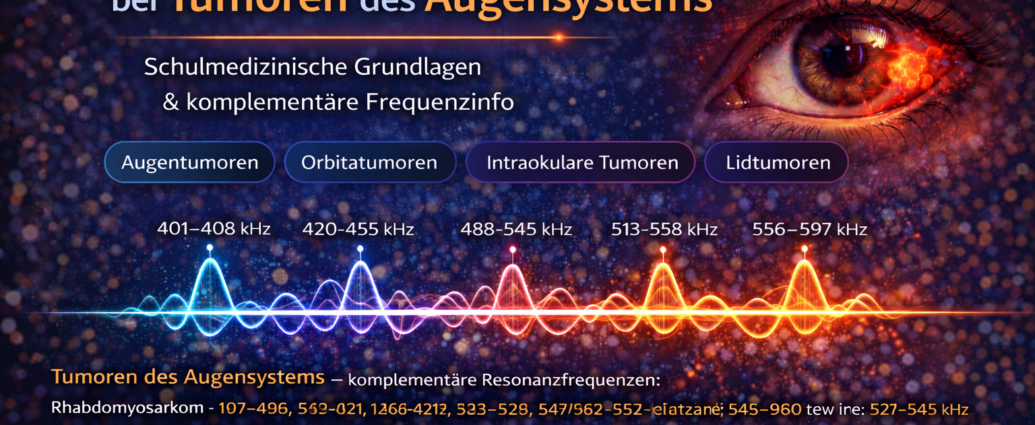
Within frequency therapy, the following resonance areas are particularly noticeable in tumors of the ocular system:
- 401 to 408 kHz
- 420 to 455 kHz
- 488 to 545 kHz
- 513 to 558 kHz
- 556 to 597 kHz
The area between 442 and 451 kHz is particularly interesting because it appears in connection with Mycoplasma species and fits into neighboring resonance patterns of other ocular tumor forms. Equally striking are the clusters around 513 to 545 kHz, which can be found in several types of tumors. In the case of malignant melanomas, the large upper range up to 597 kHz on.
These superimpositions make it clear that the ocular system shows a multi-layered complementary resonance pattern within frequency therapy.
Importance of frequency therapy in a complementary context
Within frequency therapy, tumors of the eye system are not only understood as anatomical spatial demands, but also as an expression of disturbed regulation and information patterns. The complementary frequency information supplements the conventional medical view with resonance spaces that are associated with the various tumor forms and accompanying biological stresses.
Especially in the ocular area, where functional precision, blood flow, nerve supply and tissue pressure are closely linked, this complementary perspective offers a special depth of observation.
Conclusion
Tumors of the ocular system comprise a broad group of benign and malignant diseases of the eye and orbit. The conventional medical approach focuses on tumour type, localization, visual development, proptosis, imaging, biopsy and an individually adapted treatment concept consisting of laser therapy, chemotherapy, radiotherapy and surgery.
This topic also opens up a complementary perspective for frequency therapy. The resonance frequencies described in the literature for rhabdomyosarcoma, basal cell carcinoma, squamous cell carcinoma, malignant melanoma, retinoblastoma, medulloepithelioma, lymphoma and sarcoma as well as the accompanying exposure to HTLV and mycoplasma species form a structured frequency information that can be considered as a supplement within information medicine.
Particularly striking are the resonance clusters between 420 and 455 kHz and the wide upper areas between the 488 and 597 kHz. The result is a detailed WordPress post that combines conventional medical basics and complementary frequency information on tumors of the eye system in a clearly structured, SEO-compatible and directly usable way.


Comments are closed, but trackbacks and pingbacks are open.