




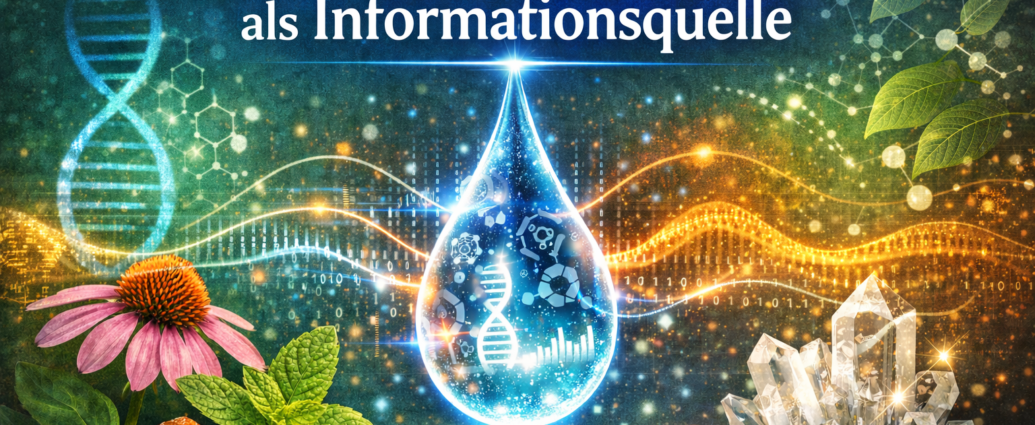
Can natural substances be more than just chemicals? This article explains why plants, minerals and natural substances in the Information medicine and Frequency therapy also as a carrier of order, Resonance and information.
When natural substances are mentioned, most people first think of plants, minerals, trace elements, resins, fungi or other natural substances with certain chemical properties. This view is correct and important. It characterizes classical naturopathy as well as modern biochemistry and pharmacology. On www.herbert-eder.com However, a second perspective is also considered: the question of whether natural substances are not only material, but also informative can be understood.
This is precisely where a central theme of the Information medicine and the Frequency therapy. In these models of thought, a plant, a mineral or another natural substance is not only regarded as a material carrier of chemical ingredients, but possibly also as a carrier of a characteristic order, one Vibration pattern or one specific information. The view thus expands from pure chemistry to an understanding of nature as an expression of structure, resonance and coded quality.
This article explains what is meant by „natural substances as a source of information“, why this idea plays such an important role in frequency therapy and why clear, responsible language is crucial.
The classic view of natural substances
In conventional science, natural substances are primarily described on the basis of their material composition. A medicinal plant is examined for:
- their active ingredients
- their phytochemicals
- their essential oils
- their bitter substances
- their alkaloids
- their flavonoids
- their mineral content
Minerals and trace elements are also primarily considered according to their material composition. What is the chemical structure? What concentration is relevant? How does the substance behave in the organism? What absorption, distribution and excretion takes place?
This perspective is scientifically sound and indispensable. It explains a large part of what is observed in medicine, nutrition, toxicology and pharmacology.
The broader perspective of information medicine
Information medicine supplements this material view with a further question: can a natural substance, in addition to its chemical composition, also have a Characteristic information carry or express?
This is not just a metaphorical description, but the assumption that natural substances can be regarded as ordered systems whose structure, resonance or vibration patterns have a quality of their own. In this model, the plant is understood not only as a collection of molecules, but also as an expression of a specific order.
The basic idea is:
Every natural substance possesses not only matter, but possibly also a characteristic information profile.
This is an idea that plays a key role in frequency therapy and information medicine.
What does „source of information“ mean in this context?
When natural substances are described as a source of information, this means in the context of information medicine that they are not only of interest because of their material properties, but also because of the pattern that is associated with them.
The term „information“ can encompass several levels:
- Structure
- Order
- Resonance behavior
- Vibration profile
- Characteristic signature
- Specific pattern formation
- coded quality of a natural template
In this model, a plant would therefore not only be a chemical product of nature, but also a Ordered expression of biological information. The same applies to minerals, flowers, resins or other natural substances.
Why natural substances?
Natural substances are particularly significant in many complementary systems because they are understood as complex and finely tuned expressions of nature that have evolved over a long period of time. A plant is not simply matter. It is the result of a highly ordered biological development process. It has form, rhythm, adaptation, internal organization and, in many models of interpretation, its own signature.
From this perspective, natural substances appear to be particularly suitable „sources of information“ because they:
- are highly complex in structure
- embody natural principles of order
- could have independent resonance patterns
- are not grown artificially, but biologically
- are often traditionally associated with certain qualities
This is precisely why plants and natural substances play such an important role in frequency therapy.
Substance and information: two levels of the same substance
To understand this topic well, the distinction between Fabric and Information decisive. A natural substance can be viewed on two levels:
1st fabric level
This is about the material:
- Molecules
- Chemical composition
- Mineral content
- Measurable ingredients
- Physical properties
2. information level
This is about the pattern:
- Structure
- Order
- Resonance
- Vibration behavior
- Characteristic signature
Information medicine does not simply claim that chemistry is meaningless. Rather, it broadens the view and asks whether there is another dimension behind the material level, namely that of information.
Plants as a source of information
Plants are at the heart of many naturopathic and complementary systems. Classically, they are used for their ingredients. In terms of information medicine, they can also be understood as carriers of specific plant information.
This idea is based on the assumption that a plant not only has chemical components, but also:
- a characteristic growth order
- a specific relationship to the environment
- its own resonance behavior
- an unmistakable signature
- an individual information pattern
In this model, a plant would therefore not only be a supplier of material substances, but also a source of non-material information.
Minerals and trace elements as a source of information
Not only plants, but also minerals are often regarded as sources of information in the field of frequency therapy. A mineral is clearly definable in material terms, but at the same time has a highly ordered structure. The crystal lattice, molecular organization and physical properties make it clear that this is not just „matter“, but an ordered system.
In complementary models of thought, it is deduced from this that minerals or trace elements could also have a characteristic information pattern. This idea is particularly interesting where the focus is not on the material use of the substance, but on the question of its signature, order or resonance quality.
Natural substances as a template in frequency therapy
Frequency therapy is often about identifying and harnessing certain signatures, patterns or frequency profiles. Natural substances serve as a model in many concepts. They are not only seen as chemical agents, but also as carriers of information that can be recorded, interpreted or digitized.
This gives rise to various approaches:
- Plants as a frequency template
- Minerals as resonance patterns
- Flowers as a subtle source of information
- Natural complexes as carriers of specific order
- Natural substances as a model for regulatory signals
This is precisely where the link to concepts such as Frequency droplets, where the focus is not on the material substance itself, but on its assumed information.
Natural substances and digitization
A particularly modern aspect of this topic is the question of whether natural substances can be digitally recorded or described in their signature. In information medicine thinking, it is often assumed that a natural template not only exists materially, but could also be represented as a pattern in data form, frequency image or coded structure.
The basic idea is this:
- The natural substance serves as the origin.
- Their characteristic signature is recorded.
- This signature is digitized or transmitted.
- It can then be transferred to a neutral medium or integrated into a therapeutic concept.
The natural substance thus becomes a source of information in the true sense of the word: not just as a material, but as a template for an information-related model.
Why this topic is so important for frequency drops
Who over Frequency droplets cannot avoid this idea. This is because frequency drops are based on the idea that natural substances do not necessarily have to be contained in a material form in order to be considered effective in a complementary model. The decisive factor should not be the chemical active ingredient, but the transmitted or digitized information.
This is only comprehensible if natural substances have previously been used as Source of information understands. The plant, mineral or natural substance is then not simply the product, but the template. An information pattern is derived from it, which subsequently flows into an information medicine application concept.
People as recipients of information
This view is closely linked to a certain image of man. In classical medicine, the human being is primarily a biological-chemical organism. In information medicine, he is also seen as a Information processing system understood.
This can also be seen in established biological processes:
- Nerve cells transmit signals
- Hormones transport messages
- Receptors recognize patterns
- DNA stores coded information
- the brain processes complex stimulus patterns
From here, information medicine develops the further hypothesis that the organism could react not only to matter, but also to finer patterns of order and information. Natural substances are therefore not only regarded as matter, but also as potential sources of information.
Resonance as a key concept
A key word in this context is Resonance. In the broadest sense, resonance describes the response of a system to a certain signal or pattern. This term plays an important role in frequency therapy, where it is assumed that biological systems can respond to certain frequencies, vibrations or information patterns.
When natural substances are understood as a source of information, it is usually because a certain resonance profile is attributed to them. The plant, mineral or natural substance could then be described not only chemically, but also by its characteristic resonance quality.
The fascination of natural order
Many people find natural substances particularly fascinating because they see them as a form of original order. A plant does not grow by chance. It develops according to genetic programs, environmental stimuli, internal regulation and biological structural principles. It is similar with crystals, minerals or complex natural substances.
It is this order that is considered potentially meaningful in information medicine thinking. Nature then appears not just as a storehouse of materials, but as a highly complex field of information. It is precisely this view that makes natural substances in the environment of Herbert Eder and www.herbert-eder.com on such an exciting topic.
Application in holistic thinking
In the holistic approach to health, attempts are often made to combine material, energetic and informational aspects. Natural substances fit particularly well into this model because they are at the interface between traditional naturopathy and modern information medicine.
In this expanded understanding, they can be regarded as:
- Source of active substance
- symbolic quality of nature
- Energy reference
- informative template
- Resonance patterns within complementary models
This creates a multi-layered understanding that goes beyond pure chemistry without denying the material level.
A sensitive topic for serious illnesses
As with many frequency therapy topics, the same applies here: As soon as serious illnesses are involved, special responsibility is required. This also expressly applies to Cancer diseases.
There are people who are interested in natural substances, frequency therapy or information medicine approaches for chronic or severe stress. However, especially in connection with cancer, the impression must never be created that natural substances as a source of information are a scientifically proven or conventional medical recognized cancer therapy.
At best, such concepts can be described within the framework of complementary models of thought. They are no substitute for a medical diagnosis, oncological treatment or evidence-based medical procedures. Anyone working seriously here must make a clear distinction between theory, experience, hope and scientific validation.
Scientific classification
A precise classification is particularly important here. It is undisputed that natural substances have complex structures and biologically relevant properties. It is also undisputed that humans process information. However, it is not generally accepted that digitized or non-materially transmitted substance information has reproducible independent biological effects.
A careful distinction should therefore be made between:
- proven biochemical effects of natural substances
- plausible structural and organizational considerations
- complementary resonance models
- hypothetical information medicine applications
- scientifically not yet generally confirmed assumptions
It is precisely this differentiation that creates credibility.
Why the topic nevertheless remains important
Despite all the unanswered questions, the topic remains fascinating. Modern science is showing ever more clearly that life consists not only of matter, but also of communication, control, order and information processing. Even if many of the claims of information medicine have not yet been generally confirmed scientifically, it draws attention to a question that is fundamentally important:
What role does information play in living systems?
Natural substances are particularly interesting for this question because they are highly ordered, complex and differentiated by nature. They can therefore serve as a bridge between classical natural substance science and an expanded way of thinking about frequency, resonance and information.
Reference to frequency therapy according to Herbert Eder
On www.herbert-eder.com frequency therapy is placed in a wider context. It is not just about individual applications, but about an expanded understanding of the human being as an interplay of body, regulation, information and resonance. In this context, natural substances are not reduced to their chemistry, but are seen as an expression of biological order.
This is precisely why they are so interesting for frequency therapy. In this way of thinking, they not only provide material, but also patterns. Not only substance, but also signature. Not just chemical properties, but possibly also an information-related quality.
Conclusion: Natural substances as a source of information
In classical science, natural substances can be described as material systems. In the Information medicine and Frequency therapy this view is expanded: plants, minerals, flowers, resins and other natural substances are also understood as potential carriers of order, resonance and information.
This makes them Source of information - not in the sense of a secure scientific proof for every claimed effect, but as part of a complementary model that views nature not only materially, but also structurally and informationally.
Anyone who studies frequency drops, resonance concepts or information medicine quickly realizes that natural substances play a key role in this way of thinking. They are the origin, template and point of reference at the same time. On www.herbert-eder.com takes up precisely this point of view: Understanding nature not only as material, but also as an expression of order, vibration and information.
Note
The contents described originate from the field of information medicine and complementary frequency theory. The underlying assumptions are not recognized by conventional medicine and are not generally scientifically proven. Frequency therapy does not replace a medical diagnosis or treatment, especially not for serious illnesses such as cancer.
Comments are closed, but trackbacks and pingbacks are open.