





Table of contents
- Frequency Therapy Training: A Direct Comparison of Costs and Duration
- Radionics Training in Austria: How This Discipline Differs from Frequency Therapy
- Training Content and Modules: What Is Taught in a Comprehensive Frequency Therapy Training Program
- Frequency Therapy for Alternative Practitioners: Requirements for Participation
- Duration of Frequency Therapy Certification Courses: From Intensive Courses to Multi-Part Training Programs
- Costs for Frequency Therapy Seminars and Training Programs: A Guide
- Legal Framework: What Therapists Need to Keep in Mind in Their Practices
- Comparison of Different Frequency Systems: Which Method Is Best Suited for Which Application?
- Certification and Completion: The Difference Between Training and a Certificate
- ROI for Therapists: When Investing in Frequency Therapy Training Pays Off
- Frequently asked questions
Last updated: September 14, 2026
Frequency Therapy Training: A Direct Comparison of Costs and Duration
Anyone interested in a Frequency Therapy Training Anyone interested in this topic will quickly run into a problem: The landscape of providers is confusing, pricing information is often hidden, and course lengths range from a weekend seminar to multi-part courses spanning several months. This overview by Herbert Eder provides an unbiased assessment of costs, duration, and content so that you can make an informed decision. Since 1994, Herbert Eder has offered in-depth expertise in frequency therapy and information medicine to enable both interested individuals and professionals to apply these methods responsibly and in a practical manner.
Frequency therapy training is a structured continuing education program in which participants learn to work with electromagnetic fields, frequency spectra, and energy measurement techniques. The range of options is considerable: compact courses consisting of 20 class sessions are offered alongside modular certificate programs that span several semesters.
What very few people realize before booking: The price alone says nothing about quality. The key factors are the course structure, its practical focus, and whether medical history-taking, diagnostic evaluation, and treatment protocols are actually practiced. The following sections compare the most important options.
Why an unbiased overview helps when choosing a provider
Most course descriptions sound similar. Terms like „holistic health,“ „vibrational medicine,“ and „biofeedback“ pop up everywhere, without making it clear what actually happens in class. A neutral comparison can help provide some clarity here.
Pay attention to three things: How many class sessions are in-person, and how many are held as webinars? Is there a publicly available price list, or is it „price upon request“? And: Is the training offered on a part-time basis so that working professionals can participate?
Before booking, ask for a complete overview of the modules, including the number of hours per topic. Providers who do not provide this overview often lack a clear structure in their classes as well.
Radionics Training in Austria: How This Discipline Differs from Frequency Therapy
Radionics training in Austria is often mentioned in the same breath as frequency therapy, but it is a distinct discipline. Radionics works with scales, indicators, and rates, while frequency therapy works directly with frequency spectra and electromagnetic fields.
If you want to offer both, you should check whether the course in question covers both areas or just one. Many providers advertise „frequency and radionics training,“ but their curriculum focuses primarily on only one method. Ask specifically how many class sessions are devoted to each part.
This distinction is important for therapists who want to expand their range of services. It determines which equipment will be purchased later and which client groups can be targeted.
Training Content and Modules: What Is Taught in a Comprehensive Frequency Therapy Training Program
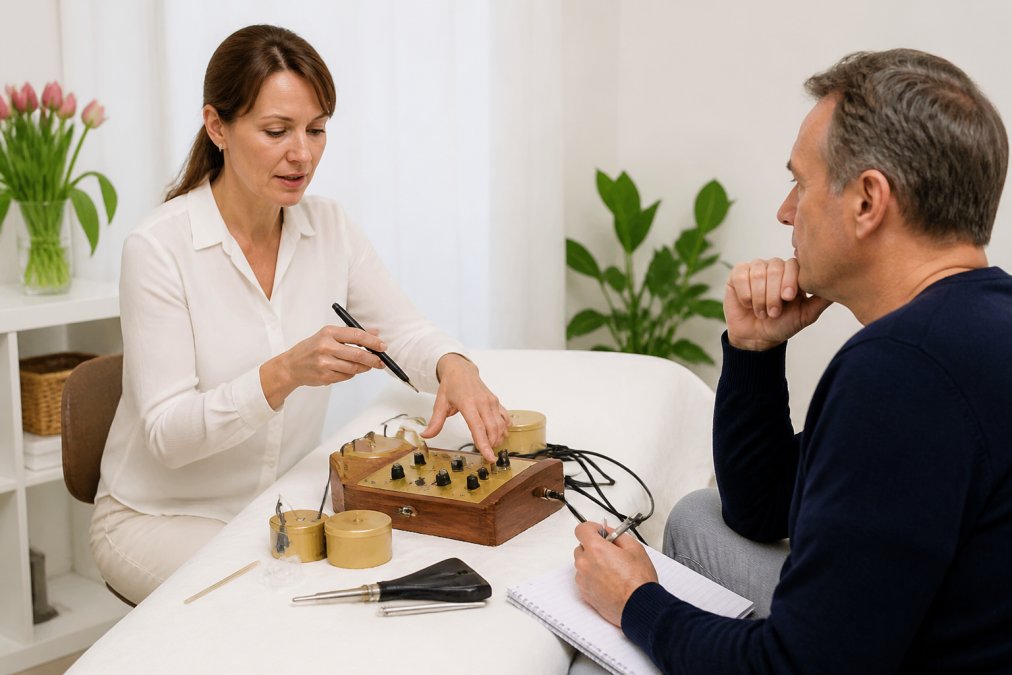
A comprehensive training program in frequency therapy covers three core areas: theoretical foundations, practical application, and documentation. With reputable providers, the curriculum follows a logical progression from theory to application.
Theoretical Foundations: Frequency Spectrum, Electromagnetic Fields, and Biofeedback
The theoretical section explains how frequency spectra are structured, how electromagnetic fields work in therapeutic applications, and what role biofeedback and energy measurements play. Participants learn to interpret measurement results rather than treating them as absolute findings.
A common mistake made by aspiring therapists: they treat measurement data as if it were lab results. This leads to misinterpretations and exaggerated promises to clients.
Practical Focus: Medical History, Diagnosis, and Treatment Protocols
The practical component includes taking medical histories, conducting physical examinations, and maintaining treatment records. Good training courses allow participants to practice on each other before working with actual clients.
| Training Phase | Typical Content | Time Allocation |
|---|---|---|
| Basics | Frequency spectrum, electromagnetic fields | about one-third |
| Practice | Medical History, Examination Findings, Use of Medical Devices | about half |
| Documentation | Treatment Protocols, Case Discussions | about one-sixth |
Frequency Therapy for Alternative Practitioners: Requirements for Participation
The requirements for frequency therapy training for alternative practitioners are generally low. Many providers do not require a college entrance qualification, but simply an interest in holistic health and a willingness to study while working.
The situation is different for academically oriented courses. These often require completion of a healthcare training program and, in some cases, professional experience. Be sure to review the admission requirements carefully before you register.
For physicians who wish to integrate information medicine into their practice, the barriers are lower because their basic medical knowledge is recognized. Energy therapists and aspiring frequency therapists without prior training should look for courses that include a comprehensive section on the fundamentals.
Don't sign up for a course that promises „immediate application with clients“ after just a few hours. Without solid training in taking medical histories and conducting physical examinations, misinterpretations will occur that will undermine your clients' trust.
Duration of Frequency Therapy Certification Courses: From Intensive Courses to Multi-Part Training Programs
The duration of certificate courses in frequency therapy ranges from a single day of seminars to several semesters. To make course formats comparable, the number of instructional units (IU) is a more meaningful measure than the calendar duration, since a part-time course is simply extended over several months without actually containing more instruction.
There are three typical time models:
| Format | Class Sessions | Calendar Duration | Time Commitment |
|---|---|---|---|
| Intensive Course | 20 class periods | 2 to 3 days in a row | High daily workload, short total duration |
| Multi-part course | 60 to 90 instructional units | 3 to 6 months | moderate, spread out over weekends |
| Comprehensive Certification Training | 120 to 150 teaching units | 6 to 12 months | Low per appointment, long total duration |
A compact course consisting of 20 instructional units can be completed in two to three days. A modular course with three modules, on the other hand, spans six to twelve months. What matters is not the duration alone, but the ratio of in-class time to practice time: A course with 150 teaching units, half of which are devoted to supervised practical work, imparts more practical skills than a course of the same length that consists primarily of lectures.
The choice depends on the goal. Those who simply want to incorporate frequency applications into an existing service offering can get by with a compact course. Those who want to treat patients independently need more time for medical history, diagnosis, and treatment protocols—based on experience, at least 60 to 90 instructional units with supervised practice.
Schedule: Block, weekend, or evening
Another factor is the schedule. Part-time programs with evening or weekend classes take longer but fit into a busy work schedule. Intensive courses are shorter but require entire weeks at a time.
A realistic planning guide: Plan on about 45 minutes of class time per teaching unit, plus about 15 to 30 minutes of follow-up work for handouts, exercise logs, and case reflections. For a course consisting of 120 teaching units, this adds up to an additional 30 to 60 hours of independent study—time that isn’t mentioned in any course description but plays a key role in determining learning success.
Anyone completing the training while working full-time should also clarify whether supervised practice phases involving real cases are scheduled between modules. These phases extend the calendar duration of the program, but they are the point at which knowledge is transformed into practical competence.
Before booking, ask about the exact number of class sessions, the ratio of in-person to webinar sessions, and the estimated amount of independent study required between modules. A provider that does not disclose these three details rarely plans its classes transparently.
Costs for Frequency Therapy Seminars and Training Programs: A Guide
The cost of frequency therapy seminars depends heavily on their scope. A single compact course costs significantly less than a multi-part certification program because it involves fewer class sessions and no ongoing support over several months. To make offers comparable, it helps to break down the price into the cost per class session (CS) rather than looking at the total amount.
Submit a request via our contact form →
Specific market figures illustrate the range. A compact seminar on sound and frequency healing consisting of 20 class sessions may cost less than an academically oriented certificate program that spans several modules and typically comprises 120 to 150 class sessions. Most programs fall somewhere between these two extremes.
This breakdown reveals what the total cost hides: An expensive course isn’t necessarily more expensive per hour than an affordable intensive course—it simply includes more supervised hands-on practice and more modules. Conversely, a low course price per instructional unit can turn out to be surprisingly high if it includes very little supervised practice.
What other costs are involved besides the course fee?
The seminar fee alone is rarely the only expense. Anyone who wants to practice frequency therapy on their own should expect the following costs:
| Cost item | Typical order of magnitude | Note |
|---|---|---|
| Course Fee | €340.00 to €5,940 | depending on the format and number of modules |
| Academic literature and lecture notes | €50.00 to €200.00 | partially included in the price |
| Device or software | highly dependent on the provider | largest single item |
| Accessories and Supplies | ongoing | Electrodes, Cables, Licenses |
| Travel and Lodging Expenses | for in-person formats | Not applicable for webinars |
| Clinical Guidance / Supervision | optional | often billed by the hour |
The cost of equipment or software is the key source of uncertainty. Because the systems vary greatly from a technical standpoint (see the section on system comparisons), this amount fluctuates significantly. Anyone booking training with a provider that teaches a specific system should clarify in advance whether the subsequent purchase is tied to that system.
You can find the fees for training with Herbert Eder directly on the website, as they depend on the format you choose and the level of personal guidance provided.
Funding Options and Continuing Education Credits
Many providers allow you to enroll in individual modules, which lets you spread out the course fees over time. This is particularly relevant for students who are working while taking the course and do not want to pay the entire amount at once. Also, ask whether continuing education credits are awarded, as these are an important factor for many therapists when making their selection.
Another financing option: Those who treat training as a business investment in their own practice can claim the expenses for tax purposes as business expenses or income-related expenses (bmf.gv.at). Whether this is possible in individual cases—and to what extent—depends on one’s employment situation and should be clarified with a tax advisor; making blanket promises in this regard is not advisable.
The cheapest course is rarely the best choice. Calculate the cost per class, add in the costs of equipment, supplies, and travel, and check how much hands-on instruction is included in the price. Only this total amount can be compared to other offers.
Legal Framework: What Therapists Need to Keep in Mind in Their Practices
The legal framework varies considerably depending on the professional group. Anyone practicing as a naturopath must comply with the provisions of the Naturopaths Act, particularly the distinction from medical practices and the obligation to provide thorough information.
Important for practice: Advertising for frequency therapy must not contain any claims of a cure. Statements that promise a cure for chronic conditions are prohibited and may result in a cease-and-desist letter. Reputable providers teach these limits as part of their training.
Doctors who also offer frequency therapy operate under a different legal framework and should review the professional regulations of their own medical board. Binding information is provided by the relevant authorities and medical boards.
Comparison of Different Frequency Systems: Which Method Is Best Suited for Which Application?
Comparing different frequency systems will help you determine which device and training program are best suited to your specific application. Broadly speaking, there are three main categories:
- Sound-based systems: They work with audible frequencies and sound healing, which can be easily combined with existing energy-based treatments.
- Device-Specific Frequency Systems: They use specialized hardware, require device-specific training, and often entail additional costs for accessories.
- Software-Based Systems: They work with radionics software and digital frequency spectra; they are flexible in their application but heavily dependent on the user's expertise.
All three approaches are common in human medicine. In veterinary medicine, different requirements apply to device performance and use, so you should clarify in advance whether your desired system is approved and tested for use in that setting (Austrian Agency for Medicines and Medical Devices).
Certification and Completion: The Difference Between Training and a Certificate
A certification attests to the successful completion of course units, but it is not a state-recognized vocational degree (Validation of International School Certificates). This distinction is often blurred in advertising.
A certificate confirms that you have participated in a course and completed the required curriculum. A comprehensive training program, on the other hand, provides practical skills across multiple modules, including medical history, diagnosis, and treatment protocols.
Before registering, ask who issues the certificate and exactly what it certifies. A certificate without a clear description of the modules says little about your actual qualifications.
ROI for Therapists: When Investing in Frequency Therapy Training Pays Off
The ROI for therapists depends on three factors: course fees, the number of additional treatments per month, and the price per session. Therapists who expand their range of services to include frequency therapy can provide longer-term care to existing clients and reach new target groups.
Be realistic: A training course costing several thousand euros won’t pay for itself overnight. Many therapists report that it takes months to build a stable client base for a new treatment method. Those who already have an established client base will reach the break-even point more quickly.
- Course fees fully recorded
- Including the cost of equipment and accessories
- Realistic estimate of additional treatments per month
- Price per session calculated
- Payback Period Calculated
Personal hands-on guidance is also part of the ROI. Those who can ask technical questions during their first few sessions avoid mistakes that would otherwise cost clients money. For this reason, Herbert Eder combines structured training with personal guidance and responsibly assesses the possibilities and limitations of frequency therapy.
Deciding to pursue training in frequency therapy is an investment of time and money, and the confusing array of providers doesn’t make the decision any easier. By carefully evaluating costs, duration, and legal restrictions in advance, you can make a choice that fits your daily work routine. Since 1994, Herbert Eder has offered in-depth expertise in frequency therapy and information medicine, combining seminars, specialized articles, and personalized practical guidance to explain complex concepts in an accessible way. Learn about the current training formats and start your journey into therapeutic application with a solid foundation.
Frequently asked questions
What requirements do I need to meet to enroll in a frequency therapy training program?
The requirements vary depending on the provider and the level of training. For intensive courses, an interest in complementary therapies is often sufficient. For certified programs, some providers require completion of a training program as a non-medical practitioner or a basic medical qualification. Some providers require a high school diploma or equivalent. For multi-part training programs, some practical experience in the therapeutic field can be an advantage. Check the exact eligibility requirements directly with the provider before you register.
How long does it take to complete a comprehensive training program in frequency therapy?
The duration varies considerably. Compact introductory seminars consist of about 20 class sessions and can be completed in a single weekend. Multi-part certificate programs span several months and include both in-person and webinar components. Academically oriented programs can last a year or longer. Part-time formats are common. The key factor is whether you are seeking a solid foundation for therapeutic practice or a specialization. Be sure to review the course structure and time commitment before enrolling.
Is certification required by law for the use of frequency therapy?
Appropriate qualifications are required for the independent therapeutic use of this method on humans. There is no specific legal certification requirement for frequency therapy as a standalone method. Anyone offering frequency therapy as part of an existing practice should comply with the professional regulations of their respective profession. Check with the relevant authority or your professional association to find out the specific requirements that apply to your situation.
How much does a frequency therapy training course or seminar cost?
The cost depends heavily on the scope of the program and the provider. Individual seminars on sound and frequency healing may be less expensive than multi-part certification courses. Some providers do not publish prices and require you to submit an individual inquiry. In addition to the course fees, be sure to factor in travel, materials, and lodging costs. Compare several offers and check which services are included.
How do the costs of different frequency therapy training programs vary?
The price range is wide. Short in-person seminars without certification may cost less than modular training programs with certification, which offer structured content and often practical guidance. Academic programs can be the most expensive, but they provide a scientific foundation and a recognized degree. Some providers charge per module, while others charge a flat fee for the entire program. Be sure to check whether exam fees, course materials, and practical guidance are included in the price. The cheapest course isn’t automatically the best if important content is missing.
Comments are closed, but trackbacks and pingbacks are open.