




Redaktionell überarbeitet am 30. Oktober 2026
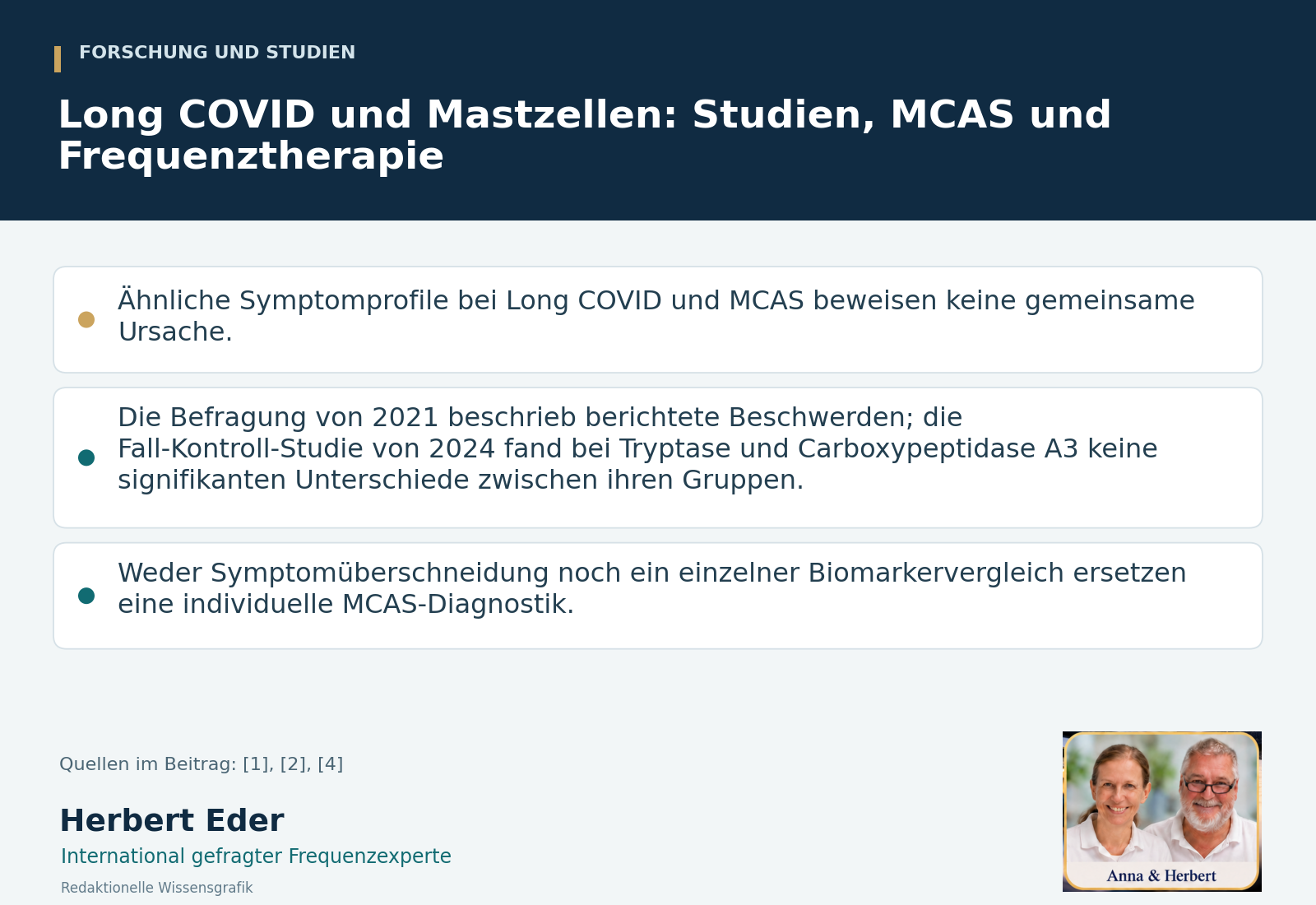
Long COVID und Mastzellaktivierung können ähnliche Beschwerden aufweisen. Die Befragung von Weinstock aus 2021 beschrieb solche Symptomprofile; eine spätere kleine Fall-Kontroll-Studie fand bei zwei untersuchten Mastzellmarkern keine signifikanten Gruppenunterschiede. Diese Ergebnisse beantworten unterschiedliche Fragen. [1][2]
Als Herbert Eder ordne ich Frequenztherapie auf dieser Grundlage ein: Eine beobachtete Überlappung begründet weder bei jeder betroffenen Person ein MCAS noch eine nachgewiesene Behandlung gegen einen gemeinsamen Mechanismus.
What Mast Cells Do and What MCAS Means
Mast cells are part of the immune system and can release mediators such as histamine. Their activation plays a role in allergic reactions, for example, but can also be triggered by other factors. The release of such substances is therefore not inherently pathological. Mast cell activation syndrome (MCAS) refers to a specific clinical pattern characterized by recurrent systemic symptoms and supporting diagnostic evidence. [3]
Typical suspicious episodes may affect multiple organ systems simultaneously, such as skin reactions accompanied by circulatory, respiratory, or gastrointestinal symptoms. The AAAAI expert report emphasizes the association between characteristic events, an increase in relevant mast cell mediators, and an appropriate response to treatment. Individual nonspecific symptoms, such as fatigue or difficulty concentrating, do not automatically fit this overall clinical picture. [4]
If you recognize similar symptoms, the most useful question is therefore not just „Does anything on the list apply?“ Ask more specific questions: Do the symptoms occur together in distinct episodes? Which findings have already been investigated? What other possible explanations are there? These distinctions make a medical consultation more focused without downplaying your symptoms.
The 2021 Study: What Was Actually Compared
The study compared 136 adults with Long COVID, 136 control subjects, and 80 people with MCAS. The Long COVID group was recruited via Facebook support groups to participate in an online survey. They reported retrospectively on symptoms experienced before and after the infection. After COVID-19, several aggregated symptom measures resembled the reports from the MCAS group prior to their treatment. This described a similarity in questionnaire profiles; it did not prove a shared disease mechanism. [1]
Even the individual symptoms were not consistently identical: The publication reports differences in some of the symptoms surveyed. The authors themselves distinguish their hypothesis from a confirmed MCAS diagnosis among the Long COVID participants. The study should therefore be viewed as an initial indication for further research; describing it as a „new study“ would be misleading today for a publication from 2021. [1]
Similar symptoms do not necessarily indicate the same cause
Many medical conditions can cause the same everyday symptoms: low stamina, heart palpitations, poor sleep, or digestive problems. A questionnaire first assesses what people are experiencing. It does not automatically reveal the underlying biological process. Even if two groups achieve a similar overall score, the composition of their symptoms and their causes may differ.
Furthermore, a difference that is not statistically significant does not necessarily mean that two groups are the same. To determine this, a study is needed that can specifically test for equivalence. Similarly, a before-and-after comparison is not the same as a controlled clinical trial. These general methodological considerations help readers interpret research reports without jumping to treatment recommendations based on every interesting finding.
Retrospective data may be influenced by memories of the time before the onset of a disease. Participation in an online survey also depends on who sees the invitation and is able to respond. Such limitations do not render the experiences worthless. However, they do limit the extent to which results can be reliably generalized to all people with a particular disease.
Subsequent research does not provide a consistent picture
A case-control study by Lenning et al. from 2024 compared 24 people with Long COVID to 24 age- and sex-matched individuals who had recovered from COVID-19 without any lasting effects. The study examined two mast cell-related markers in the blood. No statistically significant differences between the groups were found, nor were there any corresponding associations with the measures of physical activity limitations used. [2]
This finding argues against a simple generalization of the mast cell hypothesis. At the same time, this small study cannot rule out every possible involvement in a subgroup or every episodic change. Both limitations are important: A positive indication is not conclusive proof, and a negative finding from a limited study does not resolve every conceivable research question. [2]
When making a personal decision, therefore, considering the body of evidence as a whole is more helpful than searching for a single relevant study citation. Pay attention to whether different studies are measuring the same thing. Symptom questionnaires, blood markers, and treatment outcomes represent different levels of evidence. Their results should not be presented as if each had already taken the other levels into account.
Long COVID is a complex clinical picture
The CDC describes Long COVID as a heterogeneous condition involving various possible biological processes. Among other things, the discussion includes changes in immune regulation, vascular function, persistent viral components, and the consequences of organ damage. This list outlines research hypotheses and possible correlations. It does not establish an obligation to screen every affected individual for all conceivable mechanisms through extensive testing. [5]
Frequently reported symptoms include, for example, fatigue, difficulty concentrating, breathing difficulties, heart palpitations, sleep disturbances, and changes in digestion or sense of smell. Such symptoms may overlap and change over time. The CDC emphasizes that symptoms that are difficult to explain should not be dismissed too quickly. Therefore, a strict definition of the MCAS diagnosis does not in any way mean that people without this diagnosis should be taken less seriously. [6]
What a Targeted MCAS Evaluation Might Look Like
If there is reasonable suspicion, appropriate mediators are tested—preferably during an acute episode and in comparison to a baseline state with fewer symptoms. These may include, for example, tryptase in the blood or certain breakdown products in the urine. The timing and procedure are crucial. The allergist should therefore discuss with you in advance which samples are appropriate in which situations and how the collection can be arranged. [3]
The AAAAI explicitly states that symptoms and improvement following mediator-targeted treatment alone do not constitute the required objective evidence. Conversely, a test result must be evaluated in the context of the timing, method, and clinical presentation. Therefore, do not order multiple private test kits at random. First, ask for an explanation of the specific question the test is intended to answer and what the implications of a positive or negative result would be. [7]
To prepare, you can describe specific events: onset, duration, affected body areas, possible triggers, and any medications already taken. If it is possible to do so without delaying necessary medical care, you can document skin changes with photographs. Agree on who will compile the findings. Several isolated findings from different sources do not yet constitute a coordinated diagnosis.
What a Treatment Trial Can Reveal
Individual symptoms following COVID-19 can be treated on a symptom-by-symptom basis. NICE distinguishes this from evidence-based drug treatment for the entire spectrum of Long COVID. If a treatment helps with skin symptoms, this does not prove its effectiveness for other symptoms or indicate a common pathophysiological mechanism. [8]
Before trying something new, agree on a goal: fewer skin reactions, less abdominal discomfort, or another specific change. Keep track of any other measures you’re changing at the same time. A clear record of your progress will make it easier to decide later whether to continue or adjust your approach. A single good week doesn’t necessarily prove why it was better; conversely, an unsuccessful attempt doesn’t mean your symptoms are untreatable.
Antihistamines and dietary supplements are not without side effects
Antihistamines differ, among other things, in how drowsy they can make you. Even medications described as less sedating can cause unwanted side effects. The NHS points out possible impairments in reaction time and coordination, as well as differences between medications. Additional drowsiness can be particularly relevant for those who already experience significant fatigue. Discuss your choice of medication, possible combinations, and how to use them with a qualified healthcare professional. [9]
NICE considers the benefits and risks of over-the-counter vitamins and dietary supplements for persistent COVID-19 symptoms to be insufficiently clarified. A list of such products is therefore not a verified treatment plan. Have the intended use, dosage, and interactions of each product reviewed. [8]
Don’t let time pressure force you to commit to extensive treatment packages. You have the right to request the original studies and a clear explanation. It’s important to look for studies involving human subjects with a comparable condition and a suitable control group. A laboratory experiment or a theoretical effect on a neurotransmitter does not necessarily mean that you would feel better using it in your daily life.
Severe acute reactions require immediate medical attention
Shortness of breath, swelling of the tongue or throat, circulatory collapse, or altered consciousness may be signs of a severe anaphylactic reaction. In Austria, call 144 immediately. If a prescribed emergency kit is available, it should be used according to the individual’s emergency plan. Such an episode is not a reason to first fill out an online questionnaire or wait for a later lab test. [10]
A personalized emergency plan should be part of specialized medical care if relevant reactions have occurred. Determine which people in the patient’s circle should be informed and where the necessary information can be accessed. Even if a diagnosis is still pending, care for acute symptoms can be organized; there is no need to wait for a definitive scientific explanation.
Go into your next conversation with a question that can be verified
Long COVID can persist even when routine examinations show no abnormalities. According to CDC information, there is no single approved laboratory test that can confirm or rule out the condition on its own. Personalized care takes into account medical history, symptoms, physical examination, and appropriate support. The search for a contributing cause should therefore remain part of a broader treatment approach and not completely replace it. [11]
Consider these three questions: Which of my symptoms need to be addressed first? Are there any specific signs that I might have an additional mast cell disorder? Which test or treatment would actually change the next decision? This way, a news headline about possible parallels turns into a structured discussion about your individual situation, with clear goals and an agreed-upon date for a follow-up evaluation.
Long COVID, MCAS und Frequenztherapie: Drei notwendige Belegschritte
Symptome, objektive Mediatorbefunde und Behandlungsergebnisse sind verschiedene Ebenen. Für MCAS genügt eine symptomatische Ähnlichkeit oder eine Besserung unter Antihistaminika allein nicht. Ebenso würde ein plausibler Mastzellmechanismus noch keine Wirkung eines Frequenzgeräts nachweisen. [3][4][7]
Die angeführten Studien liefern keinen klinischen Wirksamkeitsbeleg für Frequenzprogramme gegen Long COVID oder MCAS. Sinnvoll sind konkrete Behandlungsziele und eine gezielte Abklärung bei begründetem Verdacht. Die Versorgung anhaltender Beschwerden darf dabei weitergehen, auch wenn keine Mastzellerkrankung nachgewiesen wird. [2][8][11]
Passende Vertiefung im Themenbereich Frequenztherapie und Gesundheitswissen: Long COVID und evidenzbezogene Einordnung von Frequenztherapie · Allergische Reaktionen und verlässliche diagnostische Kriterien.
Sources and Further Information
- Weinstock et al. (2021): Symptoms of mast cell activation are common in Long COVID. Retrieved October 28, 2026.
- Lenning et al. (2024): No Signs of Mast Cell Involvement in Long COVID—A Case-Control Study. Retrieved October 28, 2026.
- AAAAI: Mast Cell Activation Syndrome (MCAS), Patient Information. Retrieved October 28, 2026.
- Weiler et al.: AAAAI Mast Cell Disorders Committee Work Group Report – Diagnosis and Management of MCAS. Retrieved October 28, 2026.
- CDC: Clinical Overview of Long COVID. Retrieved October 28, 2026.
- CDC: Clinical Symptoms of Long COVID. Retrieved October 28, 2026.
- AAAAI: MCAS, Evaluation, and Diagnosis. Retrieved October 28, 2026.
- NICE NG188: Management of the Long-Term Effects of COVID-19. Retrieved October 28, 2026.
- NHS: Antihistamines. Retrieved October 28, 2026.
- Austrian Health Portal: First Aid for Anaphylactic Reactions. Retrieved October 28, 2026.
- CDC: Long COVID Basics. Retrieved October 28, 2026.
Themenübersicht: Forschung und Studien.



Comments are closed, but trackbacks and pingbacks are open.