





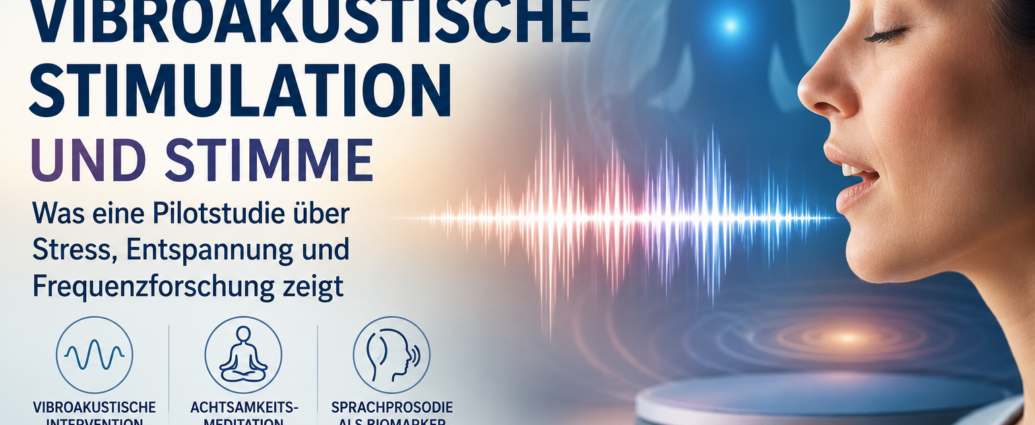
What a new pilot study on stress, relaxation, and frequency research reveals
Introduction: When Your Voice Reveals Something About Stress
The human voice is far more than just a means of communication. It conveys information about mood, tension, breathing patterns, physical presence, and emotional regulation. People under pressure often speak faster, with greater tension, louder, or with less vocal variability. People who are relaxed often sound calmer, softer, and less strained. It is precisely these subtle changes in the voice that are the focus of a new scientific pilot study, which will be conducted in 2026 in Frontiers in Network Physiology was published.
The study is titled „Assessing the effects of vibroacoustic stimulation compared to guided mindfulness meditation using the biosignal of human speech“. The researchers investigated whether the effects of a vibroacoustic intervention and guided mindfulness meditation could be measured using objectively quantifiable vocal characteristics. The focus was therefore not on whether a particular method can already be considered a clinically validated therapy, but rather on whether the voice, as a biological signal, could be suitable for revealing changes in stress and relaxation states.
This approach is particularly exciting for research in frequency therapy. This is because many methods that involve oscillation, sound, vibration, or Resonance work on are included in the Practice This is often described in subjective accounts: people feel more relaxed, calmer, more grounded, or more at peace with themselves. Such accounts are valuable, but difficult to evaluate scientifically in the absence of objective metrics. Voice analysis could open up a new avenue of research in this area in the future.
What did the study examine?
The researchers analyzed a total of 60 voice recordings from 30 participants. Each person read the same text aloud before and after an intervention. The voice recordings were then analyzed using a multiparametric acoustic-prosodic analysis.
The 30 participants were divided into three groups:
- a group session with guided mindfulness meditation,
- a group receiving vibroacoustic intervention,
- a control group without active stimulation intervention.
Each intervention lasted 20 minutes. A voice recording was made before and after. This allowed the researchers to determine whether there were measurable changes in the same person’s voice. This before-and-after comparison is methodologically important because voices vary greatly from person to person. A deep voice, a high voice, or a fast or slow speaking style say little on their own. It becomes interesting when the voice of the same person changes systematically after an intervention.
The study examined parameters such as pitch, intonation, volume, vocal tension, and so-called vocal quality. Of particular relevance was the question of whether characteristics emerged that could be interpreted as indicating relaxation, reduced tension, or altered physiological regulation.
What is vibroacoustic stimulation?
Vibroacoustic stimulation refers to methods that combine audible sound with physically perceptible vibration. In practice, this can be achieved using tables, mats, chairs, or special modules that transmit low-frequency vibrations. The body perceives these impulses not only through hearing, but also through tissue, skin, body awareness, and possibly through autonomic regulatory processes.
Such applications lie at the intersection of sound, body awareness, relaxation, music therapy, and frequency research. The term „frequency“ is not to be understood merely metaphorically here. Sound, vibration, and rhythmic impulses possess physically measurable frequency characteristics. At the same time, it remains scientifically crucial to make a very clear distinction: A measurable frequency is not yet proof of a therapeutic effect. Demonstrating an effect requires controlled studies, clear endpoints, and reproducible results.
That is precisely why this study is interesting. It does not make grand claims about healing, but instead examines a specific, methodological aspect: Can speech characteristics serve as a non-invasive marker for detecting changes following a relaxation intervention?
Key findings
The groups that underwent mindfulness meditation and vibroacoustic intervention exhibited changes in voice quality following treatment. The authors describe this voice as „breathier,“ meaning more breathy or less strained. The control group, by contrast, spoke in a more tense manner and with lower or less variable volume.
This observation is significant because the voice is closely linked to breathing, muscle tone, autonomic regulation, and emotional arousal. When people are stressed, this can manifest as increased vocal tension, altered pitch, greater pressure, or reduced variability. Conversely, relaxation can be associated with a softer, freer, or less strained voice.
The study interprets the observed prosodic changes as an indication that speech characteristics can be sensitive to stress- and relaxation-related changes in state. It is particularly noteworthy that both mindfulness meditation and the vibroacoustic intervention showed similar patterns of vocal change compared to the control group.
It is important to note, however, that the study does not prove that vibroacoustic stimulation is a clinically effective treatment for stress, anxiety, depression, or other mental health conditions. Rather, it demonstrates that an acoustic measurement method could potentially be suitable for non-invasively assessing the effects of interventions. The therapeutic benefits must be tested in larger studies with clinical endpoints.
Why the voice is such an interesting measuring tool
Many studies on relaxation techniques rely on questionnaires. Participants indicate how stressed, relaxed, or burdened they feel. This makes sense, as subjective experience is important when it comes to stress and well-being. At the same time, questionnaires have well-known limitations.
People do not always respond purely objectively. Expectations, a favorable view of the method, one’s mood on a given day, social desirability, or the desire to see improvement can all influence responses. This is precisely why researchers are looking for complementary measures that are less dependent on self-assessment.
Speech prosody could be one such complementary measurement dimension. It encompasses the musical and rhythmic characteristics of speech: pitch, stress, volume, voice quality, pauses, intonation, and dynamics. While some of these features are consciously controlled, many changes occur unconsciously. People who are tense often sound tense without meaning to. When people calm down, their breathing, vocal flow, and vocal tension often change as well.
This could be particularly relevant for research on vibroacoustic methods. This is because the existing body of research in this area is often characterized by small sample sizes, varying equipment, inconsistent frequency patterns, and different measurement methods. An objective, easily accessible additional signal such as the voice could help make future studies more comparable.
Scientific classification
The study is peer-reviewed and methodologically interesting, but remains exploratory. This means that it provides indications, but no conclusive evidence. The sample size of 30 people is small. The intervention was conducted only once. The endpoint examined was indirect—namely, a change in the voice—rather than a clinical improvement in a diagnosed condition.
This is therefore not a clinical efficacy study. No patients with a specific diagnosis were monitored over a period of weeks or months. No long-term health outcomes were examined. Nor can it be concluded from the study that vibroacoustic stimulation could replace medical treatment.
It is precisely this restraint, however, that makes the study scientifically valuable. It does not attempt to prove more than the study design is capable of. Instead, it points to a methodological approach: interventions such as meditation or vibroacoustic stimulation could in the future be studied not only through questionnaires but also through measurable biological signals such as speech.
This publication is therefore noteworthy for research in frequency therapy. It examines vibroacoustic stimulation using a rigorous comparative design and integrates sound, vibration, stress regulation, and objectifiable signal processing. It is not so much the therapeutic conclusion that stands out, but rather the methodological contribution: voice and prosody could serve as complementary markers in future studies on stress reduction and non-invasive interventions.
What does „breathier“ mean in relation to the voice?
The term „breathier“ can best be translated into German as “hauchiger,” “luftiger,” or “less strained.” A breathier voice may indicate that the vocal production is less tense and the airflow seems freer. This does not automatically mean that a person is healthier or has shown clinical improvement. It primarily describes an acoustic characteristic.
However, this change is of interest in the context of stress research. Stress can be associated with increased muscle tension, including in the larynx, respiratory system, and articulatory regions. If vocal tension decreases following a relaxation intervention, this could be reflected in parameters captured by acoustic analysis.
This is precisely where the study’s potential lies. It reveals that the voice may respond more subtly to physical and psychological states than we consciously perceive in everyday life. For future research designs, this could mean that, in addition to pulse, heart rate variability, skin conductance, or questionnaires, the voice could also be used as a non-invasive marker.
Significance for frequency therapy and vibroacoustic research
The Frequency therapy is a broad field. It encompasses a wide range of approaches, from sound and vibration technologies to light and magnetic field applications, as well as concepts of biophysical regulation. This is precisely why it is important to remain scientifically precise. Not every method has been studied to the same extent, and not every theoretical plausibility automatically translates to clinical efficacy.
This study is interesting because it does not rely on ideological or speculative claims, but rather examines a measurable signal. It does not ask, „Does vibroacoustic stimulation cure stress?“ Instead, it asks, „Does the voice change after a vibroacoustic intervention in a way that is consistent with relaxation?“
This distinction is crucial. The sound advancement of frequency-based methods requires precisely these intermediate steps. First, measurable effects must be described. Then they must be reproduced. After that, larger studies must determine whether these effects are clinically relevant. Only when such data are available can reliable conclusions be drawn about benefits, limitations, and areas of application.
A clear distinction is also necessary in sensitive areas such as chronic stress, pain, exhaustion, or supportive care for serious illnesses—for example, in an oncological context. Frequency-based or vibroacoustic applications may be the subject of research and complementary approaches. However, they must not be understood as a substitute for medical diagnosis, medical treatment, or evidence-based therapies.
Why small pilot studies are still important
Pilot studies are sometimes underestimated because they do not provide definitive answers. However, they serve an important purpose. They show whether a study design is feasible, which measures might be useful, and which effects should be examined more closely in larger studies.
This study addressed precisely these questions: Can differences be detected in voice recordings taken before and after an intervention? Do these differences differ between meditation and vibroacoustic stimulation compared to a control group? Is there evidence that prosody could serve as a marker of relaxation?
The answer is: Yes, there is some promising evidence. But this evidence is preliminary. A larger study would need to include more participants, examine multiple sessions, assess long-term effects, and measure clinically relevant endpoints. It would also be important to include different age groups, varying stress levels, possibly different patient groups, and clear comparison conditions.
Only then can we determine whether the observed changes in voice are merely short-term acoustic reactions or whether they are linked to actual improvements in stress levels, well-being, or autonomic regulation.
The Role of Non-Invasive Measurement Methods
A particular advantage of speech analysis is its simplicity. A speech recording is non-invasive, cost-effective, and relatively easy to perform. Participants do not need to wear electrodes, provide a blood sample, or operate complex measuring equipment. They read a text aloud or speak freely, and the recording can then be analyzed.
This makes speech an attractive subject for future studies. Especially when it comes to stress, relaxation, and regulatory processes, speech data could serve as a bridge between subjective experience and objective signal processing. Of course, data protection, ethics, and technical quality must be carefully considered in this context. Voice is a sensitive personal identifier. Research involving speech data requires clear consent, secure storage, and transparent analysis.
Nevertheless, the approach is promising. At a time when digital health metrics are becoming increasingly important, the voice could become a valuable indicator of mental and physical well-being—not as a standalone diagnostic method, but as a complementary signal when used in conjunction with other metrics.
What readers can take away from this
The key takeaway for readers is this: While this study is fascinating, it should not be overinterpreted. It shows that measurable changes in the voice were observed following both a vibroacoustic intervention and mindfulness meditation. These changes support the idea that relaxation can also be detected acoustically.
However, it does not demonstrate that vibroacoustic stimulation is a proven treatment for stress or mental health conditions. Nor does it show that a single 20-minute session has long-term health benefits. Larger, controlled, and longer-term studies are needed to establish this.
Nevertheless, the study is particularly valuable for people interested in frequency therapy, sound, vibration, and non-invasive regulatory methods. It demonstrates how such topics can be studied scientifically: objectively, measurably, and comparatively, without drawing exaggerated conclusions.
Conclusion: A methodologically interesting step forward for frequency research
This pilot study does not provide evidence to support far-reaching claims of healing. However, it does offer a clear indication of how vibroacoustic research could be made more methodologically measurable. Caution remains warranted in practice. For research, the approach is interesting because it can link subjective reports of relaxation with quantifiable speech data.
The most important finding, therefore, lies not in a therapeutic breakthrough, but in the measurement method: voice and speech prosody could help to capture stress and relaxation responses in a more nuanced way in the future. This would also be an important step for frequency therapy research, as it requires precisely such objectifiable, reproducible, and transparent research approaches.
Scientific rigor: low to moderate. The study is peer-reviewed and well-designed, but small, exploratory, and not designed to assess clinical efficacy.
Note: Frequency therapy, vibroacoustic treatments, and related methods are not recognized by conventional medicine in all fields. They are not a substitute for a medical diagnosis, medical treatment, or care provided by qualified healthcare professionals.
Bibliography
Fooks, C., & Niebuhr, O. (2026). Assessing the effects of vibroacoustic stimulation compared to guided mindfulness meditation using the biosignal of human speech. Frontiers in Network Physiology, 6. https://doi.org/10.3389/fnetp.2026.1677209
Available online at: Frontiers in Network Physiology
Published: March 13, 2026
Item type: Original Research Article
Topic: Vibroacoustic stimulation, mindfulness meditation, speech prosody, stress measurement, non-invasive biosignals.



Comments are closed, but trackbacks and pingbacks are open.