




Why healing doesn't depend solely on medication
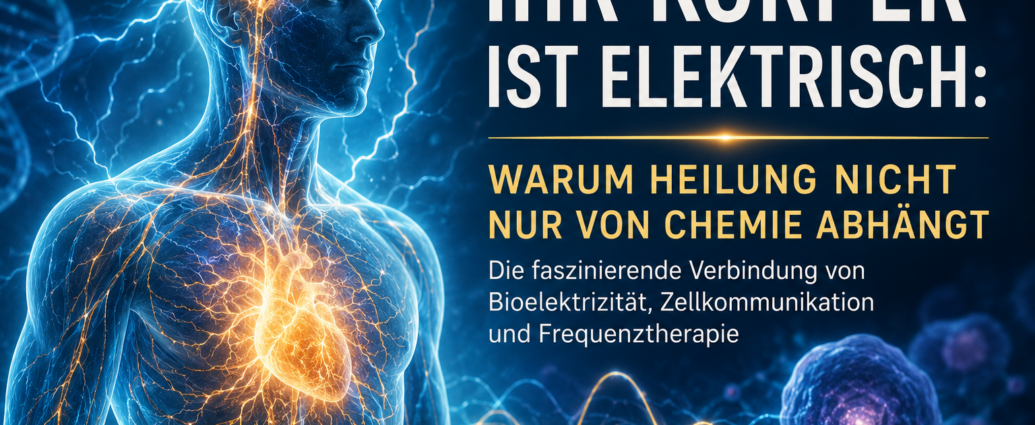
Your body is electric: Why healing isn't just about chemistry
When we talk about health, illness, and healing, many people first think of chemistry: hormones, enzymes, signaling molecules, inflammatory mediators, vitamins, minerals, and medications. This way of thinking has had a profound influence on modern medicine—and it is important. Without biochemistry, we would not be able to understand metabolism, the immune system, the Digestion, have little understanding of cell division or the effects of many medications.
But the human body is not just a chemical system. It is also an electrical system.
Every nerve cell functions electrically. Every heartbeat is coordinated by electrical impulses. Every muscle movement requires electrical stimulation. Every cell has an electrical potential across its membrane, known as the membrane potential. And research is increasingly showing that electrical and bioelectrical signals are not merely byproducts of life, but can influence biological order, cell behavior, wound healing, development, and regeneration. Review articles on Bioelectricity describe how the body's own stress gradients are related to growth, development, wound healing, and regeneration.
This means that healing is not just a matter of the right chemical substance. Healing is also a matter of communication, order, tension, rhythm, and Information.
It is precisely here that modern research into bioelectricity also touches on key concepts of Frequency therapy and Information medicine: The body is not a passive object controlled solely by chemical molecules. It is a dynamic, oscillating, electrically active regulatory system.
1. The cell as an electrical unit
Every living cell is surrounded by a membrane. This cell membrane separates the interior of the cell from its surroundings. This creates a difference in the distribution of charged particles—such as sodium, potassium, calcium, chloride, and other ions.
This difference generates an electrical voltage. This is referred to as membrane potential.
The membrane potential is not only important in nerve cells. Skin cells, immune cells, stem cells, connective tissue cells, bone cells, and tumor cells also possess electrical properties. Changes in the membrane potential can influence how cells grow, migrate, divide, differentiate, or communicate with one another. A scientific review article describes how changes in electrical potentials across cell membranes influence many cellular processes and can also affect membrane proteins and enzymes.
This is a crucial point: the cell is not merely a small chemical reactor. It is also an electrically polarized information system.
Or, to put it more simply:
A healthy cell doesn't just have a metabolism—it also has tension.
2. Bioelectricity: The Language Between Chemistry and Information
Bioelectricity refers to the electrical processes that occur in living organisms. These include nerve impulses, heart rhythms, muscle activity, cell membrane potentials, and electrical fields in tissues.
We are familiar with these phenomena from medical diagnostics:
- The ECG measures the heart's electrical activity.
- The EEG measures electrical activity in the brain.
- The EMG measures electrical activity in the muscles.
- Nerve conduction velocities indicate how efficiently electrical signals are transmitted within the nervous system.
But bioelectricity goes deeper than that. It doesn't just involve the large, measurable signals from the heart, brain, and muscles. It also involves the behavior of individual cells and entire clusters of cells.
Developmental biologist Michael Levin and other researchers describe bioelectricity as a regulatory principle involved in embryonic development, regeneration, and possibly also in cancer processes. In a review article in Cell Bioelectricity is described as a signaling network that operates on multiple levels—from individual cells to tissues, and on to the body’s form and regeneration.
This changes the way we view the body:
It is not only genes and molecules that determine what a cell does. Electrical states and bioelectrical patterns can also play a role.
3. Healing begins with communication
Healing is a highly complex process. When tissue is injured, many biological processes must be coordinated:
Cells must recognize that damage has occurred. Inflammatory cells must reach the right location. Connective tissue cells must migrate. New blood vessels must form. Skin cells must close the wound. The immune system must cleanse the area but not overreact. Repair processes must begin—and later be slowed down again.
It's all about communication.
Traditionally, this communication has been explained primarily in biochemical terms: through cytokines, growth factors, hormones, enzymes, and immune messengers. However, research on wound healing shows that the body’s own electrical fields may also play a role. Injuries generate so-called injury currents and electric fields that can influence cell orientation and migration. A review article describes these injury-induced currents as important signals for tissue repair and regeneration.
That doesn’t mean chemistry isn’t important. On the contrary: chemistry and electricity are closely linked. Ions are chemically charged particles. Cell membranes are chemical structures with electrical functions. Enzymes respond to electrical environments. Nerve impulses are based on ionic currents.
The real insight, therefore, is not: chemistry or electricity.
But rather: Chemistry and electricity together form the language of life.
4. Why the body can respond to frequencies
Wherever electrical processes occur, frequencies also play a role.
An electrical impulse has a temporal profile. The heart beats rhythmically. The brain operates within measurable frequency ranges. Nerves fire in patterns. Muscles respond to impulses. Cells are embedded in electrical and electromagnetic environments.
Frequency basically means: repetitions per unit of time. In biological systems, rhythms are found everywhere:
- Heart rhythm
- Breathing rhythm
- Sleep-wake cycle
- Brain waves
- hormonal cycles
- Cell division rhythms
- Metabolic rhythms
- patterns of electrical activity
The body, then, is not static. It is organized rhythmically.
From the perspective of frequency therapy, this concept is central: if biological systems are rhythmically and electrically active, then organized frequency pulses can, in principle, have a regulatory effect. However, it is important to make a very careful distinction: not every frequency automatically has a therapeutic effect. Not every electrical signal is beneficial. The effect depends on intensity, frequency, duration, tissue type, initial condition, and biological context.
But the basic idea that electrical or electromagnetic pulses can influence biological processes is not far-fetched. In medicine, electrical or electromagnetic methods are already being studied or applied in certain areas, such as bone healing, wound healing, neuromodulation, or pain management. Reviews on pulsed electromagnetic fields describe, among other things, applications and research in the field of bone and cartilage tissue.
Frequency therapy is thus part of a broader biophysical context: life is not merely matter, but also movement, charge, tension, rhythm, and information.
5. The Wound as an Electrical Event
A wound is not just mechanical damage. It is also a bioelectrical event.
When skin or tissue is injured, the electrical properties of the tissue change. Cells at the wound edge respond to chemical and electrical signals. Certain cells can orient themselves along electrical fields—a phenomenon known as galvanotaxis or electrotaxis.
Recent studies on electrical stimulation in wound healing suggest that electrical signals can influence the migration, proliferation, and activity of cells involved in tissue repair. A recent review from 2025 describes electrical stimulation as a research and therapeutic approach for chronic wounds, discussing its effects on both healing processes and the risk of infection.
This is particularly interesting in the case of chronic wounds. Chronic wounds are often characterized by the body getting stuck in an incomplete healing phase. Communication is disrupted. Inflammation, blood flow, metabolism, cell migration, and tissue regeneration are not harmoniously coordinated.
This illustrates why a purely chemical model sometimes falls short. A wound needs more than just substances. It needs order. It needs direction. It needs an environment in which cells know what to do.
Bioelectrical signals could be part of this orientation.
6. Cancer and Bioelectricity: A Cautious but Important Look
When it comes to cancer, particular care is required. Cancer is a complex group of diseases involving many biological, genetic, immunological, metabolic, and environmental factors. No serious analysis should reduce cancer to a single mechanism.
At the same time, research on bioelectricity suggests that the electrical states of cells and tissues may be linked to cell behavior, growth, differentiation, and de-differentiation. Michael Levin and other researchers also discuss bioelectric signaling networks in the context of cancer, particularly the question of how cells lose their connection to the tissue network and can decouple. In the scientific literature, bioelectricity is discussed, among other things, as a regulatory level in embryogenesis, regeneration, and cancer.
That does not mean that frequency therapy can cure cancer. Such a claim would be unfounded and unsupported by scientific evidence.
But it means that the question of how electrical cell states, tissue communication, membrane potentials, and regulatory patterns are related to pathological cell behavior is scientifically relevant.
From the perspective of information medicine, cancer is therefore of interest not only as a „cell division problem,“ but also as a problem involving disrupted order, communication, and regulation. It is precisely here that biophysical considerations can open up new avenues of thought—always as a complement to, and never as a substitute for, oncological diagnosis and therapy.
7. Why chemistry alone doesn't explain everything
Modern biomedicine has made enormous strides thanks to a chemical approach. Antibiotics, anesthesia, hormone therapies, chemotherapy, immunotherapies, enzyme diagnostics, and laboratory analyses would be impossible without an understanding of biochemistry.
But the deeper our understanding of the body becomes, the clearer it becomes that chemistry alone is not the whole History.
Here’s an example: Two cells can have the same genes but perform different functions. A skin cell, a nerve cell, and a muscle cell all carry essentially the same DNA, yet they behave completely differently. Why? Because information is interpreted, organized, and regulated differently.
This regulation occurs through biochemical, mechanical, and electrical mechanisms, and likely also through other biophysical processes.
The question is therefore not just:
What substances are present?
But also:
How are they organized?
What signals do the cells receive?
What is the voltage?
Which rhythms dominate?
Which communication channel is disrupted?
What kind of order can be restored?
This is a fundamentally different perspective on healing.
8. The Body as a Field of Information
The term „information medicine“ describes the idea that the body is not merely composed of matter, but that order, communication, and information play a central role in health and disease.
This can also be explained from a biological perspective. A cell must constantly process information:
- Is there enough oxygen?
- Are there any signs of inflammation?
- Do I have to split myself in two?
- Do I have to rest?
- Do I have to go hiking?
- Do I have to specialize?
- Am I part of a healthy tissue network?
- Do I need to initiate a repair process?
This information is not transmitted solely through chemical means. It also manifests itself in electrical voltages, charge distributions, membrane potentials, mechanical forces, light reactions, temperature differences, and vibration patterns.
The body is therefore not like a machine made up of individual replacement parts. It is more like an orchestra. Chemical substances are the instruments. Electrical and rhythmic signals are part of the score. Healing does not simply mean replacing an instrument, but rather restoring harmony to the ensemble.
9. Frequency therapy as a regulatory stimulus
Frequency therapy is an approach that uses vibrations, frequencies, or electromagnetic pulses to support the body’s natural regulatory processes. The focus is not on the idea that a frequency mechanically „repairs something,“ but rather that it can provide a stimulus to which a living system responds.
A living system is always active. It receives stimuli, processes them, and responds to them. This response can vary greatly from one individual to another.
Therefore, from the perspective of information medicine, frequency therapy is not a simple cause-and-effect model. Rather, it is a dialogue with the body’s regulatory system.
It is important to use responsible language in this context: Frequency therapy is not a substitute for conventional medical diagnosis or treatment. It can be viewed as a complementary approach—one that focuses on order, regulation, vibration, and bioenergetic processes.
A thorough medical evaluation is essential, especially in cases of serious illnesses such as cancer, chronic inflammation, neurological conditions, or chronic fatigue.
10. Electrical Activity and the Nervous System
The nervous system is the body’s most obvious electrical system. Thoughts, movements, sensory perceptions, pain, muscle tension, heart rate regulation, and stress responses are closely linked to electrical activity.
Stress clearly demonstrates just how closely electrical and chemical processes are linked. When the body is in a state of alarm, the activity of the autonomic nervous system changes. Heart rate, breathing, muscle tension, hormone release, and immune activity all change.
A chronically activated stress response can hinder healing processes. This is not only because stress hormones have a biochemical effect, but also because the body operates in a different electrical and rhythmic state.
Relaxation, sleep, breathing, meditation, music, light, touch, and rhythmic stimuli can therefore be more than just pleasant complementary measures. They can influence the body’s regulatory system.
Here, too, it becomes clear that healing requires not only substance, but also rhythm and regulation.
11. Music, Light, and Frequency: Why the Body Resonates
Humans respond to vibrations. Music can have a calming or energizing effect. Light influences the sleep-wake cycle. Sounds can affect emotions. Rhythmic stimuli can help coordinate movement. Breathing rhythms influence heart rate variability and autonomic balance.
All of this shows that the body is capable of resonating.
Resonance does not imply mystical arbitrariness. Resonance means that a system can be particularly sensitive to certain stimuli when they align with its internal dynamics.
Frequency therapy takes this idea a step further: since cells, tissues, and organs possess electrical and rhythmic properties, targeted frequency pulses could be viewed as regulatory stimuli.
From a scientific perspective, a great deal of distinction is needed here. Some methods have been studied more thoroughly than others. Some applications belong in clinical medicine, while others fall under the umbrella of complementary medicine. However, the basic idea—that biological systems respond to physical stimuli—is easy to understand.
12. Healing as the Restoration of Order
If we view healing solely from a chemical perspective, we focus primarily on substances: What is missing? What is present in excess? Which neurotransmitter is elevated? Which medication can address this?
If we also consider healing from a bioelectrical perspective, other questions arise:
- Is cell communication functioning properly?
- Are there any issues with the electrical voltage?
- Is the tissue in a regenerative state?
- Are there any chronic patterns of inflammation or stress?
- Can rhythmic or frequency-based stimuli help with regulation?
- How well can the body switch between exertion and recovery?
This broadens our perspective. It does not replace conventional medicine, but rather complements it with a biophysical perspective.
Healing is not merely about treating a symptom, but about restoring the body's ability to regulate itself.
13. Why this perspective is important for the future
The medicine of the future will likely not be exclusively chemical. It will combine chemical, genetic, immunological, electrical, mechanical, digital, and information-based approaches.
We are already seeing this trend today:
- Electrical stimulation in neuromodulation
- Electromagnetic Research in Bone Healing
- Bioelectrical research on wound healing
- Light Therapy and Photobiomodulation
- Brain stimulation
- Cardiac Rhythm Diagnostics
- wearable sensors for measuring biological signals
- Research on Cell Tension and Regeneration
This shows that the body is increasingly understood as a dynamic information system.
Frequency therapy operates within this broader conceptual framework. It doesn’t just ask: What substance is missing? It also asks: What information, what frequency, what rhythm, what order can support the system?
14. A New View of Humanity
The statement „Your body is electric“ is not a metaphor. It is a biological fact.
You are not just skin, bones, muscles, blood, and organs. You are a highly complex field of electrical voltages, ionic currents, frequencies, rhythms, chemical signals, light reactions, information patterns, and consciousness.
Every heartbeat is triggered by an electrical impulse. Every thought involves electrical activity. Every movement requires nerve impulses. Every cell depends on electrical activity. Every healing process requires communication.
Once we understand this, our perspective on health changes.
Health isn't just a lab result.
Health is order.
Health is rhythm.
Health is communication.
Health is the ability to regulate oneself.
And healing isn't just about altering chemistry. Healing is also about restoring harmony to the body's living electrical orchestra.
Conclusion: Healing is chemistry, electricity, and information
The human body is a chemical marvel. But it is also an electrical and information-processing system. Modern research on bioelectricity shows that electrical signals can play an important role in development, wound healing, regeneration, and cell behavior.
This opens up a fascinating prospect for frequency therapy and information medicine: if the body is organized electrically and rhythmically, then frequencies can be understood as regulatory impulses—not as a substitute for medical treatment, but as a complementary approach to order, communication, and self-regulation.
The key message is:
Your body doesn't heal solely through chemistry. It heals through communication. And part of that communication is electrical.
Note
Frequency therapy is not recognized by conventional medicine and cannot replace diagnosis, treatment, or therapy provided by licensed physicians, alternative practitioners, or other medically qualified professionals. A medical evaluation should always be sought, particularly in cases of serious illnesses such as cancer, chronic conditions, acute symptoms, or unclear signs of illness.
Comments are closed, but trackbacks and pingbacks are open.