





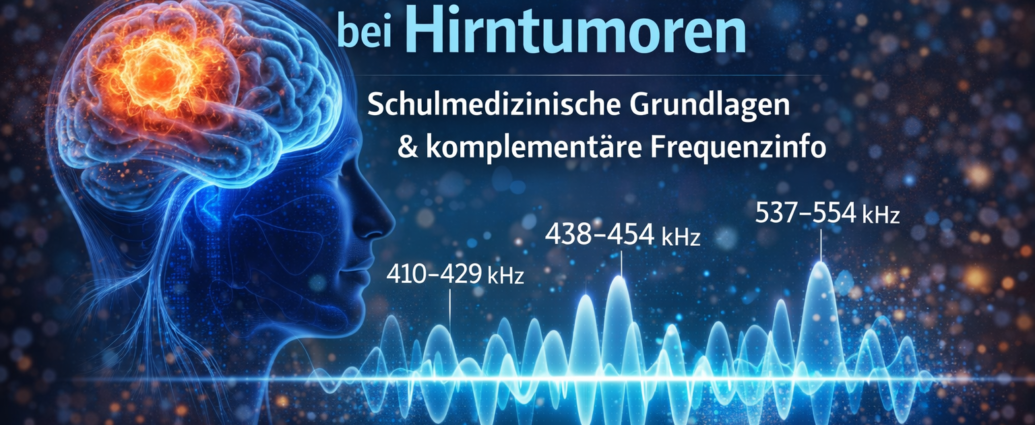
Conventional medical principles and complementary frequency information
Author: NLS Information medicine Ltd, Herbert Eder
Introduction
Brain tumors are among the most complex clinical pictures in medicine. They differ not only in their biological nature, but also in their location, their growth, their influence on the surrounding tissue and their effect on the entire nervous system. Some brain tumors grow slowly and remain relatively localized over a long period of time, while others develop highly aggressively, infiltrate neighbouring structures and quickly lead to severe neurological deficits.
In the literature, a clear distinction is made between benign and malignant brain tumors. For conventional medicine Practice this separation is of great importance because it significantly influences diagnostics, treatment planning and prognosis. At the same time, many people in the field of Frequency therapy and information medicine for complementary considerations that deal with resonance patterns, tissue information and complementary frequency ranges.
In the following, the focus is initially on the conventional medical aspects of brain tumors. This is followed by the complementary Frequency info with the resonance areas of individual brain tumor forms described in the literature.
What are brain tumors?
Brain tumors are abnormal tissue formations within the brain, the adjacent meninges or related structures inside the skull. They can be benign or malignant changes. Even if benign tumors do not metastasize, they can cause considerable problems in the brain, as even a limited mass inside the skull can exert pressure on sensitive structures.
The brain is located in a rigid bony space. Therefore, any additional tissue mass can lead to an increase in intracranial pressure. This is a particular danger of brain tumors: even slow-growing or histologically benign changes can have serious neurological consequences if they displace important brain regions or exert pressure on cerebrospinal fluid pathways, nerve tracts or vessels.
Benign brain tumors from a conventional medical perspective
Benign brain tumors consist of abnormal but non-metastatic tissue. Despite their benign nature, they can cause considerable discomfort if they are located in sensitive regions or affect brain structures as they grow.
Schwannome
Schwannomas develop from Schwann cells that envelop nerve fibers. This type of tumor often affects areas where nerves run through narrow anatomical structures. Depending on the location, hearing disorders, dizziness, balance disorders or pressure symptoms can occur.
Ependymomas
Ependymomas originate from cells that line the inner surfaces of certain ventricles of the brain. The literature describes them as frequently occurring in the fourth ventricle in children, whereas in adults they are more likely to occur in other ventricular regions or in the spinal cord. Their location makes them particularly clinically relevant because they can obstruct the flow of cerebrospinal fluid and thus lead to increased pressure in the skull.
Meningiomas
Meningiomas develop from the meninges. They usually grow slowly, but can go unnoticed for a long time due to their location. As they grow in size, they often cause headaches, focal neurological deficits or pressure symptoms.
Adenomas
Adenomas develop from glandular tissue. Pituitary adenomas are particularly well known. These can initially become noticeable through visual disturbances because they are located close to the visual pathway. Typical symptoms are restrictions of the visual field, progressive visual disturbances and hormonal abnormalities. With further growth, eye muscle disorders or other neuroendocrine changes can also occur.
Osteomas and hemangioblastomas
Osteomas originate from bony structures of the skull, hemangioblastomas from vascular structures. Even though these tumors are rarer, they show how different the tissues of origin within the skull can be.
Congenital brain tumors
Certain benign tumor forms can already be present at birth. In the literature, these include craniopharyngiomas, chordomas, germinomas, teratomas, dermoid cysts and angiomas. Such changes underline the fact that brain tumors can play a role not only in adulthood, but also in childhood and even congenitally.
Malignant brain tumors and their special features
Malignant brain tumours are characterized by the fact that they destroy adjacent tissue, grow infiltratively or enter the brain as metastases from other parts of the body. In conventional medicine, a distinction is made between primary and secondary brain tumors.
Metastases in the brain
The most common malignant tumors in the brain are Metastases. They originate from other organs and reach the brain via the bloodstream. Such metastases can occur as a single focus or affect several regions of the brain simultaneously. In many cases, the neurological symptoms depend on both the brain findings and the original tumor disease.
Primary brain tumors
Primary brain tumors develop directly in the brain. These are particularly common Gliomas. These develop from tissues that surround, support or functionally accompany nerve cells. Some gliomas grow slowly, others have a highly malignant behavior.
Gliomas, astrocytomas and glioblastomas
Gliomas
Gliomas form an important group of primary brain tumors. They arise from glial structures and can occur in different forms. Their aggressiveness varies significantly depending on their biological behavior.
Astrocytomas
Astrocytomas can occur in many areas of the brain and also in the spinal cord. Common localizations are the cerebrum, cerebellum, thalamus, optic chiasm and pons. These tumors often grow infiltratively and slowly, but can lead to large cavities or pseudocystic changes as they progress. In individual cases, calcification is described. Histologically, differently differentiated forms of astrocytes are found.
Astrocytomas can progress relatively slowly over a long period of time. Nevertheless, even a slowly growing Tumor can become dangerous if it increases intracranial pressure or affects central functional regions. Typical symptoms include headaches, slowed thinking, nausea, visual problems and neurological deficits.
Anaplastic astrocytoma and glioblastoma
The more aggressive forms are the anaplastic Astrocytoma and especially glioblastoma. Glioblastoma multiforme is a highly malignant brain tumor that can penetrate deep into the surrounding brain tissue and is often only diagnosed at an advanced stage. It can be highly vascularized and often shows necrosis, bleeding, cell proliferation and pronounced tissue destruction.
Glioblastoma in particular can quickly lead to a considerable increase in intracranial pressure. The consequences range from severe headaches and cognitive slowdown to impaired consciousness, drowsiness and, in severe cases, coma.
Other important forms of brain tumor
Oligodendrocytomas
Oligodendrocytomas are comparatively rare. They are often described as rather soft, compact tumors and often tend to calcify. Some tumors exhibit mixed forms with astrocytic components.
Ependymoblastomas
Ependymoblastomas are described in the literature as mostly solitary tumor masses that can occur primarily in one cerebral hemisphere of adults. They are thought to originate from the wall of the lateral ventricle.
Reticulum cell sarcoma
Reticulum cell sarcoma can occur primarily in the brain and often shows similar clinical symptoms to glioblastoma. The literature emphasizes that, unlike some other tumours, it can be radiosensitive.
Medulloblastomas
Medulloblastomas are rare tumors that particularly affect children before puberty. Due to their biological aggressiveness and their location at the back of the skull, they are of high clinical relevance.
Sarcomas and adenocarcinomas in the brain
Sarcomas and Adenocarcinomas are among the more unusual types of cancer inside the skull. They arise from cells that do not belong to the classic nerve cell or glial cell series and therefore have their own biological characteristics.
Why even benign brain tumors can be dangerous
In the brain, it is not only the histology that is decisive, but also the location. A benign tumor in an unfavorable location can be life-threatening if it presses on vital centers, vascular structures, the brain stem or cerebrospinal fluid pathways. For this reason, the interplay of growth type, location, size and biological behavior is always decisive for brain tumors.
A central problem is the intracranial hypertension, i.e. the increase in pressure inside the skull. If the pressure rises critically, serious complications can arise, including the displacement of brain tissue. Such conditions are among the most dangerous emergencies in neuro-oncology.
Pseudotumor cerebri and hypertensive encephalopathy
Not every situation with symptoms of intracranial pressure is a classic tumor. The literature also describes conditions that can cause tumor-like symptoms.
Pseudotumor cerebri
In pseudotumor cerebri syndrome, those affected often complain of headaches lasting weeks, papilledema, slight constriction of the visual field and enlarged blind spots. They may also experience dizziness, double vision or sensory disturbances. A disturbance of the cerebrospinal fluid outflow or venous outflow conditions is discussed. Clinically, it is important to note that increased intracranial pressure can exist even without a real tumor.
Hypertensive encephalopathy
A severe blood pressure derailment can also cause symptoms that resemble a brain tumor. These include headaches, seizures, confusion, drowsiness and, in extreme cases, coma. There are also signs of vascular and organ damage. This differential diagnosis is essential in conventional medical clarification.
Typical symptoms of a brain tumor
The symptoms of brain tumors depend heavily on the location, speed of growth and size. Common symptoms are
- Headache
- Dizziness
- Balance disorders
- Coordination problems
- Double vision
- Nausea and vomiting
- Concentration disorders
- slowed thinking
- Seizures
- Visual disturbances
- Changes in consciousness
- Pressure fluctuations and vegetative complaints
In the case of metastases, there may be additional symptoms from the original tumor disease.
Diagnostics of brain tumors
The conventional medical diagnosis is based on the symptoms, the clinical neurological examination and imaging procedures. These are particularly important:
CT
The Computer tomography often serves as a quick initial examination, especially in emergency situations.
MRI
The Magnetic resonance imaging is particularly valuable for the detailed imaging of brain tumors. It shows the location, extent, edema and often also characteristic differences between different tumor forms.
X-ray
In certain cases, calcifications or bony changes may become visible, even if X-rays only play a supplementary role today.
The exact classification of a brain tumor is then based on further examinations, follow-up checks and, if necessary, histological findings.
Conventional medical treatment of brain tumors
The therapy depends on the location, size, type of tumor and general condition. If possible, surgical removal is attempted. Other forms of treatment may also be necessary.
Operation
Surgical removal is often the most important measure if the tumor is accessible and the operation appears neurologically justifiable.
Radiotherapy
Depending on the type of tumor, radiation may be used, for example for residual tumors, findings that cannot be completely removed or particularly radiosensitive tumors.
Concomitant drug therapy
Corticosteroids are often used for intracranial pressure, edema or inflammatory reactions. In addition, diuretic medication can help to reduce the pressure.
Further oncological measures
Depending on the type of tumor, further specific procedures may be necessary, including combined treatment concepts.
The prognosis depends on many factors. Slow-growing meningiomas or astrocytomas can persist for years, while aggressive tumors such as Glioblastomas, medulloblastomas or multiple brain metastases usually progress much more rapidly.
Why brain tumors are particularly interesting for frequency therapy
Frequency therapy deals with the question of whether biological processes can be described by characteristic oscillation and resonance patterns. In the area of brain tumors, this topic is particularly interesting because the brain is not only a highly complex organ, but also works in an extremely finely regulated manner in terms of electricity, biochemistry and information.
Within information medicine, it is therefore often assumed that certain tissue changes can also be viewed on a complementary resonance level. This is precisely where frequency lists come into play. They are described in the literature as resonance areas of individual tumor forms and are used in the context of frequency therapy as complementary frequency info understood.
This is not about isolated numbers, but about resonance fields that are considered within a complementary approach. This perspective is particularly exciting for many users when it comes to brain tumors, because structure, function, pressure ratios, electrical activity and complex regulatory processes are closely linked.
Frequency info - complementary resonance frequencies for brain tumors
The following are those mentioned in the literature complementary resonant frequencies of individual brain tumor forms:
Astrocytoma
343, 354, 436, 438, 450, 453-454 kHz
Glioma
438-448, 476, 554 kHz
Glioblastoma
328, 339, 368, 372, 402-409, 416-429, 438-439, 444, 459, 472-476, 513, 544, 554, 557-560 kHz
Droglioma
436 kHz
Meningioma
390, 546-548 kHz
Ependymoma
440-446, 464-470, 537 kHz
Pituitary adenoma
426-438 kHz
Ependymoblastoma
426-438, 440-446, 464-470, 537 kHz
Reticulum cell sarcoma
335-338, 470-471, 500-506, 510-515, 542-550 kHz
Classification of the complementary frequency ranges
It is striking that some frequency windows overlap in several tumor shapes. The following resonance zones are particularly interesting:
- 426-438 kHz
- 438-446 kHz
- 464-470 kHz
- 470-476 kHz
- 500-515 kHz
- 542-554 kHz
In frequency therapy, such clusters are referred to as complementary are considered significant because they may indicate common resonance patterns among different types of brain tumors. In particular, the areas around 436 to 446 kHz, 470 to 476 kHz and 542 to 554 kHz act like superordinate resonance clusters in the literature.
It is precisely this condensation that is interesting for information medicine: not only the individual tumor name, but also the recurring frequency pattern is regarded as complementary frequency information.
Frequency info compact
Astrocytoma: 343, 354, 436, 438, 450, 453-454 kHz
Glioma: 438-448, 476, 554 kHz
Glioblastoma: 328, 339, 368, 372, 402-409, 416-429, 438-439, 444, 459, 472-476, 513, 544, 554, 557-560 kHz
Droglioma: 436 kHz
Meningioma: 390, 546-548 kHz
Ependymoma: 440-446, 464-470, 537 kHz
Pituitary adenoma: 426-438 kHz
Ependymoblastoma: 426-438, 440-446, 464-470, 537 kHz
Reticulum cell sarcoma: 335-338, 470-471, 500-506, 510-515, 542-550 kHz
Conclusion
Brain tumors cover a broad spectrum from benign to highly malignant diseases. For conventional medicine, precise diagnostics, imaging, neurosurgical assessment, pressure monitoring and differentiated therapy planning are of primary importance. Location, growth, depth of infiltration and the influence on intracranial pressure are particularly important.
For frequency therapy, the topic of brain tumors also opens up a complementary view of resonance patterns and tissue information. The frequency ranges of astrocytoma, glioma, glioblastoma, meningioma, ependymoma, pituitary adenoma and other tumor forms described in the literature form supplementary frequency information within information medicine, which is of particular interest in the context of frequency therapy.
The recurring resonance clusters in particular show that different forms of brain tumors can be viewed not only morphologically, but also on a complementary frequency level. This creates an in-depth perspective on frequency therapy and brain tumors, which is particularly exciting for many readers and users.


Comments are closed, but trackbacks and pingbacks are open.