





Symptoms, diagnostics and complementary frequency information
Author: NLS Information medicine Ltd, Herbert Eder
Introduction
Gliomas are among the most significant tumor diseases of the central nervous system. They are described in the literature as primary brain tumors that can take very different courses depending on their location, growth pattern and biological aggressiveness. Brain stem gliomas and optic gliomas are particularly complex because they develop in highly sensitive anatomical regions and can impair neurological functions at an early stage.
For conventional medicine, the main focus of gliomas is on precise localization, imaging, neurological deficits and therapeutic planning. At the same time, the topic is also important for Frequency therapy and information medicine, because in addition to the structural tumor characteristics, the literature also describes complementary resonance areas and accompanying infectious stresses.
In the following WordPress article, the focus is initially on the conventional medical basics of gliomas. Only in the last section does the Frequency info with the complementary frequency ranges mentioned in the literature.
What is a glioma?
A Glioma is a Tumor, which originates from glial cells or glial cell rows. Glial cells perform numerous tasks in the nervous system, including supporting functions, metabolic support, protection and regulation of the neuronal environment. If a tumor develops from these cell lines, it can have considerable neurological effects depending on its location.
In the literature, glioma is described not only according to its cell line, but also according to several other criteria:
- Place of origin of the tumor
- Exact localization
- Direction of growth
- Expansion
- Degree of brain stem enlargement
- exophytic growth
- Presence of cysts
- Necrosis
- Bleeding
- Hydrocephalus
It is precisely these characteristics that determine how a glioma manifests itself clinically and how great its influence on neighboring structures is.
Brain stem gliomas - special location, special challenge
Brain stem gliomas are primary brain tumors in the area of the brain stem. This area lies between the aqueduct and the fourth ventricle and contains numerous vital nerve pathways, core areas and regulatory centers. Even small tumors here can lead to considerable neurological deficits.
In the literature, brain stem gliomas are divided into several groups according to their anatomical location:
Diffuse intrinsic pontine gliomas
This form is located in the area of the pons and usually has the most unfavorable prognosis. Precisely because the pons contains many central connecting pathways, diffuse tumors can be particularly troublesome there.
Tectal gliomas
These tumors are located in the area of the tectum. A typical consequence can be the narrowing of the fourth ventricle or the cerebrospinal fluid ducts with the development of hydrocephalus.
Cervicomedullary gliomas
This form affects the junction between the brain stem and the upper spinal cord. Both cranial nerve functions and long motor and sensory pathways can be impaired here.
The prognosis for intrinsic pontine gliomas is described in the literature as more severe than for tectal or cervicomedullary forms.
Optic gliomas - gliomas of the optic nerve
Optic glioma is described in the literature as the most common primary neoplasm of the optic nerve. It not only affects visual function, but can also affect other adjacent structures through further growth.
Benign optic gliomas
The less aggressive form mainly affects children. It often progresses more slowly, but can still lead to visual impairment and functional limitations.
Aggressive optic gliomas
The more aggressive variant is more likely to affect adults and can take a severe course despite treatment.
A typical early sign is the Decrease in visual acuity of the affected eye. Further symptoms may occur as the tumor progresses. Particularly in young patients, a painless proptosis described. These are often added later:
- Optic atrophy
- Further increasing visual deterioration
- Nystagmus
- Symptoms due to chiasm compression
- Hypothalamic complaints such as changes in appetite or sleep
- Obstructive hydrocephalus with a large mass
The literature also describes that optic gliomas can develop in stages: initially as generalized hyperplasia of glial cells in the nerve, later with increasing disorganization and loss of normal neural structures.
Typical symptoms of gliomas
The symptoms of a glioma depend greatly on its location, size and rate of growth. The following symptoms in particular are mentioned in the literature:
- Double vision
- Headache
- Nausea
- Vomiting
- Drooping eyelids or lack of facial control
- Weakness
- Tiredness
- Papilledema
- epileptic seizures
What is particularly striking is that these symptoms can sometimes develop slowly and insidiously. In some cases, they may go unnoticed for months. In the case of rapidly growing, higher-grade tumors, however, the onset can also be abrupt.
Symptoms near the brain stem
When pontine or cervicomedullary regions are affected, cranial nerve disorders and signs of the long tracts are often seen. These can include motor deficits, coordination disorders and changes in sensitivity.
Symptoms of tectal gliomas
Here, the cerebrospinal fluid outflow disorder with hydrocephalus is often in the foreground. This results in headaches, nausea and vomiting.
Symptoms of optic gliomas
In addition to visual disturbances and proptosis, chiasm symptoms, nystagmus or hypothalamic changes may also occur.
Why the location of the glioma is so crucial
In the case of gliomas, the anatomical location plays a key role in determining the clinical picture. The brain stem and visual pathway are among the most sensitive regions of the nervous system. Even small lesions there can impair functions that are important for vision, eye movement, facial motor skills, swallowing, balance, sleep regulation or autonomic control.
Large lesions can also compress the third or fourth ventricle. This can cause a obstructive hydrocephalus which is accompanied by headaches, nausea, vomiting and increasing pressure. This pressure dynamic is a key issue in the conventional medical assessment of gliomas.
Possible biological and infectiological connections
In the literature, brain stem gliomas and optic gliomas are also described in connection with combined biological stresses. These include in particular
- Mycoplasma species
- HPV
- HTLV
- Other infectious factors
These relationships are described in the literature as possible contributing components of tumor development. This is of particular interest in the field of frequency therapy because not only the tumor itself, but also possible accompanying biological stresses are included in complementary considerations.
Diagnosis of gliomas
The diagnosis of a glioma is based on neurological assessment and modern imaging. The following procedures in particular are mentioned in the literature:
MRI
The Magnetic resonance imaging is the central method for visualizing gliomas. It shows the location, extent, accompanying edema, cerebrospinal fluid influence and the relationship of the tumor to adjacent structures very precisely.
PET
Positron emission tomography can provide additional information about metabolic activity and functional properties of the tumor tissue.
Surgery and biopsy
In selected cases, surgical securing or Biopsy, to confirm the diagnosis histologically and to plan further therapy in a targeted manner.
The balance between diagnostic safety and functional protection is particularly important in the case of deep-seated or highly sensitive tumors.
Conventional medical treatment of gliomas
The therapy depends on the location, tumor type, growth behavior and general condition of the patient. The literature describes that the following procedures are usually the mainstay of treatment for brain stem gliomas and optic gliomas:
Chemotherapy
It plays a particularly important role in difficult-to-operate or functionally risky localizations.
Radiotherapy
It is a key treatment method, especially for inoperable or unfavorably located gliomas.
Neurosurgery
Surgical treatment is rarely carried out, especially if the anatomical position poses a high risk. However, it can be useful or necessary in selected situations.
Conventional medical treatment is always based on tumor biology, location and the expected functional benefit.
Glioblastoma - the aggressive form within the gliary spectrum
Glioblastoma represents the highly aggressive form within the astrocytic-gliary tumor spectrum. The literature describes significantly broader and denser resonance clusters for glioblastomas than for simpler gliomas. Clinically, glioblastoma is also usually more aggressive, infiltrative and stressful.
Characteristic are:
- Rapid growth
- Infiltration of surrounding brain tissue
- High functional impairment
- Increasing intracranial pressure
- Frequently pronounced neurological deficits
This is precisely why glioblastoma is a topic of particular importance in both conventional medicine and frequency therapy.
Why gliomas are particularly interesting for frequency therapy
Gliomas are highly relevant for frequency therapy for several reasons. Firstly, they affect central control centers of the nervous system. Secondly, not only tumor structure and growth, but also accompanying infectious factors play a role in their development and manifestation. Thirdly, gliomas and Glioblastomas several dense resonance fields, which are regarded as complementary frequency patterns within information medicine.
Frequency therapy thus expands the structural conventional medical view to include a resonance model in which tumor behavior, location, accompanying stresses and frequency patterns are considered together.
Frequency info - complementary resonance frequencies for gliomas
In the literature Gliomas following Complementary resonant frequencies called:
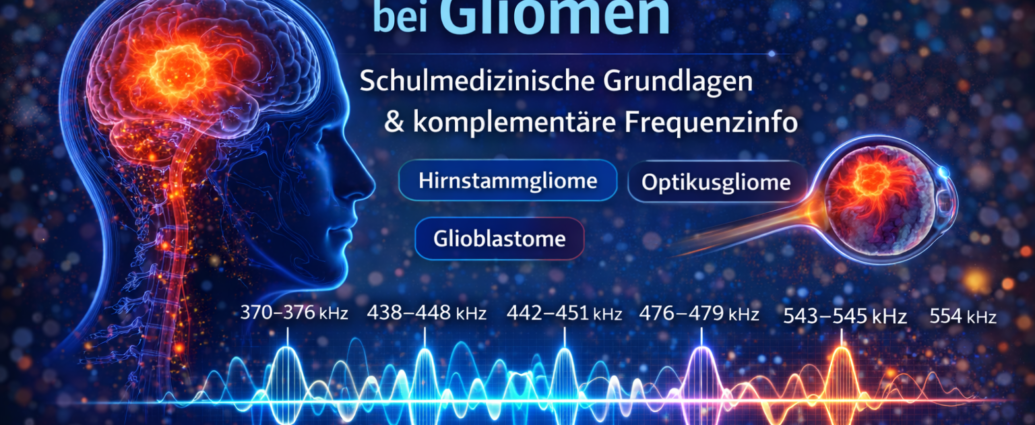
370-376 kHz (HTLV), 438-448 kHz (HPV), 442-451 kHz (Mycoplasma), 476-479 kHz (HPV), 543-545 kHz (HPV), 554 kHz
These data show several conspicuous resonance zones:
Medium resonance zone
- 370-376 kHz
Upper central resonance field
- 438-448 kHz
- 442-451 kHz
Higher resonance ranges
- 476-479 kHz
- 543-545 kHz
- 554 kHz
Particularly striking is the area between 438 and 451 kHz, as two complementary frequency windows overlap there. This compression is particularly interesting for frequency therapy.
Frequency info - complementary resonance frequencies for glioblastomas
In the literature Glioblastomas following Complementary resonant frequencies called:
328, 339, 368, 370-376 kHz (HTLV or EBV), 402-409 kHz (HPV), 418-425 kHz (HPV), 437-448 kHz (HPV), 442-451 kHz (Mycoplasma fermentans), 476-479 kHz (HPV), 512, 543-545 kHz (HPV), 554-558 kHz
This frequency list is much broader and has several dense clusters:
Lower area
- 328 kHz
- 339 kHz
- 368 kHz
- 370-376 kHz
Medium resonance field
- 402-409 kHz
- 418-425 kHz
Upper central field
- 437-448 kHz
- 442-451 kHz
Higher resonance ranges
- 476-479 kHz
- 512 kHz
- 543-545 kHz
- 554-558 kHz
Glioblastoma in particular shows a pronounced resonance pattern across several areas. Particularly striking are the clusters between 402 and 451 kHz and between 543 and 558 kHz.
Frequency info compact
Glioma - complementary resonance frequencies:
370-376 kHz, 438-448 kHz, 442-451 kHz, 476-479 kHz, 543-545 kHz, 554 kHz
Glioblastoma - complementary resonance frequencies:
328, 339, 368, 370-376 kHz, 402-409 kHz, 418-425 kHz, 437-448 kHz, 442-451 kHz, 476-479 kHz, 512, 543-545 kHz, 554-558 kHz
Complementary classification of the resonance ranges
Within frequency therapy, several focal points can be derived from the literature:
- 370-376 kHz as a recurring medium frequency range
- 402-451 kHz as a central resonance field, especially in glioblastoma
- 476-479 kHz as an overarching higher area
- 543-558 kHz as a prominent upper resonance chamber
These frequency clusters are complementary understood not only as individual frequencies, but as resonant spaces. In particular, the ranges around 438 to 451 kHz and 543 to 558 kHz appear as central condensations within the literature references.
Conclusion
Gliomas are among the most complex tumor diseases of the nervous system. Brain stem gliomas and optic gliomas in particular pose a major challenge due to their location and their influence on central neurological functions. The conventional medical approach focuses on anatomy, imaging, neurological deficits and individually adapted forms of therapy such as chemotherapy, radiotherapy and, in selected cases, surgical measures.
The topic also opens up a complementary perspective for frequency therapy. The resonance frequencies for gliomas and glioblastomas described in the literature form a structured frequency information that can be considered as a complementary aspect within information medicine. Particularly striking are the resonance fields between 370 and 376 kHz, 402 and 451 kHz and 543 to 558 kHz.


Comments are closed, but trackbacks and pingbacks are open.