





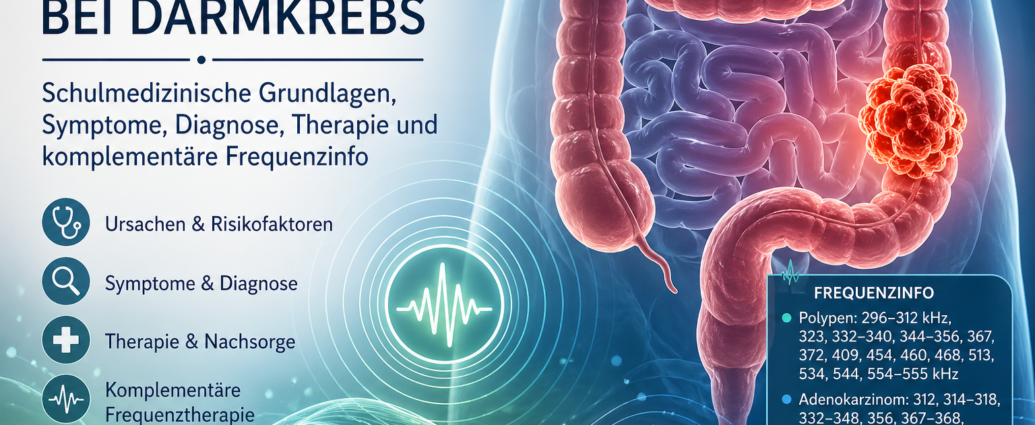
Bowel cancer is one of the most significant malignant diseases of the digestive tract. The colon is particularly affected, i.e. the section of the intestine responsible for the thickening of the stool, the reabsorption of fluid and the further processing of the intestinal contents. In medical terms, bowel cancer plays a major role because many changes can develop over a long period of time and early symptoms often remain unspecific.
The literature describes that malignant diseases of the colon are often associated with changes in the intestinal mucosa. These include polyps, adenomas, inflammatory processes and certain chronic irritations of the tissue. It is particularly important to differentiate between benign mucosal changes and structures that may have an increased risk of degeneration at a later stage.
From the perspective of Frequency therapy and Information medicine the intestine is not only seen as a digestive organ, but also as a complex regulatory field. The mucous membrane, immune system, microbiome, metabolism, tendency to inflammation and Cell communication are closely connected with each other. In this context, frequencies are considered complementary, i.e. supplementary to conventional medical diagnostics, therapy and aftercare.
Colorectal cancer frequency therapy: conventional medical classification
Bowel cancer does not usually develop suddenly, but often develops via precursors. The following play a central role in this Intestinal polyps. Not every polyp is dangerous, but certain forms may have a higher significance for the development of cancer. Adenomatous polyps in particular are regarded in medicine as possible precursors of malignant changes. Villous adenomas are assessed particularly carefully as they are more frequently associated with degeneration processes.
Congenital multiple polyposis of the colon is also considered a condition with a significantly increased risk. Numerous polyps occur here, which can greatly increase the likelihood of malignant changes. Long-standing chronic inflammatory bowel disease, in particular ulcerative colitis, can also increase the risk of cancer developing in the affected section of the bowel at a later stage.
Conventional medicine therefore focuses on early detection, regular checks, tissue examinations and the timely removal of conspicuous changes. Colonoscopy is particularly important here because polyps can be detected, assessed and often removed directly.
Colorectal cancer frequency therapy: development and risk factors
The development of bowel cancer is complex. Various influencing factors are described in the literature. These include changes in the intestinal mucosa, chronic inflammation, hereditary factors, polyp formation, cell division disorders and long-term stimuli in the intestinal tissue.
Older frequency medical presentations also mention microbiological and viral influences, which were discussed in connection with polyps and pathological mucosal changes. From today's perspective, conventional medicine considers bowel cancer to be primarily the result of genetic changes, disturbed cell regulation, inflammatory processes and individual risk factors.
Complementary frequency therapy can broaden the view of regulatory patterns. It is not about looking at individual cells in isolation, but about the interplay between tissue, the environment, the immune system, metabolism and energy levels. Information. This holistic approach is particularly important for many users of information medicine when it comes to chronic processes.
Colorectal cancer frequency therapy: polyps as possible precursors
Intestinal polyps are mucosal growths that can protrude into the intestine. Many polyps go unnoticed for a long time. Some cause no symptoms, others can bleed or lead to changes in the intestine. Digestion lead to a diagnosis. A histological examination is crucial, as this is the only way to assess whether a polyp is harmless, needs to be checked or is already critically altered.
Adenomatous polyps can change over time. This process is described in medicine as the adenoma-carcinoma sequence. An initially benign change in the mucous membrane can gradually develop into a malignant disease. The risk can vary depending on the size, tissue shape and cell changes.
In frequency therapy, polyps are seen as an indication of a disturbed order in the local tissue and mucosal environment. A complementary question that may arise here is which frequency patterns are associated with mucosal regulation, tissue stability, inflammatory tendency, lymph flow and intestinal environment.
Colorectal cancer frequency therapy: Adenocarcinoma of the colon
Adenocarcinoma is the most common form of colon cancer. It develops from gland-forming mucosal tissue. The degree of differentiation can vary greatly. Some tumors still resemble the original tissue relatively closely, while others already show clearly degenerated cell structures.
The literature describes that the degree of differentiation does not always directly correspond to the growth rate or the tendency to spread. Precise diagnostics, tissue examination, imaging and individual medical assessment are therefore particularly important.
Intestinal tumors can spread in various ways. The regional lymph node station is often affected. Spread via lymphatic channels or blood vessels is also possible. As the venous blood drainage from the intestine leads to the liver via the portal vein system, among other routes, the liver is an important location that is carefully considered when diagnosing the spread of tumors.
Colorectal cancer frequency therapy: typical symptoms
Colorectal cancer can be very inconspicuous at the beginning. Especially in the early stages, symptoms are often vague, variable or attributed to other causes. Possible symptoms include general weakness, fatigue, unintentional weight loss, loss of appetite, reduced performance or a non-specific feeling of illness.
Tumors in the area of the appendix or ascending colon can remain clinically silent for a long time. They do not always cause a narrowing of the intestinal lumen and do not necessarily lead to visible bleeding. In some cases, anemia is noticed first because small amounts of blood can be lost over a long period of time.
Tumors in the area of the sigmoid colon or lower sections of the intestine can lead to stool changes, pain, cramp-like symptoms or signs of constriction. In acute situations, this can lead to an intestinal obstruction or, in severe cases, to a perforation situation with peritonitis.
Colorectal cancer frequency therapy: diagnosis from a conventional medical perspective
The conventional medical diagnosis is based on several procedures. The physical examination, including the digital rectal examination, plays an important role. This allows changes in the rectal area to be felt.
Colonoscopy is a key diagnostic procedure. It allows direct examination of the intestinal mucosa, the removal of tissue samples and the removal of polyps. Laboratory values, tumor markers, liver values and imaging procedures can also be used.
In the literature, alkaline phosphatase, bromosulphalein retention and carcinoembryonic antigen are mentioned as diagnostically relevant parameters. Today, laboratory values are always considered in the overall picture and never evaluated in isolation.
For further evaluation, an ultrasound, Computer tomography, Magnetic resonance imaging or specialized examinations of the rectum are used. The key factor is whether the Tumor whether the cancer is localized, whether lymph nodes are affected, and whether there are signs of metastases in other organs.
Colorectal cancer frequency therapy: differentiation from other diseases
Not every bowel complaint means bowel cancer. Many diseases can cause similar symptoms. These include intestinal inflammation, diverticular disease, chronic inflammatory bowel disease, infections, endometriosis, benign tumors, carcinoids or metastases of other cancers.
Tuberculosis of the intestine or lymphatic diseases can also be described in the literature as possible differential diagnoses. Precise clarification is therefore crucial. Complaints such as blood in the stool, unintentional weight loss, persistent stool changes, unexplained anemia or severe abdominal pain must be taken seriously.
Frequency therapy does not replace this assessment, but can be integrated into a holistic care concept. Collaboration with doctors, therapists and specialized agencies is particularly important.
Colorectal cancer frequency therapy: conventional medical therapy
The therapy depends on the location, size, spread and tissue type of the tumor. Surgery is a central component of treatment for many forms of bowel cancer. The aim is to completely remove the affected section of bowel and, if necessary, to include the associated lymph nodes.
Depending on the stage, additional procedures may be used. These include chemotherapy, targeted therapies, immunotherapy or, in the case of certain localizations, radiotherapy. The exact choice depends on the individual findings.
Aftercare is also important. It includes check-ups, laboratory values, imaging, colonoscopies and the monitoring of possible relapses. Diet, exercise, bowel function, mental stability and quality of life also play an important role.
Colorectal cancer frequency therapy: a complementary approach
Frequency therapy views the human being as a regulative system. Vibration, Resonance, cell communication and energetic order. Especially in the case of complex diseases such as bowel cancer, this perspective can also be helpful in looking at the body's overall environment.
In a complementary context, the aim is not to replace conventional medical procedures. Rather, frequency therapy can be used to support regulatory processes, energetic balance, intestinal environment, lymph flow, metabolism and general stabilization.
The intestine is closely linked to the immune system. A large part of immune activity takes place in the intestinal mucosa. This is why the intestinal environment is also of particular interest in the context of frequency therapy. Frequencies can be understood here as information impulses that are geared towards resonance, regulation and energetic communication.
Colorectal cancer frequency therapy: the importance of the intestinal environment
The intestinal environment includes the mucous membrane, intestinal flora, pH value, digestive performance, inflammatory tendency, enzyme activity and immune response. A stable gut is essential for nutrient absorption, detoxification, barrier function and general well-being.
In addition, frequency therapy can be tailored to address several areas. These include energy programs for intestinal regulation, mucous membranes, the lymphatic system, liver function, inflammation balance, and overall vitality. In the Practice Often, the focus is not only on the intestines themselves, but also on the liver, the immune system, the autonomic nervous system, and emotional stress.
The body can be under considerable stress, especially in the case of serious illnesses. Operations, medication, anxiety, pain, digestive problems and exhaustion put a strain on the regulatory system. Frequencies are seen here as complementary gentle impulses that can support the body in its order.
Colorectal cancer frequency therapy: polyps and resonance patterns
In frequency therapy literature, polyps are not only seen as tissue structures, but also as an expression of certain resonance patterns. This view differs from the purely anatomical view. While conventional medicine examines the polyp histologically, frequency therapy is also interested in its energetic signature.
The specified frequency ranges can serve as a guide in a complementary setting. They are not used in isolation, but are always considered in the context of the overall picture of the person. This includes findings, resilience, digestion, mucosal behavior, immune situation and general regulatory capacity.
It is particularly important to use frequency lists responsibly. Frequencies are not a diagnosis and are not the sole basis for therapy decisions. They are part of a complementary field of information and are classified individually.
Colorectal cancer frequency therapy: adenocarcinoma and frequency patterns
Adenocarcinoma of the colon is a malignant change in the gland-forming mucosal tissue. Frequency therapy also asks which resonance areas are associated with such tissue patterns in the literature.
The frequency lists can serve as a working basis. They are used in the context of complementary support and should be considered together with conventional medical measures, laboratory values, imaging and medical follow-up.
The focus is on an integrative approach: conventional medicine takes over diagnostics, staging and tumor therapy. Frequency therapy can also focus on regulation, energetic support, stabilizing the environment and supporting quality of life.
Colorectal cancer frequency therapy: holistic support
Holistic support for bowel cancer involves more than just looking at the tumor. People experience the disease physically, emotionally and energetically. Digestive problems, fatigue, loss of appetite, weight changes, anxiety and uncertainty can have a major impact on everyday life.
Complementary measures can help to strengthen body awareness and promote self-regulation. These include an adapted diet, sufficient fluid intake, exercise within the scope of possibilities, breathing exercises, relaxation, sleep regulation and accompanying frequency therapy applications.
Frequency therapy can be used to address the following issues in particular:
- Energetic intestinal regulation
- Support of the mucosal environment
- Accompaniment of the lymph flow
- Energetic liver relief
- Vegetative stabilization
- Strengthening general vitality
- Support in case of exhaustion
- Harmonizing frequency impulses in the sense of information medicine
Colorectal cancer frequency therapy: the role of frequencies
In information medicine, frequencies are regarded as ordered vibration patterns. Every cell, every tissue and every organ is in a dynamic exchange of information. From this perspective, illness can also be understood as a disruption of order, communication and resonance.
In the case of bowel cancer and its precursors, the focus is on the tissue level of the colon, on changes to the mucous membrane, on the environment and on possible regulatory blockages. In this context, frequency lists serve as orientation for complementary applications.
The frequencies are not selected mechanically, but are embedded in a therapeutic concept. Acute stress, chronic processes, conventional medical treatments and the individual constitution are taken into account.
Frequency info: complementary frequencies for polyps
The literature mentions the following frequently found resonant frequencies in polyps of the colon:
296-312 kHz
323 kHz
332-340 kHz
344-356 kHz
367 kHz
372 kHz
409 kHz
454 kHz
460 kHz
468 kHz
513 kHz
534 kHz
544 kHz
554-555 kHz
These frequencies are considered in a complementary context and can serve as energetic orientation for polyp patterns as part of frequency therapy. It is particularly useful to integrate them into a comprehensive intestinal concept that takes into account conventional medical control, mucosal observation, the intestinal environment, nutrition and regulatory capacity.
Frequency info: complementary frequencies for adenocarcinoma
The literature mentions that in the case of Adenocarcinomas The following resonant frequencies are frequently found in the large intestine:
312 kHz
314-318 kHz
332-348 kHz
356 kHz
367-368 kHz
392-393 kHz
402-414 kHz
426-438 kHz
442-454 kHz
460-464 kHz
524-525 kHz
534-545 kHz
555-557 kHz
These frequency ranges are classified as complementary in frequency therapy. They can be understood as resonance indications that are considered in the context of the whole person, the medical diagnosis, the ongoing treatment and the individual resilience.
Conclusion: Frequency therapy for colorectal cancer
Colorectal cancer is a serious disease for which conventional medical diagnosis, early detection and treatment are key. Polyps, adenomas, chronic inflammatory bowel disease and family history in particular deserve special attention.
Frequency therapy expands the view to include the aspect of resonance, regulation and energetic information. It sees the intestine not just as an organ, but as a living field of communication between the mucous membrane, immune system, metabolism and vegetative control.
When used as a complementary therapy, frequency therapy can help shift the focus to the entire regulatory system. The frequency lists found in the literature provide additional guidance for polyps and adenocarcinomas of the colon—always as part of a responsible, holistic, and medically supervised comprehensive treatment plan.
Comments are closed, but trackbacks and pingbacks are open.