





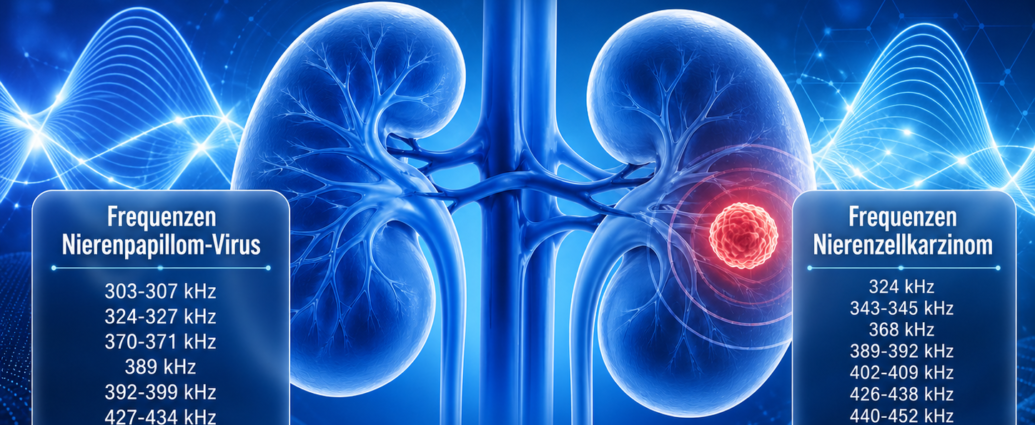
Conventional medical principles, symptoms, diagnostics and supplementary Frequency info benign and malignant tumors of the kidney
Kidney tumors are among those diseases that can go unnoticed for a long time. Benign changes to the kidney in particular often cause no symptoms and are often only discovered by chance during an imaging examination. Malignant tumors of the kidney, on the other hand, can cause very different symptoms and do not always manifest themselves through classic complaints in the urinary tract.
From a conventional medical perspective, a distinction is made between benign kidney tumors, cystic changes, congenital malformations and malignant neoplasms. In the complementary view of Frequency therapy certain frequency patterns are also discussed, which are mentioned in the literature in connection with kidney tumors, renal papillomas and renal cell carcinomas.
Frequency therapy for kidney tumors: conventional medical overview
The kidney is a highly complex organ with central importance for the water balance, the excretion of metabolic products, the regulation of blood pressure and the formation of certain hormonal signals. Tumors of the kidney can develop from different types of tissue. Some remain harmless and asymptomatic, others can grow aggressively or Metastases form.
In many cases, benign kidney tumors do not pose an immediate clinical problem. They are usually discovered incidentally, for example during an ultrasound examination, an X-ray, a CT scan, or an MRI. Benign or associated changes mentioned in the literature include, among others, renal papillomas, Lipomas, fibrolipomas, cystic changes, hydronephrosis, renal cysts, and multicystic renal dysplasia.
Malignant kidney tumors are of particular medical importance because they can remain inconspicuous for a long time. In children, the most common malignant kidney tumor is nephroblastoma, also known as Wilms' tumor. This Tumor presumably originates from embryonic kidney tissue and can contain both epithelial and connective tissue components.
In adults, renal cell carcinoma, formerly known as hypernephroma or Grawitz tumor, is the most common malignant neoplasm of the kidney. It develops from cells of the kidney tissue and can manifest itself through local spread or metastases.
Frequency therapy for benign kidney tumors
Benign kidney tumors can take various forms. They often remain asymptomatic as long as they are small and do not displace any important structures. In many cases, they are discovered during a routine examination. The conventional medical assessment is based on size, location, growth tendency and imaging appearance.
Renal cysts are one of the more common findings. Many simple cysts are harmless and only require follow-up. More complex cystic changes must be assessed more closely, as in rare cases they may indicate malignant development.
Papillomas of the kidney are described in the literature as benign epithelial changes. Even if such findings are rarely clinically conspicuous, they can be considered as part of a holistic therapy concept. In frequency therapy, certain resonance frequencies are discussed, which are not to be understood as a substitute for conventional medical diagnostics or therapy, but as a complementary therapy. Information.
Frequency therapy for renal cell carcinoma
Renal cell carcinoma is the most common malignant form of kidney tumor in adults. It can be asymptomatic for a long time. This is precisely why early detection is so important. Some tumors are only discovered when they are already larger or cause symptoms due to distant metastases.
Typically, symptoms do not always appear immediately in the kidney area. In some cases, metastases first become noticeable, for example in the lungs, bones, liver or brain. As a result, the clinical picture can appear very different.
In renal cell carcinoma, a combination of symptoms consisting of blood in the urine, flank pain and a palpable mass in the abdomen is classically described. However, this so-called classic triple combination only occurs in some patients. Often there are initially unspecific signs that do not immediately indicate kidney disease.
Common symptoms of kidney tumors
Possible symptoms of malignant kidney tumors include unexplained episodes of fever, a moderate increase in white blood cells, blood in the urine, pain in the flank, a feeling of pressure in the abdomen or a palpable mass. General symptoms such as weight loss, tiredness, night sweats or reduced performance may also occur.
Some kidney tumors can produce hormone-like substances. This can lead to side effects that are not initially directly associated with the kidney. Increased red blood cell production, high blood pressure or paraneoplastic symptoms are described in the literature.
An increase in red blood cells can occur if the tumor produces a substance with an erythropoietic effect. Pressor substances can also increase blood pressure. Tumors of the juxtaglomerular cells in particular can produce renin and thus cause severe high blood pressure. In some cases, surgical removal of the affected kidney can have a significant effect on blood pressure.
Spread and side effects
Malignant kidney tumors can grow into neighbouring structures. Spread to the renal veins is possible and can cause further complications. Systemic side effects can also occur, such as protein metabolism disorders, deposition processes or paraneoplastic syndromes.
Paraneoplastic symptoms are symptoms that are not caused directly by local tumor growth, but by messenger substances, immune reactions or metabolic changes. The literature describes nerve inflammation, muscle disorders and general weakness in connection with malignant tumors of the kidney and urinary bladder.
Calcifications within a tumor mass can also occasionally become visible. In certain cases, they may already be visible on a simple X-ray of the abdominal cavity, although more precise imaging techniques are usually used today.
Frequency therapy and conventional medical diagnostics
Renal tumors are diagnosed by conventional medicine using a combination of clinical examination, laboratory values and imaging procedures. Ultrasound, computer tomography, magnetic resonance imaging and, in certain cases, nuclear medicine procedures play a central role.
Intravenous imaging of the urinary tract, renal vascular imaging and modern cross-sectional imaging techniques can also contribute to clarification. The choice of examination depends on the question, the findings and the suspected type of tumor.
The differential diagnosis is particularly important. This involves clarifying whether it is actually a primary kidney tumor or whether other masses, metastases, cysts, inflammatory changes or malformations are present. Precise medical clarification is particularly important in the case of unclear kidney findings.
Conventional medical treatment options
Treatment depends on the type of tumor, tumor size, spread, general condition and individual risk factors. In the case of malignant kidney tumors, the focus is often on surgery. Depending on the findings, partial removal of the kidney or complete removal of the affected kidney may be necessary.
Drug therapies are also used for certain types of tumors. In the literature, vinblastine is mentioned in connection with chemotherapeutic treatment approaches. Depending on the stage of the tumor, modern treatment strategies may also include targeted therapies or immunological procedures.
Renal cell carcinomas are traditionally considered to be relatively insensitive to radiation. Nevertheless, radiotherapy can be used in certain situations, for example to treat metastases or to alleviate symptoms. The exact therapy is planned individually.
Frequency therapy for kidney tumors in a complementary context
Frequency therapy looks at biological processes from the point of view of vibration, Resonance and energetic regulation. In the complementary field, certain frequency ranges are associated with tissue reactions, microorganisms or pathological patterns. The literature also mentions frequencies that have been described in connection with renal papilloma viruses or renal cell carcinomas.
It is important to classify this as supplementary frequency information. The frequency lists are not intended as a substitute for diagnostics, surgery, chemotherapy, radiotherapy or other conventional medical measures. However, they can be documented and considered as a supplement to a holistic concept.
Particularly in the case of tumor diseases such as renal cell carcinoma, nephroblastoma or unclear renal masses, conventional medical clarification is always the first priority. Only on this basis can a decision be made as to whether and how additional measures can be sensibly integrated.
Frequency therapy, kidney and regulatory medicine
From the perspective of regulatory medicine, the kidney is not just an excretory organ. It is also closely linked to blood pressure, fluid balance, electrolytes, acid-base balance and hormonal control circuits. In cases of chronic stress, tumor diseases or systemic processes, the kidney can therefore play a special role in the entire organism.
Frequency therapy is often used in the complementary field with the aim of supporting regulatory processes, detecting energetic stress and checking individual resonance patterns. Frequency lists can serve as a guide. However, they are no substitute for individual testing, clinical diagnosis or medical follow-up.
Particular care should be taken with kidney tumors, as the kidney is a sensitive and vital organ. Complementary frequency applications should therefore always be embedded in a comprehensive concept that takes the entire human condition into account.
Frequency therapy and cancer in an expanded view
Cancers are complex biological processes. They not only affect a single organ, but can influence the entire metabolism, the immune system, the hormonal balance and mental stability. This complexity is particularly evident in renal cell carcinoma because the tumor can trigger systemic side effects in addition to local growth.
Frequency therapy does not look at cancer in isolation, but in connection with the environment, Cell communication, resonance fields and regulatory capacity. Supplementary frequency information can therefore be seen as part of a broader complementary approach. This also includes nutrition, relaxation, sleep, stress regulation, exercise, mental stabilization and careful medical support.
Every complementary method should be used responsibly, especially in the case of cancer. Frequencies can be documented, tested and individually assessed. However, the basis always remains a clear conventional medical diagnosis and a realistic assessment of the stage of the disease.
Frequency info: Renal papilloma and renal cell carcinoma
The following frequency lists are taken from the literature and are reproduced here as complementary frequency information. They can serve as orientation for resonance ranges in the context of frequency therapy.
Frequency therapy for renal papilloma virus
The following resonance frequencies are mentioned in the literature for the renal papilloma virus:
303-307 kHz,
324-327 kHz,
370-371 kHz,
389 kHz,
392-399 kHz,
427-434 kHz,
436-439 kHz,
450-454 kHz,
469 kHz,
540-546 kHz,
564-567 kHz.
These frequencies are considered in the complementary context of frequency therapy. They can be of particular interest when papillomatous changes in the kidney or corresponding resonance patterns are the focus of consideration.
Frequency therapy for renal cell carcinoma
In the literature, the following resonance frequencies are mentioned particularly frequently for renal cell carcinoma:
324 kHz,
343-345 kHz,
368 kHz,
389-392 kHz,
402-409 kHz,
426-438 kHz,
440-452 kHz,
475 kHz,
493 kHz,
513 kHz,
540 kHz,
552-558 kHz,
568 kHz.
These frequencies are classified as supplementary frequency information in the context of frequency therapy. They can be used for documentation, complementary observation and individual frequency therapy work.
Frequency therapy for kidney tumors: Summary
Kidney tumors can be benign or malignant and often remain without clear symptoms for a long time. Benign changes such as cysts or papillomas are often discovered by chance. Malignant tumors such as renal cell carcinoma in adults or nephroblastoma in children require precise conventional medical diagnosis and individually tailored treatment.
Typical symptoms may include blood in the urine, flank pain, fever, high blood pressure, weight loss or a palpable mass. However, the symptoms are often unspecific. Imaging procedures such as ultrasound, computer tomography, magnetic resonance imaging and other examinations are therefore crucial.
In a complementary context, frequency therapy offers a supplementary level of consideration. In particular, the frequency lists mentioned in the literature on renal papilloma virus and renal cell carcinoma can be used for frequency therapy documentation and orientation. A responsible combination of conventional medical clarification, individual support and supplementary frequency information is crucial.


Comments are closed, but trackbacks and pingbacks are open.