





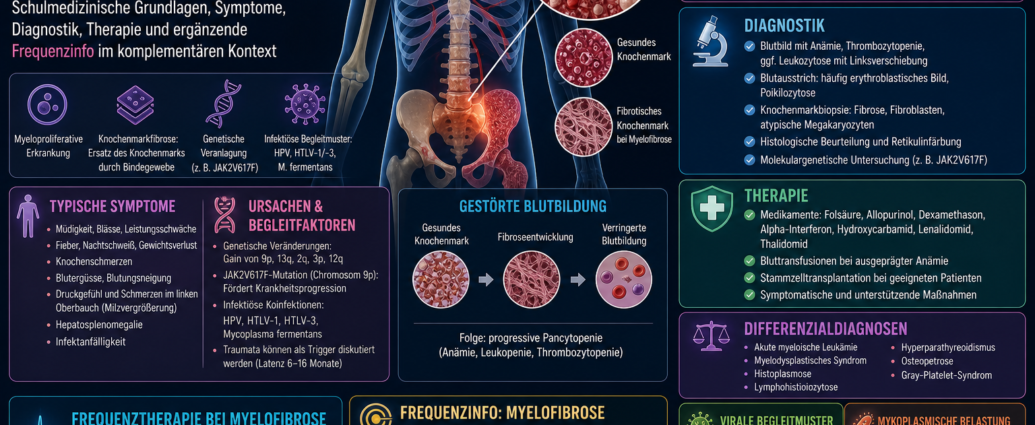
The Frequency therapy in myelofibrosis In the complementary medicine context, it is described as a supplementary perspective on conventional medical principles, impaired blood formation, bone marrow fibrosis, genetic factors, symptoms, diagnostics, and possible resonance patterns. Myelofibrosis is a disease of the bone marrow in which normal hematopoietic tissue is progressively replaced by fibrous connective tissue.
From the perspective of conventional medicine, myelofibrosis is one of the myeloproliferative disorders. This leads to a pathological change in the stem cells in the bone marrow. This change can impair the production of red blood cells, white blood cells, and platelets. The literature also mentions certain resonance frequencies that are used as a complementary therapy in the context of frequency therapy Frequency info can be documented and examined.
Frequency Therapy for Myelofibrosis: An Overview from Conventional Medicine
Myelofibrosis is a chronic disease of the bone marrow. The bone marrow is the primary site of blood formation. This is where red blood cells, white blood cells, and platelets are produced from hematopoietic stem cells.
Myelofibrosis is characterized by the abnormal proliferation of altered stem cells and progressive scarring or fibrosis of the bone marrow. This scarring is referred to as fibrosis. In this process, the normal bone marrow is gradually replaced by collagen-containing connective tissue fibers.
The further this process progresses, the more difficult it becomes for the body to produce enough functional blood cells. This can lead to anemia, susceptibility to infections, a tendency to bleed, and general weakness.
Frequency Therapy for Myelofibrosis and Bone Marrow Fibrosis
A characteristic feature of myelofibrosis is increased reticulin staining in the bone marrow. Reticulin is a fibrous network that is closely associated with collagen structures. The literature describes that the fibrous network observed in myelofibrosis contains collagen and also contains fibronectin.
Reticulin staining reacts with a protein that is closely associated with type III collagen and can be considered a form of procollagen. These changes indicate that the normal bone marrow matrix is being overgrown and remodeled.
As a result, the bone marrow gradually loses its original structure. The normal environment in which blood cells mature and develop is replaced by connective tissue. This transformation explains many of the typical symptoms and changes in blood counts.
Primary and Idiopathic Myelofibrosis
Primary myelofibrosis is also known as idiopathic myelofibrosis. „Idiopathic“ means that, from a conventional medical perspective, the exact cause has not been fully elucidated. However, the literature describes genetic predisposition and combined patterns of infectious exposure as possible contributing factors.
The disease does not develop suddenly, but usually progresses over a long period of time. At first, symptoms may be absent or very nonspecific. As fibrosis of the bone marrow progresses, symptoms become more pronounced.
As the disease progresses, blood formation may increasingly take place outside the bone marrow. This process is called extramedullary hematopoiesis. The liver and spleen, in particular, can then take over some of the functions of blood formation and become enlarged.
Frequency Therapy for Myelofibrosis and Genetic Factors
The literature describes various chromosomal abnormalities associated with myelofibrosis. Gains or alterations in regions such as 9p, 13q, 2q, 3p, and 12q are frequently reported.
The JAK2V617F mutation is particularly significant. It is a gain-of-function mutation in the JAK2 gene on chromosome 9p. This mutation can be detected in many adult patients with idiopathic myelofibrosis.
The JAK2V617F mutation affects signaling pathways that are important for the growth and maturation of blood cells. The literature describes that this mutation may be associated with a shift from platelet production toward increased red blood cell production. It is also associated with massive splenomegaly and possible leukemic transformation.
Myelofibrosis and Impaired Blood Formation
Blood formation is a finely tuned process. Stem cells give rise to various cell lines: red blood cells for transporting oxygen, white blood cells for the immune system, and platelets for blood clotting.
In myelofibrosis, this process is disrupted by changes in the bone marrow. The fibrous replacement of the marrow cavity results in a reduced ability to produce healthy blood cells. This can lead to a progressive decrease in several cell lines, a condition known as pancytopenia.
Typical symptoms include anemia, fatigue, pallor, reduced performance, an increased tendency to bleed, and susceptibility to infections. Depending on the blood test results, some cell lines may be more severely affected than others.
Extramedullary Hematopoiesis in Myelofibrosis
When the bone marrow can no longer perform its function adequately, the body attempts to shift blood production to other sites. This process is called extramedullary hematopoiesis.
The liver and spleen, in particular, may be enlarged. An enlarged spleen is called splenomegaly, and an enlarged liver is called hepatomegaly. Together, these conditions are referred to as hepatosplenomegaly.
An enlarged spleen can cause discomfort in the upper left abdomen. Some people experience pressure, a feeling of fullness, or pain in this area. An enlarged spleen can also break down blood cells at an increased rate, thereby further exacerbating changes in blood counts.
Symptoms of Myelofibrosis
Myelofibrosis often begins gradually. Many symptoms are nonspecific at first and may develop slowly. Typical symptoms include paleness, fatigue, and reduced physical performance. These symptoms are often caused by anemia.
Possible complaints are
- Tiredness
- Paleness
- feeling of weakness
- Power reduction
- Fever
- Bruising
- Tendency to bleed
- Bone pain
- Pain in the upper left abdomen
- Pressure caused by an enlarged spleen
- Weight loss
- Night sweats
- Susceptibility to infection
- Feeling of fullness
- feeling full quickly
Bone pain can result from changes in the bone marrow. Bruises and signs of bleeding indicate platelet or clotting disorders.
Changes in Blood Counts in Myelofibrosis
Changes in blood counts are an important part of the diagnostic process. The literature describes anemia and/or thrombocytopenia. In addition, an elevated white blood cell count may occur, sometimes accompanied by a left shift.
A left shift means that immature precursors of white blood cells appear in the blood. The blood smear may show an erythroblastic picture, in which immature precursors of red blood cells are found in the peripheral blood.
Poikilocytosis has also been reported. This means that red blood cells can take on unusual shapes. These changes reflect impaired blood formation and alterations in the bone marrow environment.
Frequency Therapy for Myelofibrosis and Possible Associated Patterns
In the literature, patterns of infectious exposure are cited as a factor in myelofibrosis, in addition to genetic factors. Specific mention is made of human papillomaviruses and human lymphotropic Viruses, especially HTLV-1 and HTLV-3, as well as Mycoplasma fermentans.
In complementary frequency-based thinking, such findings are regarded as potential resonance fields. In this approach, bone marrow, hematopoiesis, the immune system, fibrosis, genetic predisposition, and patterns of microbial exposure are collectively integrated into a broader regulatory framework.
Frequency therapy therefore views myelofibrosis not only as a localized change in the bone marrow, but also as a systemic process that affects the blood, spleen, liver, immune system, and metabolism.
Frequency Therapy for Myelofibrosis and Diagnosis
Conventional medical diagnosis of myelofibrosis includes blood tests, blood smears, bone marrow examinations, and histological analysis. These tests assess cell count, cell morphology, maturation stages, and the proliferation of connective tissue.
The bone marrow often shows marked fibrosis, clusters of fibroblasts, and conspicuous megakaryoblasts. Megakaryocytes are the precursor cells of platelets. In myelofibrosis, they may be enlarged, deformed, or arranged in an atypical manner.
Hyperplasia with a predominance of megakaryocytic and erythroid precursors is described less frequently. This means that certain cell lineages may be present in increased numbers in the bone marrow before fibrosis progresses further.
Differential Diagnosis of Myelofibrosis
Myelofibrosis must be distinguished from other conditions that can cause similar changes in blood counts or bone marrow. Differential diagnosis is therefore an important part of the conventional medical evaluation.
The literature cites the following conditions, among others:
- acute myeloid leukemia
- Myelodysplasia
- Histoplasmosis
- Lymphohistiocytosis
- Hyperparathyroidism
- Osteopetrosis
- Gray-Platelet Syndrome
Some of these diseases can cause similar symptoms, changes in blood counts, or bone marrow findings. Therefore, histological analysis, laboratory test results, molecular diagnostics, and clinical course are crucial.
Conventional Medical Treatment of Myelofibrosis
Treatment is based on symptoms, blood test results, spleen size, risk profile, age, general health, and genetic findings. The goal is to alleviate symptoms, treat changes in blood test results, reduce complications, and monitor the course of the disease.
Various treatment approaches are described in the literature. These include folic acid, allopurinol, dexamethasone, alpha-interferon, hydroxycarbamide, lenalidomide, and thalidomide. In addition, blood transfusions may be necessary in cases of severe anemia.
In certain cases, a stem cell transplant may be a treatment option. However, it is an intensive procedure and is evaluated on a case-by-case basis depending on the patient’s age, risk factors, general health, and clinical course.
Frequency Therapy for Myelofibrosis in a Complementary Context
Frequency therapy looks at biological processes from the point of view of vibration, Resonance and regulation. In myelofibrosis, the complementary approach focuses on the bone marrow, hematopoiesis, connective tissue proliferation, splenic involvement, liver involvement, the immune status, and possible microbial resonance patterns.
The literature cites specific resonance frequencies associated with myelofibrosis. In the context of frequency therapy, these frequencies are not considered in isolation but are documented as supplementary frequency information.
Frequency therapy can help provide a more comprehensive picture of the body’s regulatory state: Which frequency ranges are identified? What accompanying microbial patterns are present? What is the connection between bone marrow fibrosis, immune stress, and blood formation?
Frequency therapy and cancer in an expanded view
Myelofibrosis is a myeloproliferative disorder that affects the hematopoietic system. It thus lies at the intersection of bone marrow, immune regulation, hematopoiesis, and connective tissue remodeling.
From a broader perspective, a link to cancer is evident because altered stem cells, genetic mutations, possible leukemic transformation, and systemic hematopoietic disorders play a central role. The disease can progress toward more severe hematologic changes.
Frequency therapy views such processes as manifestations of a disruption in biological order. In this context, Cell communication, bone marrow environment, fibrosis, immune status, microbial interactions, and genetic susceptibility are all taken into account.
Frequency Information: Myelofibrosis
The following frequencies are cited in the literature in connection with myelofibrosis. In the complementary context of frequency therapy, they are regarded as supplementary resonance ranges.
Frequency Therapy for Myelofibrosis
340 kHz,
343-347 kHz,
353 kHz,
370–374 kHz,
396 kHz,
410 kHz,
418-426 kHz,
430–433 kHz,
442-451 kHz,
493-495 kHz,
514 kHz,
525-527 kHz,
543–546 kHz.
These frequencies are described in the literature as resonances that are frequently observed in myelofibrosis. In the context of frequency therapy, they can be used as a supplementary guide for documentation, resonance analysis, and individualized treatment.
Frequency info: viral accompanying patterns
The literature describes human papillomaviruses and human lymphotropic viruses as possible co-infections in myelofibrosis. HTLV-1 and HTLV-3 are specifically mentioned.
Frequency Therapy for Viral Resonance Fields
343-347 kHz,
370–374 kHz,
396 kHz,
410 kHz,
418-426 kHz,
430–433 kHz,
442-451 kHz,
525-527 kHz,
543–546 kHz.
In a complementary context, these areas can be documented as potential viral resonance fields. They are considered in conjunction with hematopoiesis, bone marrow, immune status, and fibrosis.
Frequency Information: Mycoplasma fermentans
Mycoplasma fermentans is mentioned in the literature as a possible contributing factor in myelofibrosis. In the context of complementary frequency therapy, mycoplasmas can be taken into account, particularly in cases of chronic, systemic, and immunological stress patterns.
Frequency Therapy for Mycoplasma Resonances
340 kHz,
343-347 kHz,
442-451 kHz,
493-495 kHz.
In frequency therapy, these frequency ranges can be documented as complementary resonance fields in cases of accompanying mycoplasma patterns.
Frequency Info: Bone Marrow and Fibrosis
Myelofibrosis is characterized by changes in the bone marrow. The normal hematopoietic structure is gradually replaced by collagen-rich connective tissue.
Frequency Therapy for Bone Marrow Fibrosis
370–374 kHz,
418-426 kHz,
430–433 kHz,
514 kHz,
525-527 kHz,
543–546 kHz.
These frequency ranges can be documented in a complementary analysis in the context of the bone marrow environment, fibrotic remodeling, and impaired hematopoiesis.
Frequency Therapy for Myelofibrosis: Comparison of Frequency Patterns
When comparing the frequencies, it is noticeable that several ranges appear as broad resonance bands. Particularly noticeable are 343–347 kHz, 370–374 kHz, 418–426 kHz, 430–433 kHz, 442–451 kHz, 493–495 kHz, 525–527 kHz, and 543–546 kHz.
Individual values such as 340 kHz, 353 kHz, 396 kHz, 410 kHz, and 514 kHz complement these larger fields. In complementary frequency therapy, this combination can be viewed as an indication of different levels: blood formation, bone marrow, immune status, viral resonance patterns, and mycoplasma infections.
The frequency lists are always considered in conjunction with the conventional medical diagnosis, the blood count, bone marrow histology, spleen size, genetic findings, and the individual’s regulatory status.
Frequency Therapy for Myelofibrosis: Summary
Myelofibrosis is a myeloproliferative disorder in which the bone marrow is progressively replaced by collagen-containing connective tissue. This disrupts blood formation and can lead to anemia, thrombocytopenia, susceptibility to infections, a tendency to bleed, bone pain, and an enlarged spleen.
In conventional medicine, blood counts, blood smears, bone marrow biopsies, reticulin staining, histological analysis, and molecular findings such as JAK2V617F play an important role. Treatment may include folic acid, allopurinol, dexamethasone, alpha-interferon, hydroxycarbamide, lenalidomide, thalidomide, blood transfusions, and, in certain cases, stem cell transplantation.
Frequency therapy offers a complementary perspective. The literature cites resonance frequencies such as 340 kHz, 343–347 kHz, 353 kHz, 370–374 kHz, 396 kHz, 410 kHz, 418–426 kHz, 430–433 kHz, 442–451 kHz, 493–495 kHz, 514 kHz, 525–527 kHz, and 543–546 kHz. These frequency lists can be used in a complementary context for documentation, resonance analysis, and individualized frequency therapy work.


Comments are closed, but trackbacks and pingbacks are open.