






Table of contents
- Stress in Everyday Work Life: Why Frequency Therapy Is Becoming Attractive to Working Professionals
- How Frequency Therapy Works for Stress Relief
- The Top 5 Frequency Therapy Approaches for Managing Work-Related Stress
- Frequency Therapy: Effects and Limitations—What the Research Shows
- Relaxation Exercises for Working Professionals: Practical Integration into the Workday
- The 5-4-3-2-1 Method for Managing Stress Between Meetings
- Distinction: Frequency therapy, biofeedback, and traditional relaxation techniques
- Safety and Contraindications: What Working Adults Should Know
- Conclusion: Frequency therapy as part of a comprehensive stress prevention program
- Frequently asked questions
Last updated: October 10, 2026
Stress in Everyday Work Life: Why Frequency Therapy Is Becoming Attractive to Working Professionals
Work-related stress has long since become the norm. Many working people report chronic tension, sleep disturbances, and physical ailments that cannot be fully resolved through traditional relaxation methods alone. This is where Frequency Therapy for Stress into play—an approach that specifically targets Frequencies works to regulate the nervous system and promote deep regeneration.
At Herbert Eder, we have observed since 1994 that working professionals are increasingly seeking holistic solutions that go beyond traditional relaxation techniques. Frequency therapy offers a scientifically grounded approach that supports both prevention and active stress reduction. This guide presents the five most effective frequency therapy approaches and shows how you can integrate them into your daily work routine.
Frequency therapy uses specific vibration patterns to calm the nervous system and support stress relief at the cellular level—a complement to traditional relaxation methods that is particularly beneficial for working professionals experiencing chronic stress.
How Frequency Therapy Works for Stress Relief
Frequency therapy is based on the assumption that biological systems respond to electromagnetic and acoustic vibrations. To realistically assess this application, it is important to distinguish between established mechanisms and hypotheses that are still being researched.
Established neurobiological foundations:
The effect of frequencies on the nervous system has been partially documented scientifically. Acoustic frequencies have been shown to influence brainwave patterns, a phenomenon known in neuroscience as the „Frequency Following Response“ (FFR). When the brain is repeatedly exposed to tones of a specific frequency, brain activity tends to adapt to that frequency. This has been studied extensively in the context of binaural beats: When two slightly different frequencies are played into each ear (for example, 100 Hz in the left ear and 107 Hz in the right ear), the brain perceives a „beat frequency“ of 7 Hz. Studies suggest that this can actually amplify theta waves (4–7 Hz) in the EEG, a state associated with relaxation and light sleep.
The parasympathetic nervous system (also known as „rest-and-digest mode“) can be activated by slow, rhythmic stimuli. This is the biological basis for why frequencies in the theta and alpha ranges can have a relaxing effect. The vagus nerve, which plays a central role in parasympathetic activation, responds to certain rhythms and frequency patterns.
Hypotheses without complete evidence:
The idea that every cell or organ has a „characteristic frequency“ and that external frequencies can „heal“ them is scientifically controversial. Rife frequency therapy, which is based on this assumption, lacks sufficient clinical evidence in peer-reviewed journals. Similarly, the Schumann resonance (7.83 Hz) as the „natural frequency of the Earth“ is a popular concept, but the claim that people in modern offices suffer from a lack of exposure to it and that artificial Schumann resonance compensates for this is not supported by high-quality studies.
Practical implications for working people:
This does not mean that frequency therapy is ineffective; it means that you should have realistic expectations. Alpha and theta frequencies have been shown to promote relaxation, much like relaxation music or breathing exercises. Rife frequencies and specialized devices should be viewed more as an experimental supplement rather than a proven therapy. The best approach combines frequency therapy with other established stress-reduction methods—not as a replacement, but as part of a holistic approach.
Regular use over several weeks yields the best results. Individual sessions may provide short-term relaxation, but real changes in stress resilience and sleep quality require consistency.
The Top 5 Frequency Therapy Approaches for Managing Work-Related Stress
1. Alpha frequencies for mental calm and focus
Alpha frequencies range from 8 to 12 hertz and correspond to a state of relaxed alertness. They are ideal for working professionals who need to switch between focused work and stress relief. Alpha frequencies promote mental clarity without inducing deep relaxation—perfect for short breaks at work.
Many working professionals report that alpha frequencies help them regain their composure after intense meetings. Their thoughts become clearer, tension eases, and their concentration improves. A typical session lasts 10–15 minutes and can be done several times a day.
Alpha frequencies are particularly effective between meetings or before making important decisions—they put the nervous system in a state where you are present but not tense.
2. Theta frequencies for deep relaxation and regeneration
Theta frequencies (4–7 hertz) promote deep relaxation and support the body’s regenerative processes. They are associated with REM sleep and allow the nervous system to truly shut down. For working professionals dealing with chronic stress, theta frequencies are particularly valuable because they support deeper healing processes.
Ideally, these frequencies should be used in a quiet environment—for example, in the evening to prepare for a good night’s sleep or during longer breaks on the weekend. A 20- to 30-minute theta session can improve sleep and support nighttime recovery.
3. Binaural beats for synchronizing the nervous system
Binaural beats are a specific form of frequency therapy: Two slightly different frequencies are played into each ear, and the brain generates a „beating frequency“ between them. This leads to deeper synchronization of the nervous system.
Binaural beats facilitate faster transitions between states of stress and relaxation. They are particularly well-suited for working professionals who have limited time—even just 15 minutes with binaural beats can produce noticeable effects. Important: They only work with headphones and require your full attention.
4. Rife Frequencies to Support Cell Communication
Rife frequency therapy is based on the assumption that specific frequencies can support cellular communication and correct imbalances. To relieve stress, frequencies are used that are intended to calm the nervous system and reduce inflammatory responses.
Rife frequencies require specialized equipment and should be used under expert guidance. For working professionals seeking more intensive support, this can be a useful supplement—especially if chronic stress has led to physical symptoms.
5. Schumann Resonance as the Earth's Natural Frequency
The Schumann resonance (7.83 hertz) is the Earth’s natural electromagnetic frequency. Many people, especially those in modern office environments, are no longer sufficiently exposed to this natural frequency. Using Schumann resonance can help restore this „grounding.“.
This frequency promotes relaxation, better sleep, and overall vitality. It is gentle and can be used for extended periods—making it ideal for use at the office or at home. Many working professionals report improved well-being and greater resilience against everyday stressors.
| Frequency range | Scope of Application | Best Time to Use | Duration |
|---|---|---|---|
| Alpha (8–12 Hz) | Mental Calm, Focus | During the day, between tasks | 10–15 min. |
| Theta (4–7 Hz) | Deep Relaxation, Regeneration | In the evening, before bed | 20–30 min. |
| Binaural Beats | Nervous System Synchronization | Versatile use with headphones | 15–20 min. |
| Rife Frequencies | Cell Communication, Reduction of Inflammation | Under professional guidance | Variable |
| Schumann Resonance | Grounding, Overall Vitality | Continuous possible | 20+ min. |
Frequency Therapy: Effects and Limitations—What the Research Shows
The Frequency Therapy: Effects and Limitations are key to responsible use. While many professionals report positive effects—better sleep, reduced tension, improved concentration—it is important to have realistic expectations.
Research on frequency therapy is still ongoing. Some mechanisms are well documented (such as the effects of specific frequencies on brain waves), while others are still being studied. Frequency therapy works best as a complement to other measures—not as a substitute for medical treatment or professional psychological support.
A common mistake is expecting immediate results. True stress reduction through frequency therapy requires regular, consistent use over a period of weeks. Patience and consistency are more important than intensive single sessions.
Relaxation Exercises for Working Professionals: Practical Integration into the Workday
Relaxation exercises for working professionals only work if they’re practical to implement. Even the best method is useless if you don’t have time for it. That’s why we focus on integrating frequency therapy for stress into existing routines: breaks between meetings, commute time, and lunch breaks.
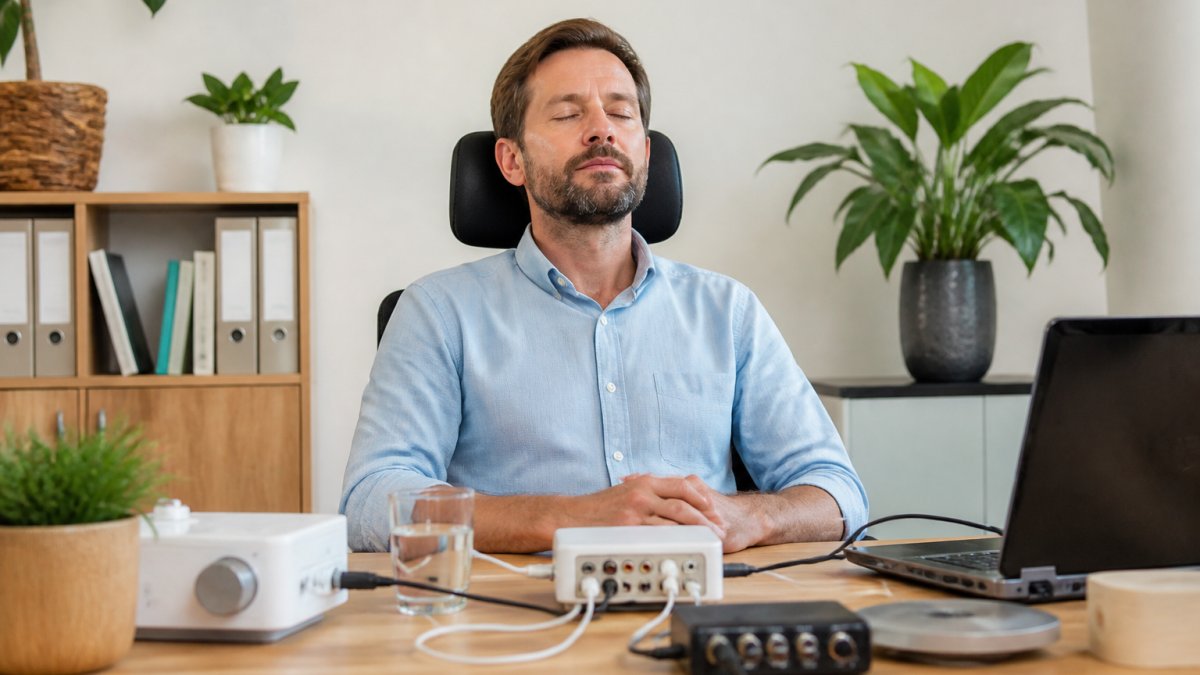
Start with 10-minute sessions of alpha frequencies between tasks. This is realistic in terms of time and produces quick results. In the evening, you can schedule longer theta sessions if you have time. Consistency beats duration—five minutes a day is better than one hour a week. (Source: Statistics on Workload and Perceived Stress)
Many working professionals incorporate frequency therapy into their lunch break or use it after work as a transitional buffer between work and leisure time. This helps relieve the mental strain of the day and makes it easier to transition into their personal lives.
Submit a request via our contact form →
The 5-4-3-2-1 Method for Managing Stress Between Meetings
The 5-4-3-2-1 method is a quick mindfulness technique you can do between meetings. It takes just two minutes and doesn’t require a specific location. Here’s how it works: Name five things you see, four you feel, three you hear, two you smell, and one you taste.
This method grounds you in the present moment and breaks the cycle of stress. It can be perfectly combined with frequency therapy—use alpha frequencies during the exercise for enhanced results. The advantage: You don’t need any equipment, just your attention.
A common mistake is to rush through this exercise. Take a full two minutes and focus on each sensory perception. If you rush through it, it loses its effectiveness.
Distinction: Frequency therapy, biofeedback, and traditional relaxation techniques
Many working professionals confuse frequency therapy with biofeedback or other relaxation methods. Here are the key differences: Biofeedback shows you your own physical responses (heart rate, skin conductance) and helps you consciously regulate them. Frequency therapy works directly with external frequencies to influence the nervous system.
Traditional relaxation techniques, such as progressive muscle relaxation or breathing exercises, activate the parasympathetic nervous system through conscious effort. Frequency therapy often promotes relaxation with less active effort—you „receive“ the frequencies passively.
All three approaches are valuable and can complement one another. The best strategy combines them: Use frequency therapy as a foundation, supplement it with traditional relaxation exercises, and use biofeedback to track your progress.
Safety and Contraindications: What Working Adults Should Know
Frequency therapy is considered noninvasive and, when used properly, has a low risk profile. Nevertheless, there are specific situations in which caution or consultation with a physician is required.
Absolute contraindications (avoid use):
Pacemakers and implantable defibrillators: Electromagnetic fields emitted by some frequency therapy devices can interfere with the operation of these devices. This applies primarily to Rife frequency devices with electromagnetic coils. Binaural beats (pure audio frequencies delivered through headphones) are safe in this case.
Epilepsy or seizure disorders: Certain frequencies, particularly in the range of 15–30 Hz (beta waves), can trigger seizures in people at risk of having them. This has been particularly well documented in cases of photosensitivity (light-induced seizures). Theta and alpha frequencies tend to be safer, but should only be used with a doctor’s approval.
Pregnancy: While audio frequencies (binaural beats) are considered safe, electromagnetic frequency therapy devices should be avoided during pregnancy. The reason: Long-term effects on the developing fetus have not been sufficiently studied. You should consult with a qualified midwife or obstetrician.
Relative contraindications (consultation with a physician is recommended):
Acute mental health crises (depression, anxiety disorders, panic disorders): Deep states of relaxation (theta frequencies) can, in some people with anxiety disorders, paradoxically exacerbate their symptoms or trigger dissociative symptoms. Individuals experiencing acute psychological distress should use frequency therapy only under therapeutic supervision, not as a form of self-treatment.
Sleep Disorders with a Psychiatric Cause: If insomnia is caused by anxiety disorders, trauma, or bipolar disorder, theta frequencies may have a relaxing effect, but they should not be used without consulting a psychiatrist or psychotherapist.
Headphone Use with Binaural Beats: Prolonged daily use (more than 1–2 hours) may cause headaches, dizziness, or tinnitus-like symptoms in some people. This is rare but has been documented. Start with short sessions (10–15 minutes) and gradually increase the duration.
Practical Scenarios for Working Professionals:
Wearing headphones at the office: Binaural beats are safe in this situation as long as you keep the volume moderate (below 85 decibels). Prolonged daily use should be interspersed with breaks; use alpha frequencies for 15 minutes instead of theta for 45 minutes.
If you have a headache or migraine: Some people report that certain frequencies trigger or worsen headaches. This varies greatly from person to person. Start with low volumes and short sessions. If you experience a headache, stop the session and consult a doctor.
After intense stress or trauma: Deep states of relaxation can lead to uncontrolled re-experiencing or flashbacks in individuals who have experienced trauma. In such cases, frequency therapy should only be used under the guidance of a therapist who specializes in trauma.
When you should consult a doctor or therapist:
- You have a pacemaker or other implanted devices
- You have been diagnosed with epilepsy or a seizure disorder
- You are pregnant or planning to become pregnant
- You have been diagnosed with a mental health disorder (depression, anxiety disorder, bipolar disorder, PTSD)
- You are taking psychiatric medications (antidepressants, antipsychotics)
- After undergoing frequency therapy, you develop new or worsened symptoms (headaches, dizziness, anxiety, sleep disturbances)
- You would like to use frequency therapy as an alternative to ongoing medical or psychotherapeutic treatment
Important Note: Frequency therapy is a complementary and preventive tool; it is not a substitute for medical or psychotherapeutic treatment. If your work-related stress leads to clinical symptoms (burnout, depression, anxiety disorder), professional help is necessary. Frequency therapy can provide support alongside therapy, but it does not replace it.
Conclusion: Frequency therapy as part of a comprehensive stress prevention program
The Frequency Therapy for Stress offers working professionals a practical, scientifically grounded approach to deeper relaxation and regeneration. The top 5 approaches—alpha frequencies for mental calm, theta for deep relaxation, binaural beats for rapid synchronization, Rife frequencies for cellular communication, and Schumann resonance for natural grounding—address a variety of needs.
The key lies in consistent, practical application. Frequency therapy does not work as a standalone measure, but rather as part of a holistic approach to stress management that also includes traditional relaxation techniques, exercise, and mental self-care.
At Herbert Eder, we support professionals and therapists in using frequency therapy responsibly and effectively. Our structured training programs and personalized practice guidance provide you not only with the theory but also with the practical skills needed to apply frequency therapy safely and effectively. With over 30 years of experience in frequency therapy and information medicine, we help you gain a solid foundation of knowledge to guide your individual practice. Get started today with a comprehensive introduction to the practical application of frequency therapy for stress relief.
Frequently asked questions
Which frequency is most effective for relieving stress?
Alpha frequencies (8–12 Hz) and theta frequencies (4–8 Hz) are considered particularly helpful for managing stress. Alpha frequencies promote mental calm while maintaining alertness, whereas theta frequencies support deep relaxation and regeneration. The optimal frequency depends on the individual’s nervous system and the desired response. Working professionals often benefit from alpha frequencies for quick bursts of focus throughout the day.
How does the 5-4-3-2-1 method for managing stress work?
The 5-4-3-2-1 method is a mindfulness technique for quickly reducing stress: Name 5 things you see, 4 things you touch, 3 things you hear, 2 things you smell, and 1 thing you taste. This method anchors your awareness in the present moment and interrupts the stress response. It takes about 2–3 minutes and can easily be done between meetings at the office.
Can frequency therapy replace medical treatment for stress?
No. Frequency therapy should be viewed as a complementary approach to stress prevention and relaxation, not as a substitute for medical treatment. In cases of chronic stress, burnout, or psychological distress, it is necessary to consult a doctor or psychotherapist. Frequency therapy can be usefully integrated into a comprehensive stress management program, but it does not replace professional medical or psychological care.
How long will it take before I notice the first improvements from frequency therapy?
Many people report feeling the first effects of relaxation after just one 15- to 20-minute session. Lasting changes in stress levels and resilience typically develop over several weeks of regular use. The duration depends on individual responsiveness, stress intensity, and frequency of use. Regular use (3–5 times a week) generally yields more noticeable results than occasional use.


Comments are closed, but trackbacks and pingbacks are open.