





Conventional medical principles, indirect stress and complementary frequency information
Why tumor processes cannot be reduced to a single trigger
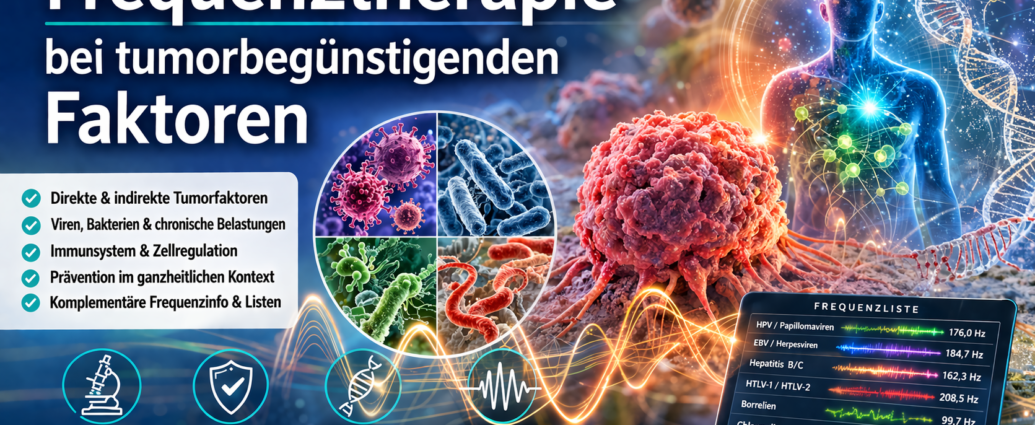
The development of tumor processes is one of the most complex processes in medicine. It has long been known that in most cases tumors cannot be explained by a single trigger. Rather, it is an interplay of various direct and indirect factors that affect the organism, the immune system, the cellular environment and the body's regulatory capacity. This is precisely why it is important for a comprehensive understanding to look carefully at conventional medical correlations and then focus on complementary aspects such as Frequency therapy and Frequency info to expand.
Tumors develop from cells that have lost their natural control over growth, division and adaptation to the tissue. Healthy cells normally follow a clear biological order. They respond to signals from their environment, they divide in a controlled manner and they are removed by the body's own mechanisms when they are damaged or become non-functional. If this order becomes unbalanced, a process can develop in which altered cells gain a growth advantage. Over time, this can lead to local tissue changes, invasive tumor processes and, in later stages, spread.
The literature shows that tumor-promoting factors can basically be divided into direct and indirect influences. This classification is interesting because it makes it clear that not all stresses are involved in the tumor process in the same way. Some factors intervene directly in cellular processes, while others tend to change the environment, the immune system or the rate of growth of existing developments. Anyone who wants to understand prevention, support and holistic regulation should consider both levels.
Direct tumor-promoting factors from a conventional medical perspective
Direct tumor-promoting factors are described in the literature as influences that are directly associated with certain types of tumors. These include above all various Viruses, which are associated with defined tissue changes and types of cancer. From a conventional medical perspective, it is important to note that such correlations do not mean that every infection automatically leads to a cancer. Tumor leads. Rather, the decisive factor is that such a factor can intervene directly in biological processes and, under certain conditions, promote pathological developments.
Human papillomaviruses are particularly well known and are associated with various cancers. Certain types of papillomavirus play a special role in the cervix. Other viruses such as HTLV-1 has been described in connection with certain forms of leukemia and lymphomas. Epstein-Barr virus is associated in the literature with specific lymphoma diseases and nasopharyngeal processes. Hepatitis viruses, on the other hand, are regarded as important stress factors for the liver and can play a role in connection with hepatocellular carcinomas. Herpes viruses such as HHV-8 are also linked to certain types of tumors such as Kaposi's sarcoma.
In addition, other viral factors are mentioned that are associated with neural tumors, skin cancer or mammary tissue changes. Such compilations show one thing above all: certain biological stresses can have a particular affinity to certain tissues. This makes it clear why tumor prevention is not just a question of general health, but also a question of specific stress constellations.
How direct factors can affect cells and tissue
According to conventional medical understanding, direct tumor-promoting factors interfere with fundamental cellular control mechanisms. They can influence the regulation of cell division, apoptosis, differentiation and immune recognition. Some of these factors alter genetic or epigenetic processes, others disrupt communication between cells and their environment. Still others promote chronic irritation, which increases the risk of pathological developments in the long term.
The literature makes it clear that such direct factors only become really significant when they encounter an organism whose protective systems are simultaneously overstretched or weakened. A stable body with good immune surveillance, a healthy mucosal barrier, functioning detoxification and a regulated metabolism can compensate for many stresses for a long time. However, if stresses accumulate, if the tissue is chronically irritated or if additional environmental factors are added, the balance can tip.
Indirect tumor-promoting factors and their significance
In addition to direct factors, the literature also mentions numerous indirect influences that do not necessarily trigger tumors themselves, but can promote their development or growth. These indirect factors tend to act via the environment, the tendency to inflammation, the immune system or the general stress level of the organism. This level is particularly important for a holistic understanding because it shows how strongly chronic concomitant stresses can influence the biological order.
The indirectly described factors include Helicobacter pylori, various parasitic strains, certain liver parasites, Helicobacter hepaticus, borrelia, chlamydia and virus groups such as herpes viruses, HIV as well as bacterial factors such as Shigella, Salmonella and Escherichia coli. These strains are associated in the literature with various types of cancer or tumor-promoting environments, for example in the stomach, bladder, liver, skin, breast, prostate, ovaries, testicles, pancreas or intestines.
From a conventional medical point of view, it is not the individual germ that is decisive as a simple explanation, but the complex interplay between chronic stress, tissue sensitivity, inflammatory dynamics, immune regulation and individual constitution. Indirect factors often create an environment in which growth, irritation or derailment of existing processes become more likely. This is precisely why they should not be underestimated in prevention.
Chronic inflammation as a bridge between stress and tumor development
Chronic inflammation is a key issue with indirect factors. Inflammation is basically a natural protective mechanism of the body. It helps to repair injuries, fight pathogens and regenerate tissue. It becomes problematic when inflammatory processes no longer subside and a permanent state of irritation develops. It is precisely such chronic inflammation that can change the tissue in the long term and create an environment in which cellular dysregulation occurs more easily.
If mucous membranes or organs are exposed to inflammation over a long period of time, the pressure on repair and adaptation systems increases. Cells have to regenerate more frequently, immune cells are permanently active, oxidative stress increases and local tissue may lose stability. For this reason, the control of chronic inflammatory processes is a central element of modern prevention. It involves not only traditional medical diagnostics, but also nutrition, intestinal health, sleep, stress regulation, metabolic balance and an overall low-inflammatory lifestyle.
The immune system as a decisive protective factor
An efficient immune system is one of the most important prerequisites for the early detection and limitation of abnormal cell changes. The body has immune monitoring mechanisms that control altered, damaged or degenerated cells. As long as this monitoring works well, many abnormal developments can be intercepted before they become clinically significant.
However, the literature makes it clear that tumor processes can be more frequent and more aggressive if the immune system is weakened. People with significant immunosuppression show an increased risk of various forms of cancer. This shows how closely tumor prevention is linked to immune balance. Not only genetic or environmental factors are relevant, but also the question of how well the body is still able to protect biological order.
A weakened immune system can have many causes. These include chronic stress, lack of sleep, toxic exposure, an unbalanced diet, long-term medication, underlying inflammatory diseases, emotional overload or a long period of exhausted regeneration. Anyone who takes prevention seriously must therefore also focus on immune stability.
Cell milieu, tissue environment and regulatory capacity
The literature suggests that it is not only direct pathogens or individual risk factors that are decisive, but also the environment in which cells live. This internal environment has a significant influence on how well an organism copes with stress. This includes oxygen supply, metabolic quality, pH regulation, micronutrient status, liver function, intestinal environment, vegetative balance and the ability to regenerate.
A stable environment helps the body to absorb stress and keep tissue healthy. A permanently disturbed environment, on the other hand, can promote inflammation, irritation, cell stress and dysregulation. It is precisely in this context that it becomes clear why prevention is not just about avoiding individual triggers. Rather, it is about bringing the entire system into a state in which adaptation, stability and order are more likely again.
Why the combination of several factors is so important
Tumor processes develop particularly frequently when several stress factors come together. A direct viral load, combined with chronic inflammation, a weakened immune system, toxic influences and poor regeneration, can be a much more critical condition than a single isolated factor. It is precisely this multiple stress factor that Practice is often overlooked.
The literature thus describes not only individual risks, but a network of influences. Recognizing this network is crucial for prevention and support. This implies that health should be promoted on several levels: through conventional medicine via diagnosis and risk assessment, and in terms of lifestyle through regeneration and stress reduction, and complementary through processes that support regulation and internal order.
Frequency therapy as a complementary approach for tumor-promoting stresses
How frequency therapy can be integrated into a holistic concept
Frequency therapy is understood by many practitioners as a complementary approach to support the organism in its regulation, adaptability and inner stability. While conventional medicine primarily describes biochemical, immunological and cellular processes, frequency therapy also focuses on biophysical aspects. It is based on the assumption that the human organism is not only organized materially, but also informatively, and that it is based on oscillation patterns, stimulus information and Resonance reacts.
This approach is particularly important for many people in complex stress situations. When direct and indirect factors act together on the organism, the focus is not only on the individual symptom, but also on the question of the general regulatory situation. Frequency therapy attempts to address precisely this level in a complementary way. It is about supporting order, regulatory stabilization and the accompanying promotion of a more harmonious inner environment.
Frequency therapy and the importance of regulatory support
In a complementary understanding, frequency therapy is not seen as an isolated measure, but as part of a comprehensive health concept. It is often used as an accompanying approach, particularly in cases of chronic stress, vegetative imbalance, exhaustion or a disturbed inner balance. The aim is to provide the organism with informative impulses that are geared towards order and regulation.
Many users associate frequency therapy with the desire to accompany the body not only in a symptom-oriented way, but also systemically. Especially with issues such as Causes of tumors, immunological stress, chronic irritation and the internal environment, this approach seems particularly useful for many people. This is because it tries to keep an eye on the bigger picture.
Why frequency lists should always be classified in a complementary manner
Frequency lists play an important role in frequency therapy. They originate from the literature and are thematically assigned to different fields of stress. However, it is crucial that they are always understood in a complementary context. The focus is not on the individual frequency in isolation, but on how it is embedded in the constitution, stress situation, regulatory capacity and therapeutic objective.
This classification is particularly important for complex issues such as direct and indirect tumor-promoting factors. Frequency lists are not seen here as a rigid solution, but as part of a regulatory accompaniment that takes into account the inner environment, the vegetative balance and the general resilience of the organism.
Frequency info
Frequency therapy for direct and indirect stress factors
In the field of frequency therapy, the frequency lists described in the literature are assigned in a complementary manner to those areas that are associated with direct and indirect stress factors. According to the complementary understanding, these include topics such as viral stress, microbial irritation, vegetative imbalance, regulatory weakness and a disturbed inner environment. Frequency therapy does not attempt to look at individual factors in isolation, but to accompany the entire stress situation in an informative way.
Frequency lists from the literature in a complementary context
The frequency lists from the literature are often used in complementary practice along certain themes. These include general regulatory support, environment stabilization, accompanying stress regulation and vegetative harmonization. In this context, the respective frequencies are not used in isolation, but embedded in programs that take into account the overall state of the organism. It is precisely this embedding that makes the difference between technical application and holistic frequency information.
Frequency therapy as part of a comprehensive prevention model
For many users, the greatest strength of frequency therapy lies in the fact that it can be combined with other health-promoting measures. A low-inflammatory lifestyle, sufficient sleep, stress reduction, support of the intestinal environment, stabilization of the immune system and conscious regeneration form the basis. Frequency therapy complements this concept by adding a level of Information, order and biophysical support. This makes it a valuable component of a holistic prevention model for many people.
Conclusion
The literature makes it clear that tumor-promoting factors are complex. Direct stresses such as certain viruses can be directly linked to individual tumor types. Indirect factors such as chronic inflammation, bacterial contamination, parasitic influences or a weakened immune system can also promote the growth and development of stressful processes. The decisive factor is almost always the interaction of several factors, not a single trigger.
Conventional medicine therefore focuses on diagnostics, immune function, stress reduction and the precise observation of biological processes. Complementary frequency therapy opens up a broader view of regulation, inner order and biophysical connections. In this context, the frequency lists from the literature are not considered in isolation, but as part of a holistic model that takes into account direct and indirect stresses as well as regeneration, environment and adaptability.
The result is a comprehensive approach that takes conventional medical findings seriously and at the same time creates space for complementary frequency information. This is precisely where the special significance of frequency therapy lies for many users: as an accompanying path to more order, stability and conscious health care.
Comments are closed, but trackbacks and pingbacks are open.