







Herbert Eder – an internationally sought-after frequency expert
Nicht jeder unregelmäßige Schlag bedeutet dasselbe
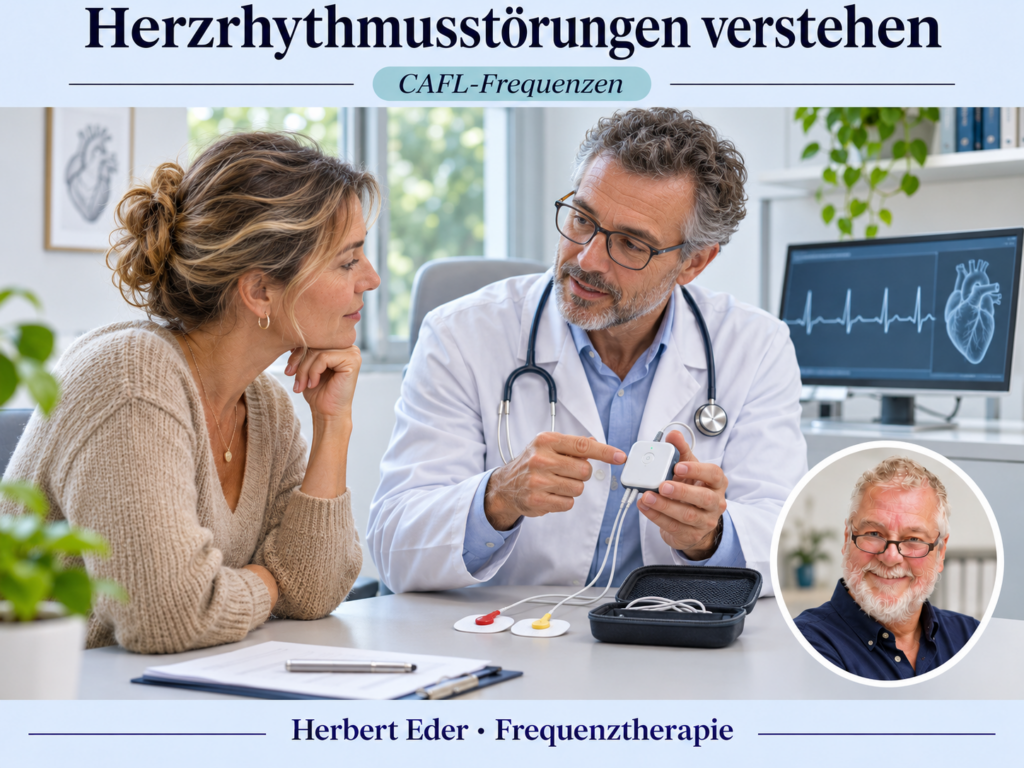
Das Herz kann zu schnell, zu langsam oder unregelmäßig schlagen. Manche Rhythmusstörungen sind wenig bedrohlich, andere benötigen gezielte Behandlung. Herzklopfen allein erlaubt keine sichere Zuordnung. Die Schreibweise Arryhthmie_Herz_TR in der CAFL-Liste wird als Quellenname erhalten, nicht als genaue medizinische Diagnose verstanden.
Beschwerden und Warnzeichen
Herzrasen, Stolpern, Schwindel, Müdigkeit oder Atemnot können auftreten. Bestehen gleichzeitig Brustschmerz, deutliche Atemnot, Ohnmacht oder das Gefühl einer unmittelbar bevorstehenden Ohnmacht, ist sofortige medizinische Hilfe erforderlich. Wiederkehrende Beschwerden sollten auch dann abgeklärt werden, wenn sie zwischenzeitlich verschwinden.
Behandlung richtet sich nach dem Befund
Die ärztliche Beurteilung klärt die Art der Rhythmusstörung und mögliche Auslöser. Je nach Befund reichen Kontrollen aus oder es kommen Medikamente, eine Katheterbehandlung, Kardioversion oder ein implantiertes Gerät infrage. Medikamente und Begleiterkrankungen werden dabei mitberücksichtigt. Eine allgemeine Maßnahme passt nicht zu allen Formen.
Zusatzmittel nicht pauschal übernehmen
Die historische Quelle nennt neben Frequenzen auch Magnesium, Coenzym Q10 und Fischöl. Diese pauschale Ergänzung ist keine individuelle Verordnung. Sie ersetzt weder die Abklärung noch eine notwendige Behandlung. Der Dezimalwert 7,83 Hz wird dokumentiert, aber nicht als physiologisch begründete Zielvorgabe ausgegeben.
How to Read the CAFL Source Correctly
This article is based on the PDF titled „CAFL-NLS Printouts DE,“ whose cover page indicates the February 2020 version. The document also includes the version number CAFL v2007-05-16. This information describes the current state of the sources; it does not represent the date of a current medical guideline. The editorial identifiers are used to uniquely identify the entries for future reference and in subsequent packages.
An entry in this collection may refer to a disease, a symptom, an organism, or a historical umbrella term. Similar names are therefore not equated without justification. The CAFL values are taken from this list and are not presented as frequencies calculated from DNA. Page numbers refer to the pages of the provided PDF.
Further Information
You can find more topics in the Category: CAFL Frequencies. The section Webinars & workshops provides information on knowledge transfer.
Sources for Academic Contextualization
Editorial source verification: November 11, 2026. The specialized sources pertain to the medical or biological topic, not the Effectiveness the CAFL values.
CAFL frequencies in Hz: documented source values
The following table preserves the order and repetitions of the numbers in each frequency block. Individual values are separated by semicolons; a comma within a value indicates a decimal place. This is for documentation purposes only and does not constitute a recommended treatment protocol.
The specialized sources cited above do not provide evidence of the diagnostic or therapeutic efficacy of these frequency values. This list cannot identify a pathogen or determine an appropriate treatment. It must not be used to replace or delay necessary medical or veterinary care. Historical information regarding treatment durations, device settings, or additional remedies is not intended as recommendations for use.
Note on assignment: Originalschreibweise Arryhthmie_Herz_TR erhalten; 7,83 als ein Dezimalwert interpretiert.
| ID and Page | Original Name | Source values in Hz |
|---|---|---|
| CAFL-0071, PDF-Seite 5 | Arryhthmie_Herz_TR | 696; 7,83 |
Additional original CAFL lines and frequencies in Hz
The following terms and numbers are documented in the historical collection „CAFL-NLS Printouts DE.pdf.“ This compilation does not confirm any diagnosis or effect. Variants and older names are not assumed to be clinically equivalent. This is not a recommendation for use; necessary medical care must not be replaced or delayed as a result.
Tachykardie
Quellenzeile CAFL-1439; PDF-Seite 64. Originalbezeichnung der Sammlung.
Original values in Hz: 1.2