








Last edited: October 30, 2026
Bei Sarkomen ist die genaue Diagnose die Voraussetzung jeder sinnvollen Therapieaussage. Fettgewebs-, Knochen- und kindliche Weichteiltumoren können sehr unterschiedliche Behandlungen benötigen. Auch wenn ein Verfahren elektromagnetische Energy nutzt, lässt sich sein Ergebnis nicht allein anhand des Wortes „Frequenz“ auf andere Geräte übertragen. [1][14]
I am Herbert Eder—an internationally sought-after frequency expert. This article therefore explains in great detail what has actually been studied regarding regional hyperthermia and where its applicability ends. The positive study involved a specialized adjunctive procedure to a tailored sarcoma treatment regimen in selected high-risk adults. [15]
What is a sarcoma, and what is not considered a sarcoma?
Sarkome sind bösartige Tumoren des Stütz- und Bindegewebes. Dazu gehören beispielsweise Fett-, Muskel-, Gefäß- und Knochengewebe. Gutartige Weichteiltumoren heißen dagegen etwa Lipoma, Fibrom oder Hämangiom. Ein Liposarcoma ist somit nicht einfach eine andere Bezeichnung für ein gutartiges Lipom. Desmoidtumoren nehmen eine besondere Stellung ein: Sie können örtlich aggressiv wachsen, bilden aber keine Fernmetastasen. Diese Unterschiede bestimmen, ob und wie behandelt wird. [2]
A Rhabdomyosarcoma gehört zu den Weichteilsarkomen und weist eine Differenzierung in Richtung Skelettmuskulatur auf. Es tritt häufiger im Kindes- und Jugendalter auf und ist kein Knochenkarzinom. Auch hier beeinflussen Unterform, Alter, Lage und molekulare Merkmale die Behandlung wesentlich. [3]
Bone sarcomas, on the other hand, arise primarily in bone or cartilage-forming tissue. A bone metastasis from breast or prostate cancer remains a secondary lesion of the original cancer. The fact that both occur in bone does not, therefore, mean that they are the same disease or require the same treatment. [2]
What changes should be examined?
A soft tissue sarcoma may initially present only as a painless swelling. As it grows, a feeling of tightness or pain may develop, for example due to pressure on neighboring structures. Tumors located deep within the abdomen often cannot be detected by palpation in the early stages. Persistent or growing swellings should therefore be examined, especially if they are deep-seated or have a large diameter. The absence of pain is not a reliable indication that there is no cause for concern. [4]
Have even a small, growing lump examined. Don't wait for multiple warning signs to appear at the same time. Many lumps are benign; the examination is designed to help distinguish between them. [5]
For most soft tissue sarcomas, no clear individual cause can be identified. Rare hereditary tumor syndromes and certain prior cancer treatments may increase the risk. However, known associations with specific subtypes cannot be generalized to all sarcomas. There is no evidence to support a blanket explanation based on diet, „detoxification problems,“ or a personal misstep. In cases of unusually young age at diagnosis or a notable family history, the medical team should consider whether genetic counseling is appropriate. [6]
Why the biopsy Should Be Scheduled at the Sarcoma Center
If there is reasonable suspicion, early consultation with a sarcoma center is important. First, imaging shows where the tumor is located and which structures are involved; depending on the body region, ultrasound, MRI, or CT may be used. The tissue sample is then planned with precision. The path of the biopsy needle can influence the subsequent surgery. A suspicious lump should therefore not simply be removed without a coordinated plan. [7]
Meist liefert eine Stanzbiopsie mehrere kleine Gewebezylinder für die Untersuchung. Die Pathologie prüft Zellbild und ergänzende Färbungen; bei schwierigen Befunden kann eine erfahrene Referenzpathologie nötig sein. Bis alle Untersuchungen abgeschlossen sind, kann Zeit vergehen. Fragen Sie, ob die Diagnose bereits endgültig ist oder noch Zusatzbefunde ausstehen. Für die Therapie zählt die verlässliche Zuordnung stärker als ein möglichst schneller, aber unvollständiger Name. [7]
The 2026 WHO classification combines tissue patterns, clinical characteristics, and molecular features to enable precise classification. As a result, additional genetic tumor analyses can classify a tumor that appears similar as belonging to a different subtype. [8]
Subtype, grade, and stage answer different questions
The subtype describes the specific type of sarcoma. The grade assesses characteristics such as cell morphology and proliferation rate in sarcomas where this is applicable; high-grade tumors are more likely to grow rapidly and spread. The stage reflects the extent of the disease. This includes tumor size, local involvement, and possible metastases. A higher grade does not, therefore, automatically mean that distant metastases have already been detected. [9]
For your prognosis, these factors must be considered together. Location, the possibility of complete removal, previous treatments, and your overall health also play a role. A survival rate for „all sarcomas“ is therefore unlikely to accurately describe your situation. Ask for an assessment specific to your subtype and inquire about what test results are still missing before the risk can be reliably assessed. [1]
Locally Confined Sarcomas: Surgery and Adjuvant Therapy
For many locally confined soft-tissue sarcomas, the focus is on complete removal. R0 means that no tumor cells are detected at the examined surgical margins. Which tissues must be removed depends on the tumor’s location and extent. Preservation and restoration of function are factored into the treatment plan. An amputation is not an automatic consequence of the diagnosis; conversely, the desire for a minor surgical procedure must not overshadow the need for adequate tumor control. [10]
Radiation therapy is added depending on the local risk of recurrence. The 2026 ESTRO guidelines for adult soft tissue sarcomas of the extremities and trunk wall recommend radiation therapy prior to surgery when indicated. The decision is made by an interdisciplinary team. This recommendation applies to the specific situations described and cannot be applied unchanged to every sarcoma in the abdomen or in children. [11]
Chemotherapy before or after surgery is not generally required for soft tissue sarcomas in adults. It may be considered in select high-risk situations. There are specific treatment protocols for rhabdomyosarcomas, extrapulmonary Ewing sarcomas, and gastrointestinal stromal tumors. If additional therapy is recommended, the treatment team should explain its specific purpose and expected benefits. [10]
Auch bei Knochensarkomen richtet sich die Kombination nach der Tumorart. Operation und Chemotherapie sind wichtige Verfahren; Bestrahlung oder zielgerichtete Medikamente werden bei bestimmten Formen eingesetzt. Rekonstruktion und Physical Therapy können helfen, Beweglichkeit zurückzugewinnen. Erfahrungen mit Bone metastases anderer Types of cancer sind darauf nicht einfach übertragbar. [12]
Metastases change the plan, but they do not end treatment
In cases of advanced soft tissue sarcomas, medications that act throughout the body are frequently used. Doxorubicin is an important active ingredient for many subtypes; combinations and subsequent therapies are selected based on tumor type, symptoms, prior treatments, and the patient’s tolerance. Targeted therapies are only suitable for specific diseases or findings. Therefore, there is neither a universal pill for all sarcomas nor any certainty that a more aggressive treatment regimen will be more beneficial for every patient. [13]
If there are only a few metastases that can be completely treated, local treatment—such as surgery—may also be an option. In cases of extensive disease, the focus is often on long-term disease control and quality of life. This includes pain management, support for fatigue, and other supportive measures. Participating in a clinical trial may be beneficial; be sure to clarify whether the trial is designed to supplement an established treatment or to investigate an unresolved treatment question. [13]
Sarcomas and Frequency Therapy: What Hyperthermia Actually Investigates
In medical hyperthermia, tissue is selectively heated. Electromagnetic energy or other technical methods, among others, can be used for this purpose. The temperature, the treated area, and the patient’s tolerance are monitored; overheating can also cause pain or burns. Heat therapy is usually combined with other cancer treatments. Therefore, the frequency used alone does not sufficiently describe the treatment or its safety and efficacy. [14]
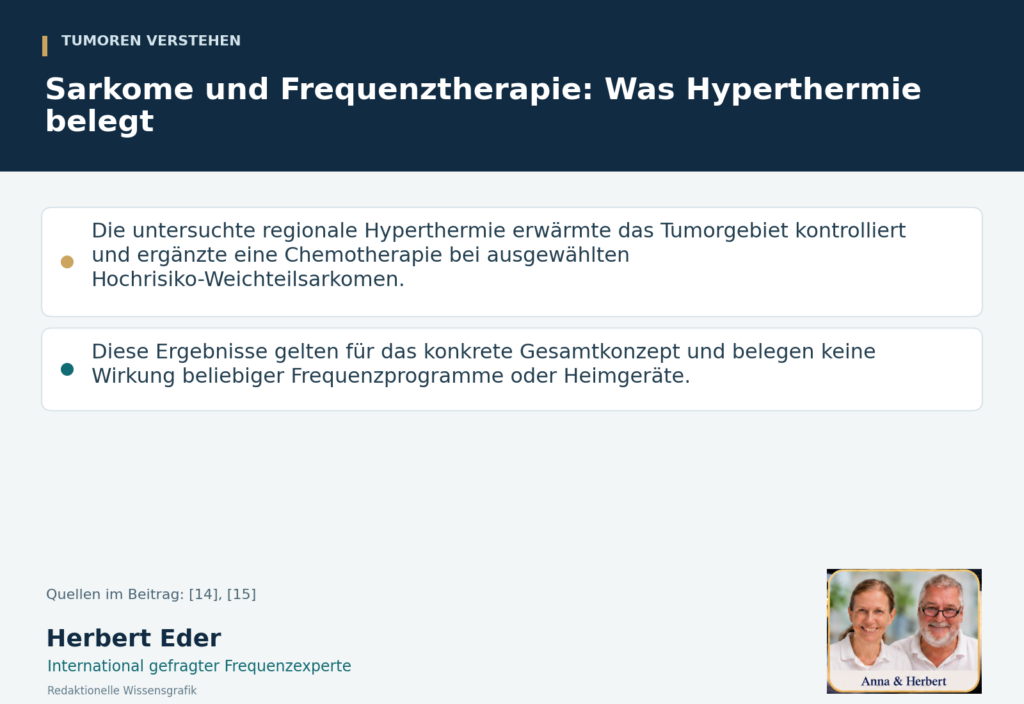
An important randomized trial is EORTC62961/ESHO95. It enrolled adults with deep-seated, high-grade soft-tissue sarcomas measuring at least five centimeters in size and without distant metastases. Chemotherapy prior to local treatment was compared with the same chemotherapy plus regional hyperthermia. In the long-term analysis, local disease control and the disease-specific and treatment-related survival rates were better in the combination arm. This involved a specialized comprehensive treatment regimen, not heat as a standalone therapy. [15]
The study allows for a limited conclusion: For appropriate high-risk patients, this specific adjunctive procedure may be relevant. It did not evaluate a random frequency list, a home device, whole-body treatment, or all types of sarcomas. Surgical planning and additional local treatment were also part of the approach. The sarcoma team must assess whether the results apply to your condition; the decision cannot be derived from a single technical buzzword. [15]
There is no reliable clinical evidence that Rife machines can cure cancer. They are not a substitute for effective sarcoma treatment. [16]
Review supplementary offerings based on their objectives
Distinguish between a treatment aimed at combating the tumor and a measure intended to provide support during treatment. Relaxation or relief from symptoms has a different goal than the claimed destruction of cancer cells. Ask about verifiable studies, observed side effects, and possible interactions with your therapy. Also inform your treatment team about any additional supplements or devices you are using. The term „complementary“ does not automatically make a treatment effective or safe. [17]
For a research project, it should be clear which patient group will be included and which research question the study aims to answer. Participation in a study can be particularly valuable for patients with rare sarcomas, but it does not guarantee any personal benefit. Ask for an explanation of what alternatives are available and what additional tests you can expect. A methodologically designed clinical trial is different from a collection of positive testimonials. [9]
Aftercare and rehabilitation are part of the overall plan
After treatment, follow-up visits are determined based on the subtype, stage, and individual circumstances. In addition to the surgical site, the chest may also be examined; the frequency and procedures will be determined. Please report any new lumps, persistent pain, or other changes between appointments. A normal follow-up finding is reassuring, but it does not replace the agreed-upon follow-up schedule or the discussion of any ongoing symptoms. [18]
Rehabilitation can begin even while you’re still undergoing treatment. Physical therapy, occupational therapy, and other forms of support are tailored to the specific functions that have been affected and your personal goals. After leg surgery, this may involve walking safely; after arm surgery, it may involve performing everyday tasks with your hands. Be sure to also discuss work-related demands, fatigue, and anxieties. Returning to your daily life requires a personalized plan—not just a final tumor diagnosis. [19]
What question can you ask to evaluate a supplementary offer?
First, ask for the specific study group: Which subtype of sarcoma, which grade, and which stage were examined? Then ask which device or medical procedure was used and what else was done in addition to the treatment. A similar technical term is not sufficient to equate a combination of chemotherapy and regional hyperthermia with a home device. [15]
The A Review of Studies on Frequency Therapy explores these questions in greater depth. My contribution What a Biopsy Reveals At the same time, this demonstrates why a confirmed tumor type—and, if necessary, one verified by reference pathology—must be established before any appropriate treatment recommendation can be made. In the case of sarcoma, even the method of tumor removal is part of the center’s collaborative planning process. [7]
Making a personal decision requires not only an assessment of potential benefits but also information on the burden of treatment, side effects, and how the therapy aligns with surgery or systemic therapy. Temporary pain relief is a different outcome than tumor control or prolonged survival. Therefore, the hyperthermia study provides neither a promise of a cure nor evidence supporting arbitrary frequency programs. Complementary therapies should be evaluated based on their specific goals and supporting evidence, while the evidence-based oncological treatment plan continues.
Sources and Further Information
- DKFZ Cancer Information Service: Soft Tissue Sarcomas, Classification and Prognosis. Retrieved October 28, 2026.
- Federal Health Portal: Sarcomas, Subtypes, and Definitions. Retrieved October 28, 2026.
- Cancer Research UK: Rhabdomyosarcoma. Retrieved October 28, 2026.
- DKFZ Cancer Information Service: Symptoms of Soft Tissue Sarcomas. Retrieved October 28, 2026.
- NHS: Symptoms of soft tissue sarcoma. Retrieved October 28, 2026.
- DKFZ Cancer Information Service: Risk Factors and Early Detection of Soft Tissue Sarcomas. Retrieved October 28, 2026.
- DKFZ Cancer Information Service: Diagnosis of Soft Tissue Sarcomas. Retrieved October 28, 2026.
- Hornick et al.: The 2026 WHO Classification of Tumors of Soft Tissue and Bone, 6th Edition. Retrieved October 28, 2026.
- National Cancer Institute: Soft Tissue Sarcoma Treatment, Patient Version. Retrieved October 28, 2026.
- DKFZ Cancer Information Service: Treatment of Localized Soft Tissue Sarcomas. Retrieved October 28, 2026.
- Roohani et al.: ESTRO Guidelines on Radiation Therapy for Soft Tissue Sarcomas, endorsed by ASTRO, 2026. Retrieved October 28, 2026.
- NHS: Treatment for bone cancer. Retrieved October 28, 2026.
- DKFZ Cancer Information Service: Treatment of Advanced and Metastatic Soft Tissue Sarcomas. Retrieved October 28, 2026.
- National Cancer Institute: Hyperthermia for Cancer Treatment. Retrieved October 28, 2026.
- Issels et al.: EORTC62961/ESHO95, Long-term outcomes of chemotherapy with regional hyperthermia, JAMA Oncology 2018. Retrieved October 28, 2026.
- Cancer Research UK: Rife machines. Retrieved October 28, 2026.
- National Cancer Institute: Complementary and Alternative Medicine for Patients. Retrieved October 28, 2026.
- Cancer Research UK: Follow-up After Treatment for Soft Tissue Sarcoma. Retrieved October 28, 2026.
- Sarcoma UK: Starting Rehabilitation. Retrieved October 28, 2026.
Topic Overview: Understanding Tumors.