






Herbert Eder – an internationally sought-after frequency expert
Ein zeitkritischer Notfall
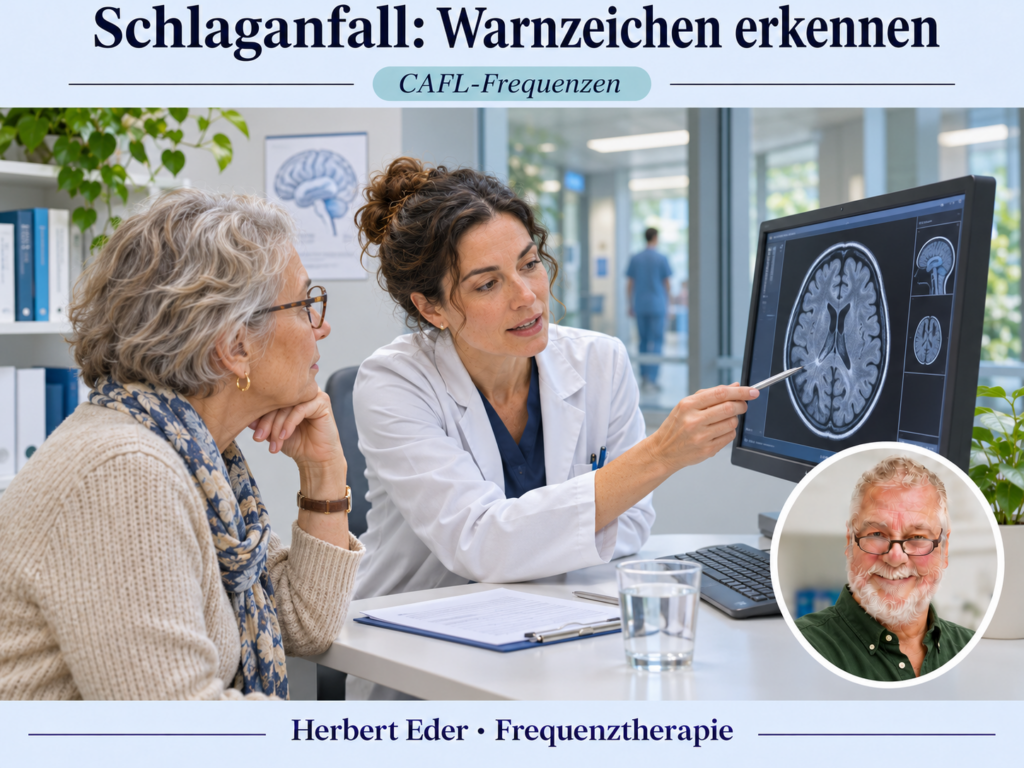
Ein Schlaganfall kann sich durch plötzlich auftretende neurologische Ausfälle zeigen. Ein herabhängender Mundwinkel, ein schwacher Arm oder eine neu gestörte Sprache sind typische Warning Signs. Auch Sehen, Balance oder Bewusstsein können plötzlich beeinträchtigt sein. Bei Verdacht sofort den Rettungsdienst verständigen und nicht auf eine Besserung warten.
Auch vorübergehende Beschwerden zählen
Verschwinden die Zeichen rasch wieder, ist das keine Entwarnung. Eine vorübergehende Durchblutungsstörung kann ebenfalls dringend abklärungsbedürftig sein. Wenn möglich, den Zeitpunkt des Beginns oder den letzten beschwerdefreien Zeitpunkt notieren. Betroffene sollen nicht selbst ins Krankenhaus fahren.
Diagnostik und Behandlung
Die rasche Untersuchung und Bildgebung klären, welche Form des Schlaganfalls vorliegt. Bei geeigneten Betroffenen kommen Medikamente zur Auflösung eines Gerinnsels oder die Entfernung eines Gefäßverschlusses infrage. Andere Befunde verlangen andere Maßnahmen. Anschließend unterstützen Rehabilitation und individuell abgestimmte Vorbeugung die weitere Versorgung.
Lähmung ist keine eindeutige Ursache
Die CAFL-Überschrift verbindet Apoplexie, Schlaganfall und Lähmung. Diese Wörter sind nicht beliebig austauschbar: Eine Lähmung kann unterschiedliche Ursachen haben. Eine Frequenzliste unterscheidet diese Ursachen nicht und darf weder Notruf noch Bildgebung oder Akutbehandlung verzögern.
How to Read the CAFL Source Correctly
This article is based on the PDF titled „CAFL-NLS Printouts DE,“ whose cover page indicates the February 2020 version. The document also includes the version number CAFL v2007-05-16. This information describes the current state of the sources; it does not represent the date of a current medical guideline. The editorial identifiers are used to uniquely identify the entries for future reference and in subsequent packages.
An entry in this collection may refer to a disease, a symptom, an organism, or a historical umbrella term. Similar names are therefore not equated without justification. The CAFL values are taken from this list and are not presented as frequencies calculated from DNA. Page numbers refer to the pages of the provided PDF.
Further Information
Weitere Themen finden Sie in der Category: CAFL Frequencies. Der Bereich Webinars & workshops bietet Informationen zur Wissensvermittlung.
Sources for Academic Contextualization
Redaktioneller Quellenabgleich: 11. November 2026. Die Fachquellen betreffen das medizinische oder biologische Thema, nicht die Effectiveness der CAFL-Werte.
CAFL frequencies in Hz: documented source values
The following table preserves the order and repetitions of the numbers in each frequency block. Individual values are separated by semicolons; a comma within a value indicates a decimal place. This is for documentation purposes only and does not constitute a recommended treatment protocol.
The specialized sources cited above do not provide evidence of the diagnostic or therapeutic efficacy of these frequency values. This list cannot identify a pathogen or determine an appropriate treatment. It must not be used to replace or delay necessary medical or veterinary care. Historical information regarding treatment durations, device settings, or additional remedies is not intended as recommendations for use.
Note on assignment: Originaltitel Apoplexie_Schlaganfall_Lähmung beibehalten. Keine Anwendungsempfehlung bei einem Notfall.
| ID and Page | Original Name | Quellwerte in Hz |
|---|---|---|
| CAFL-0065, PDF-Seite 5 | Apoplexie_Schlaganfall_Lähmung | 40; 1800; 880; 787; 727; 650; 625; 600; 125; 95; 72; 20; 1865; 522; 428 |
Additional original CAFL lines and frequencies in Hz
The following terms and numbers are documented in the historical collection „CAFL-NLS Printouts DE.pdf.“ This compilation does not confirm any diagnosis or effect. Variants and older names are not assumed to be clinically equivalent. This is not a recommendation for use; necessary medical care must not be replaced or delayed as a result.
Stroke_follow_up
Quellenzeile CAFL-1419; PDF-Seite 63. Originalbezeichnung der Sammlung.
Original values in Hz: 2112, 3, 203, 1800, 880, 787, 727, 650, 625, 600, 125, 95, 72, 1865, 522, 428, 10000, 20, 2720