



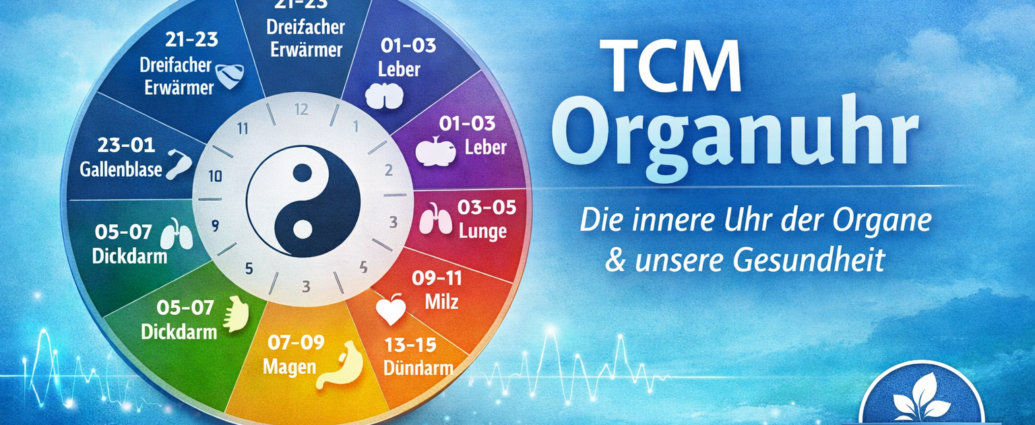
Many people are familiar with this: you wake up always at the same time is tired in certain phases of the day or regularly gets complaints at similar times. Traditional Chinese Medicine (TCM) describes an exciting model for this: the internal organ clock (also known as the meridian clock). It is based on the assumption that our organs have different „activity peak phases“ in a 24-hour rhythm - and that imbalances can become particularly apparent in precisely these time windows.
This article explains the TCM organ clock in an understandable way, classifies typical symptoms and gives practical tips on how you can organize your everyday life according to this „inner clock“.
What is the TCM organ clock?
In TCM, the life energy circulates Qi along meridians. Each meridian is assigned to an organ function circuit. Within 24 hours, each of these functional circuits has a two-hour time slot, in which it is particularly active. In this phase, regeneration, metabolism, detoxification or build-up processes should be particularly „in the foreground“.
Important: In TCM, „organ“ does not only mean the anatomical organ, but a Functional circuit (e.g. liver = also emotions such as anger/frustration, tendons, eyes; spleen = also digestion/transport, brooding, energy build-up).
The organ clock at a glance (24-hour rhythm)
23:00 - 01:00: Gall bladder
Topic: Decisiveness, fat digestion, courage
If you are often awake: Brooding, „not being able to decide“, restlessness
TCM impulse: Eat lighter in the evening, reduce screen time, clear end of the day (close to-do list)
01:00 - 03:00: Liver
Topic: Detoxification, blood, emotion anger
When you wake up: Often in cases of stress, pent-up anger, excessive demands
TCM impulse: Avoid alcohol/heavy foods late, increase bitter substances/greens during the day, breath + stretches (flanks)
03:00 - 05:00: Lungs
Topic: Breathing, skin, grief/letting go, immune system
When you wake up: Often for sadness, respiratory issues, dry mucous membranes
TCM impulse: Evening nasal care/moisturizing, quiet breathing, fresh air in the morning
05:00 - 07:00: Large intestine
Topic: Excretion, letting go
If you have problems: Blockage or „incomplete“
TCM impulse: warm water in the morning, routines, high in fiber - but digestible
07:00 - 09:00: Stomach
Topic: Absorption, digestive fire
If you don't have an appetite: Stomach Qi weak, stress
TCM impulse: Warm breakfast (porridge/soup), coffee not on an empty stomach
09:00 - 11:00: Spleen/pancreas
Topic: Energy build-up, „transforming food into Qi“, brooding
When you are tired: Sugar/carbohydrate rollercoaster, rethink
TCM impulse: Regular meals, less raw food in the morning, short breaks for exercise
11:00 - 13:00: Heart
Topic: Circulation, Shen (mind/emotion), joy
When there is unrest: Nervousness, palpitations, „too much on your mind“
TCM impulse: Short rest at lunchtime (10 minutes), social warmth, don't eat when stressed
13:00 - 15:00: Small intestine
Topic: Separating the „Clean from the Unclean“ (Digestion & mental)
When you are tired: Digestion ties up energy
TCM impulse: Keep lunch digestible, avoid too fatty/too much
15:00 - 17:00: Bubble
Topic: Excretion, fluid balance, nervous system
If you have head pressure: drink too little or stress „builds up“
TCM impulse: Water/unsweetened tea, small movement, back warmth
17:00 - 19:00: Kidney
Topic: Life energy, regeneration, fear/confidence
When you are exhausted: „Battery empty“, constant stress
TCM impulse: Take it easy in the evening, eat salty/hot food in moderation, sleep early (before 11 pm)
19:00 - 21:00: Circulation/Sexuality (Pericardium)
Topic: Heart protection, closeness, relaxation
If you are irritable: Overstimulation, lack of demarcation
TCM impulse: Warm bath, massages, cell phone away - calm the nervous system
21:00 - 23:00: Triple warmer
Topic: Hormone & temperature regulation, overall coordination
If you can't get down: Stress hormones, too much input
TCM impulse: Sleep ritual, dimming the light, breathing exercises (4-7-8 or Box Breathing)
What does it mean if I always wake up at the same time?
In TCM, this is a possible indication that the associated functional circuit needs „more attention“. However, it is not a diagnostic tool in the conventional medical sense.
A few typical examples:
- 01-03 o'clock (liver): Stress, anger, alcohol, eating very late
- 03-05 o'clock (lung): Grief, respiratory tract irritation, dry air
- 05-07 o'clock (large intestine): Digestive rhythm, letting go, lack of fiber/fluid
If you wake up frequently at night, it is also worth taking a look at the basics: dinner, alcohol, screen time, sleep hygiene, room temperature, breathing, stress levels.
Practical everyday tips according to the organ clock
- Go to bed before 11 pm: In TCM this is a key because the gallbladder/liver „work“ at night.
- Have a hot breakfast: Supports stomach & spleen - especially when tired in the morning.
- Don't rush at lunchtime: Heart time - eating + short rest promote regeneration.
- Drink & move in the afternoon: Bladder time - supports elimination and head clarity.
- Calm the nervous system in the evening: Less stimuli, more ritual.
Frequency therapy as a complementary approach to regulation
Many people combine TCM impulses with regulative procedures to better support stress, sleep and the autonomic nervous system. In the Practice is also often discussed in this context Frequency therapy as an approach that (from the user's point of view) can support regulation, relaxation and bio-rhythmics, for example to accompany sleep routines or relaxation measures.
It is important to remain realistic: It is often the combination of Rhythm, sleep hygiene, stress reduction, nutrition and complementary applications that bring about noticeable changes in the long term.
Conclusion
The Internal organ clock of TCM is a fascinating model to better understand recurring patterns in everyday life - especially in sleep, energy and digestion. It invites you to listen to your body and to organize your day more in line with natural rhythms. Those who combine this approach with consistent routines and - if desired - complementary procedures can often experience greater stability and well-being.
Disclaimer
The contents described serve to Information and do not replace a medical diagnosis or treatment. Frequency therapy is not recognized by conventional medicine and cannot replace therapy by trained doctors or alternative practitioners. In case of persistent or severe complaints, please seek medical advice.
Author: NLS Information medicine Ltd, Herbert Eder