





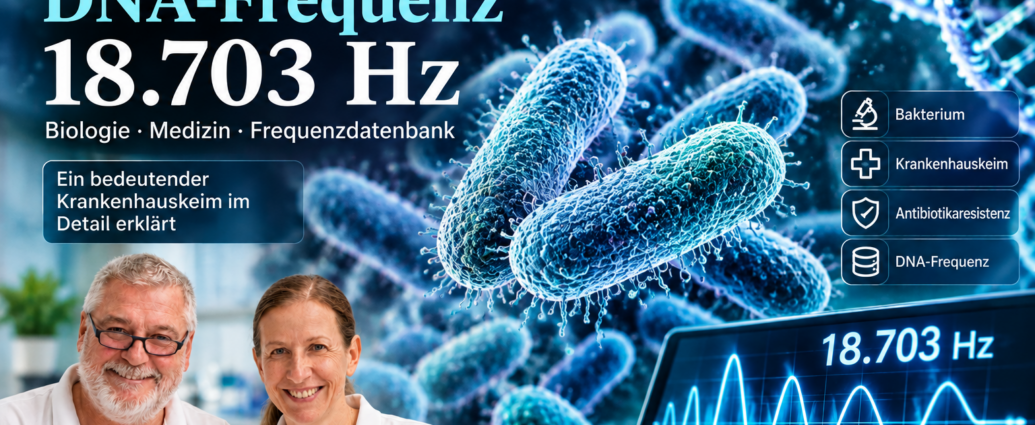
From Herbert Eder | Series of Articles DNA Frequencies
Acinetobacter baumannii is listed in the DNA frequency database used with a frequency of 18,703 Hz. Behind this entry is a bacterium that has garnered attention primarily in connection with hospital-acquired infections and antibiotic resistance.
To better understand this, it is helpful to first consider the organism and its database entry separately. What distinguishes Acinetobacter baumannii? Why is this bacterium medically significant? And what does the entry of 18,703 Hz in a DNA frequency database mean?
This article explains the biological background and presents the frequency value in a clear and understandable way. The following applies: A frequency assignment describes a database entry. On its own, it is neither a diagnosis nor evidence of a therapeutic effect.
Acinetobacter baumannii in the DNA frequency database
The entry can be summarized as follows:
| Characteristic | Information |
|---|---|
| Name in the article | Acinetobacter baumannii |
| Spelling in the DNA Frequency Database | Acinetobacter baumanii |
| Assigned DNA Frequency | 18,703 Hz |
| Conversion to kilohertz | 18,703 kHz |
| Additional strain designation | Not specified in the entry |
The database contains the alternative spelling „Acinetobacter baumanii.“ In this series of articles, it is treated as a spelling error in the species name Acinetobacter baumannii classified and corrected accordingly. The frequency value remains unchanged.
The number 18,703 Hz is written with a period as the thousands separator. This refers to eighteen thousand seven hundred three hertz.
The link remains clear for retrieval purposes: The database name „Acinetobacter baumanii“ and the article discussed here refer to the same entry with the value 18,703 Hz.
What is Acinetobacter baumannii?
Acinetobacter baumannii is a gram-negative, rod-shaped bacterium. The term „gram-negative“ describes its behavior during microbiological staining. It is a characteristic used for biological classification and does not indicate how dangerous a single detection is.
The scientific name consists of two parts: Acinetobacter refers to the genus, baumannii the species. Unlike the Acanthamoeba database entry discussed earlier, this entry therefore identifies a specific species rather than just a genus.
This distinction is important when working with a DNA frequency database. A classification as Acinetobacter baumannii should not be applied to other Acinetobacter species without additional justification.
Similarly, the entry in question does not contain any specific information about a particular strain. The focus is on the species name and the Hertz number; additional characteristics of a specific isolate under study are not specified.
Colonization and infection are not the same thing
An important term in connection with Acinetobacter baumannii is the Settlement, also known as colonization. In this case, the bacterium may be present in a person without causing any illness.
One Infection On the other hand, this indicates that the organism is involved in a disease process. A positive test result must therefore always be evaluated in the context of the body site being examined, the symptoms, and the other findings.
This distinction prevents a common fallacy: The detection of a bacterium does not automatically mean that it needs to be treated. That decision should be left to medical professionals.
It is even less possible to infer a specific medical condition from a name in a frequency database. The entry „Acinetobacter baumannii – 18,703 Hz“ does not contain any test results for a specific person.
It describes a classification within a collection, not an individual's health status.
Why is Acinetobacter baumannii a concern in hospitals?
Acinetobacter baumannii can cause infections, particularly in seriously ill people. Possible illnesses include Pneumonia, as well as infections of the bloodstream, wounds, and the urinary tract.
This bacterium is particularly relevant for people receiving intensive care, on mechanical ventilation, or who require medical access devices such as catheters. Severe underlying medical conditions can also increase susceptibility.
Transmission via Contacts and Objects
Transmission can occur through contaminated hands, surfaces, or medical devices. Therefore, thorough hand hygiene, cleaning, and appropriate protective measures are essential components of infection prevention.
However, the term „hospital-acquired pathogen“ is not a complete biological description. It draws attention to an important medical context, but on its own says nothing about a specific person’s test results.
It is therefore crucial for patients and their families to discuss their individual situation with the treatment team rather than jumping to conclusions based on general information.
Acinetobacter baumannii and Antibiotic Resistance
One reason for seeking medical attention is that certain strains of Acinetobacter baumannii may be resistant to several antibiotics. This can make it more difficult to treat an actual infection.
However, antibiotic resistance does not automatically mean that no treatment is possible. The key factor is which medications are still effective against the specific pathogen and which treatment is appropriate for the infection in question.
A laboratory can test how sensitive the bacterium is to various antibiotics. The doctor's choice also takes into account the affected area of the body, the patient's condition, and other medical factors.
What the frequency database does not reveal
The value 18,703 Hz does not contain any information on the antibiotic susceptibility of a specific strain.
Therefore, it does not indicate whether a bacterium is resistant or whether a particular medication will be effective. Similarly, antibiotic resistance does not automatically mean that a frequency treatment will be effective.
These are two different questions: One concerns sensitivity to medications, and the other concerns the alleged effect of a physical signal. Each would require appropriate studies of its own.
Understanding the 18,703 Hz DNA Frequency
Hertz is the unit of frequency. For a periodic process, it describes how many times the process repeats itself in one second.
A signal generated in this manner with 18,703 Hz thus goes through 18,703 cycles per second. The conversion to kilohertz is:
18,703 Hz = 18.703 kHz
Both notations represent the same numerical value in different units.
However, this information does not yet explain what is being repeated. To do so, we would need to know which physical quantity is being referred to and how the signal is generated or transmitted.
A higher frequency does not automatically mean it is stronger
When comparing this to other database entries, one might get the impression that a higher Hertz value indicates a stronger effect. This conclusion is not justified.
Frequency describes the repetition rate. Signal strength is a different quantity.
So 18,703 Hz although it has a higher frequency than 7,837 Hz from the previous post about Acanthamoeba. However, this does not mean that the first value indicates a stronger, deeper, or more effective application.
Nor can the danger posed by an organism be determined by the magnitude of its assigned Hertz value.
What does „DNA frequency“ mean in the context of Acinetobacter baumannii?
In this series of articles, we use DNA frequency as a designation for classification within the DNA frequency database being used.
The entry links the name Acinetobacter baumannii to 18,703 Hz. However, it does not contain any additional explanation from which an experimentally confirmed natural frequency of the entire DNA could be inferred.
Similarly, the identification alone does not indicate that the bacterium has been specifically inhibited or eliminated.
The correct statement is therefore:
„In the DNA frequency database used, Acinetobacter baumannii is assigned the frequency 18,703 Hz.“
This wording describes the existing entry without implying any further effect.
Why a Full Name Remains Important
A frequency value is easier to understand when it is clear which term it refers to. That is why verifying the name is part of the editorial process.
In this case, the spelling error „baumanii“ is corrected. However, no strain number, specific resistance type, or specific disease is added, as the entry does not contain such information.
This ensures that the presentation remains easy to follow: The spelling is corrected; unconfirmed properties are not added to the database.
What information is missing for a specific application?
A frequency number alone does not constitute a complete application protocol.
For a clear technical description, it would be necessary, for example, to specify the type of signal used, the signal's form, its intensity, and its duration. It would also be important to specify how a potential reaction should be recorded.
This information cannot be derived from the combination of the organism's name and the Hertz value.
Therefore, it is not possible to determine from the entry in question a specific duration of use, the number of repetitions required, or a suitable device setting.
In this post, the focus remains on the Description of the organism and documentation of its database entry. No treatment guidelines are derived from this.
Octaving at 18,703 Hz: The Mathematical Relationships
In this series of articles, we define "octaving" as the repeated halving or doubling of a frequency value.
If the initial value is halved, the following numbers result:
| Calculation step | Frequency |
|---|---|
| Original values from the DNA frequency database | 18,703 Hz |
| Halved once | 9,351.5 Hz |
| Halved twice | 4,675.75 Hz |
| Divided by two three times | 2,337.875 Hz |
These values are related by a clear mathematical relationship. Each step down halves the previous value.
However, the following is crucial for the documentation: The original value considered here is only 18,703 Hz. The other numbers are derived from this and are not additional original entries.
Does the effect remain the same when the amount is halved?
You can't tell that just from the bill.
The statement „The frequency was halved“ describes a mathematical operation. The statement „The effect remains the same“ would be a separate biological claim.
Even if two numbers are related by being doubled or halved, this does not prove that they are equivalent in a given application.
That is why the original value and the conversion are clearly separated in this series.
Why a frequency list is no substitute for a personal diagnosis
A DNA frequency database can match names and numbers. However, it cannot determine on its own whether a particular person is carrying a bacterium or has contracted the disease.
To arrive at a medical diagnosis, a specific situation must be examined. A corresponding row in the table, however, contains neither a sample nor an examination of that person.
This can be illustrated with a simple example: If someone reads the term “Acinetobacter baumannii” in a report and then finds the corresponding database entry, this initially only indicates that this organism name also appears in the frequency collection.
It does not prove that the numerical value is appropriate for the individual situation.
A database mapping can provide additional information. It does not replace the medical interpretation of a test result.
What this database entry effectively conveys
This entry provides a structured introduction to a complex topic. It links a specific name to a documented Hertz value and offers an opportunity to examine the biological background in greater detail.
Its informational value does not lie in promising the most far-reaching effects possible. It lies in the clear distinction between the various levels:
The organism name explains what it is. The frequency value indicates the assigned value. The medical classification describes when the bacterium may be relevant to humans.
Anyone who can distinguish between these levels can work with a DNA frequency database without equating a number with a diagnosis or a confirmed treatment.
Frequently Asked Questions About Acinetobacter baumannii and 18,703 Hz
What DNA frequency is associated with Acinetobacter baumannii?
In the DNA frequency database used, the value is 18,703 Hz stored. This is described in the article as the "original assignment.".
Why does the database say „Acinetobacter baumanii“?
The database contains this alternative spelling. For the article, it is classified as a spelling error and the standard technical term is used. Acinetobacter baumannii corrected. The frequency value remains the same.
Does the entry describe a specific resistant strain?
No. The entry in question does not specify a strain designation or a specific resistance profile. Therefore, this information should not be assumed retroactively.
Is 18,703 Hz a proven treatment frequency?
Mere inclusion in the DNA frequency database does not prove this. Therefore, this article does not present the treatment as a confirmed therapy against Acinetobacter baumannii.
Does a frequency halved have the same effect as the original frequency?
No. Halving the dose yields a mathematically related value. This does not result in the same biological effect.
Can the database value replace a lab result?
No. The test results do not include an analysis of a specific person or sample. They cannot detect colonization, infection, or antibiotic resistance.
Conclusion: Classifying Acinetobacter baumannii and its prevalence rate
Acinetobacter baumannii is listed in the DNA frequency database used at 18,703 Hz. The article corrects the alternative spelling of the name; the associated numerical value is carried over unchanged.
Three things are crucial for understanding: the unambiguous identification of the organism, the correct representation of the frequency, and the distinction between database information and medical application.
This results in an entry that explains the term without attributing an unconfirmed meaning to it.
18,703 Hz is the documented frequency assignment. Whether a specific application is appropriate and effective must be evaluated independently of this.
Medical advice
This contribution serves the Information via a DNA frequency database. The assignment of 18,703 Hz is not a proven treatment protocol and does not constitute a promise of healing. Frequency applications are not a substitute for a medical diagnosis or necessary medical treatment. Prescribed therapies must not be altered, delayed, or discontinued on one’s own initiative due to the use of a frequency application.


Comments are closed, but trackbacks and pingbacks are open.