





From Herbert Eder | Series of Articles DNA Frequencies
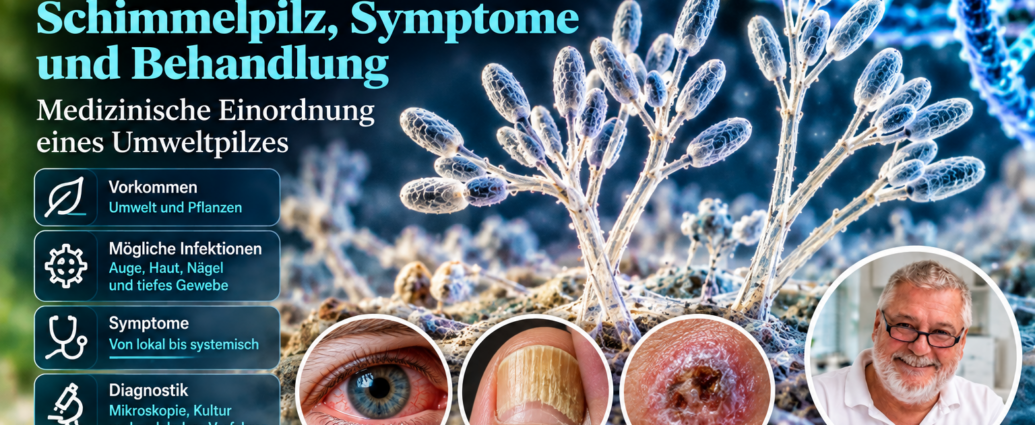
Acremonium refers to a group of molds that are primarily found in the environment. Some species can cause infections in humans, particularly in the cornea of the eye, on the nails, or in deeper tissues. Such conditions are rare but warrant a thorough medical evaluation. The key factor here is not merely the name of the fungus, but the relationship between its detection, the patient’s symptoms, and their overall health. Mycology | University of Adelaide
What does a positive Acremonium test result mean? What symptoms might occur? Who is particularly at risk, and how are such infections diagnosed and treated? This article explains the key medical concepts. The corresponding entries from the DNA frequency database are documented at the end.
What is Acremonium?
Acremonium belongs to the Thread Fungi. These grow with fine fungal filaments, known as hyphae, which together form a fungal network. Small reproductive units called conidia develop on certain structures. Under the microscope, their shape and arrangement, among other characteristics, are important for identification.
The name does not refer to a single species of fungus. In addition, some species formerly classified under Acremonium have since been reassigned to other genera. These include, for example, those now known as Sarocladium kiliense and Sarocladium strictum identified fungi. For this reason, older findings and more recent laboratory reports may use different names for the same organism. Mycology | University of Adelaide
For medical evaluation, it is important to identify the organism as accurately as possible: Molds that look similar are not necessarily the same pathogen and may not have the same sensitivity to medications. PubMed
Where is Acremonium found, and how do infections occur?
Many Acremonium species live in soil and on dead plant material. Their presence is primarily a natural part of the environment. An infection can occur when fungal material enters sensitive areas of the body, for example through a wound. Injuries caused by plant material or contaminated foreign objects play a particularly significant role in corneal infections. Mycology | University of Adelaide
A typical example is an eye injury sustained while gardening or doing farm work. In such cases, a plant part can not only damage the cornea but also introduce microorganisms. Such an infection is also possible in people whose general immune system is not compromised. PubMed Central (PMC)
This should be distinguished from invasive fungal infections, in which fungi penetrate tissues and can affect internal organs. The risk of these diseases is particularly high in individuals with severely compromised immune systems. CDC Stacks
Who is particularly at risk?
In cases of mold infections, you must Local risk factors and a a generally weakened immune system be distinguished.
Factors such as eye injuries, previous surgeries, diseases of the ocular surface, and contact lens use can play a role. Therefore, a person does not necessarily need to have a serious pre-existing medical condition for a fungal infection of the cornea to develop. CDC
In contrast, the risk of invasive fungal infections is particularly elevated in people who have undergone organ or stem cell transplants, those with certain types of cancer, and those undergoing treatment that severely suppresses the immune system. Medications such as corticosteroids can also play a significant role, depending on the dose, duration, and accompanying circumstances. These risk factors apply to fungal infections in general and are not exclusively associated with Acremonium. CDC Stacks
Among the pathogens historically referred to as Acremonium, bloodstream infections associated with central venous catheters have also been described. The clinical situation and possible routes of entry must therefore always be taken into account. PubMed Central (PMC)
What conditions can occur?
Corneal Inflammation: Acremonium Keratitis
One important condition is Fungal keratitis, that is, a fungal infection of the cornea. The cornea forms the transparent front part of the eye and is essential for sharp vision.
Possible symptoms include pain, redness, sensitivity to light, increased tearing, and blurred vision. However, these symptoms can also be caused by other eye conditions. The causative agent cannot be reliably identified based on the symptoms alone. CDC
Acremonium keratitis can lead to a corneal ulcer and permanent damage. Advanced cases may require surgery, including a corneal transplant. A delayed diagnosis can complicate the course of the disease.
A painful, red eye accompanied by blurred vision should be examined by an ophthalmologist immediately—especially after an injury. Attempting to treat a possible fungal infection on your own—especially with cortisone-containing eye drops—can be problematic. PubMed Central (PMC)
Nail Infections
Acremonium can also be found on a Onychomycosis, that is, a fungal infection of the nail. Symptoms described include, for example, discolored and thickened fingernails or toenails. One documented case involves Acremonium egyptiacum, whose precise identification required molecular testing. Jumper
However, in the case of an unusual mold finding, treatment should not be initiated based solely on the name. Environmental molds, in particular, can be present in samples without necessarily being the definitive cause of the abnormality. The assessment must therefore be consistent with the clinical examination and direct fungal detection. Europe PMC
Infections of the Skin and Subcutaneous Tissue
Among the clinical presentations described under Acremonium or earlier Acremonium designations is the Mycetoma. This is a chronic infection that often develops after pathogens enter the body through small breaks in the skin.
Typical symptoms include slowly progressing swelling and channels leading to the skin’s surface, from which fluid and small granules may ooze. As the condition progresses, deeper tissues and bones may be affected. A mycetoma can be caused by fungi or certain bacteria; this distinction is crucial for treatment. Not every mycetoma is caused by Acremonium. Mycology | University of Adelaide
Rare Invasive Infections
In rare cases, infections of the bloodstream and internal organs have also been described under Acremonium classifications. Such courses of the disease can be serious, particularly in immunocompromised individuals or in connection with medical access points. When considering older case reports, it is important to note that the fungal classification used at that time may be different today. PubMed Central (PMC)
Fever, breathing difficulties, or unusual skin changes are not specific to any particular fungus. However, in people with severely compromised immune systems, such symptoms must be evaluated promptly. CDC Stacks
Does a positive test result always mean you have the disease?
No. A positive test for a fungal infection and a fungal infection that requires treatment are not the same thing.
The significance depends, among other things, on the part of the body from which the sample was taken and whether the fungus actually matches the clinical picture. A finding in a respiratory sample or on a surface sample should be interpreted differently than detection in diseased tissue.
In the case of Acremonium, it is also true that identification based solely on appearance can be difficult. Other fungi may look similar. Therefore, a more detailed examination in a specialized laboratory may be necessary before drawing far-reaching conclusions. Europe PMC
How is an Acremonium infection diagnosed?
The process begins with a review of the patient’s symptoms and an examination of the affected area. Important factors include, for example, previous injuries, surgeries, existing immune deficiencies, and medications the patient has already taken.
Appropriate samples are collected depending on the suspected diagnosis. Tissue samples may be necessary for deeper infections; if organ involvement is suspected, imaging studies may also be considered. The findings must be evaluated collectively. CDC Stacks
In the laboratory, direct microscopy and fungal culture can reveal whether fungal structures are present and which organism is growing. Genetic testing can be helpful for more precise identification. For infections that are difficult to treat, testing for susceptibility to antifungal medications is also important. Such a laboratory test supports treatment decisions but does not replace monitoring the clinical course of the disease. PubMed
How are Acremonium infections treated?
Treatment depends on the the affected organ, the extent of the infection, the identified fungus, and the patient's condition. There is no standard treatment regimen for all fungi and clinical presentations classified under Acremonium. Variations in susceptibility to antifungal medications can make the selection process difficult. PubMed
Eye Treatment
Fungal keratitis is treated with specifically indicated antifungal medications. These may include, for example, natamycin eye drops. Depending on the depth, severity, and course of the condition, additional medications or surgical interventions may be necessary.
Regular follow-up with an ophthalmologist and adjusting treatment based on the actual course of the disease are crucial. A treatment that is sufficient in an early-stage case may not be adequate for an advanced corneal ulcer. PubMed Central (PMC)
Treatment of Other Types of Infections
For nail and skin infections, the decision on whether local or systemic treatment is necessary is based on the confirmed diagnosis. In cases of fungal mycetoma, prolonged antifungal therapy and surgical intervention may be required in combination. Jumper
In the case of a bloodstream infection, it is also necessary to identify the site of entry. For example, an infected catheter may contribute to the persistence of the infection and require removal. Such decisions, as well as the selection of medications, should be made under the care of a specialist. PubMed Central (PMC)
What can be done to help prevent this?
When gardening or working with plant material, it is important to protect yourself from injuries. Appropriate footwear can be especially helpful in situations where sharp parts of plants could injure the skin. After minor injuries, it is advisable to clean the wound and monitor its progress. Persistent swelling or a wound that does not heal should be examined. World Health Organization
People with severe immune deficiencies should take mold exposure particularly seriously. In the event of water damage or visible mold, they should not attempt to clean up the area themselves and should avoid contaminated rooms as much as possible. For the living environment, eliminating the causes of moisture and performing proper remediation are more important than simply identifying a single species of mold. CDC
Frequently Asked Questions About Acremonium
Is Acremonium a bacterium?
No. Acremonium is a type of mold. Its biological classification and the required treatment therefore differ from those of bacterial infections. Mycology | University of Adelaide
Can Acremonium cause an infection even in healthy people?
Yes. In particular, a localized infection following an injury—such as to the cornea—can occur even in the absence of significant systemic immunodeficiency. PubMed Central (PMC)
Does every case of Acremonium infection require treatment?
Not automatically. The test results must be evaluated in light of the type of sample, the patient's symptoms, and other test results. Europe PMC
Can this condition affect vision?
A fungal infection of the cornea can cause permanent damage. Therefore, you should not wait for pain or vision loss to develop; instead, you should see an ophthalmologist promptly for an evaluation. Europe PMC
Conclusion: Assess symptoms and test results together
If Acremonium is detected, three questions are crucial: Which fungus was actually identified? Does the identification match the symptoms? What treatment is needed for the affected area of the body?
An accurate diagnosis prevents both unnecessary treatment and dangerous delays. An early evaluation by a specialist is particularly important in cases of eye problems and for people with severely compromised immune systems. Europe PMC
Acremonium in the DNA Frequency Database
The following entries are documented in the DNA frequency database used:
| Database Name | Assigned DNA Frequency |
|---|---|
| Acremonium 1 | 10,624 Hz |
| Acremonium 2 | 11,792 Hz |
This information documents only matches from the DNA frequency database. No claims regarding medical effects or promises of healing are derived from it. It is not a substitute for medical diagnosis or treatment.

Comments are closed, but trackbacks and pingbacks are open.