




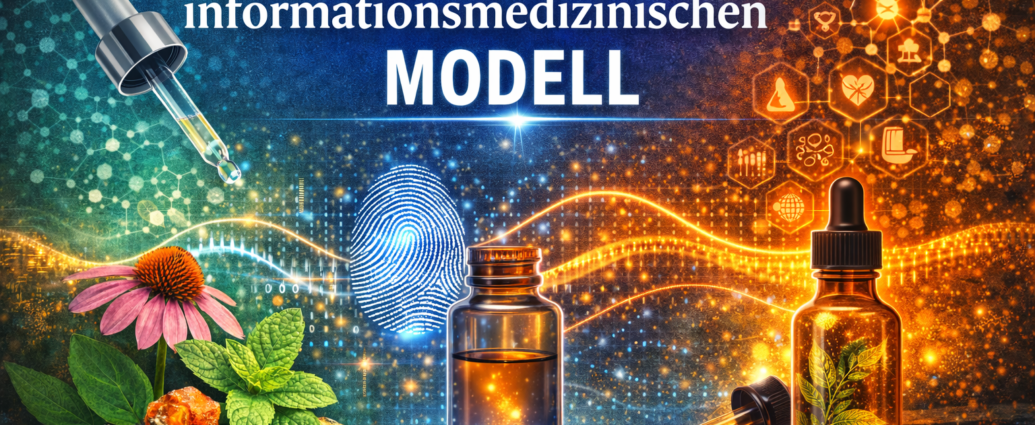
What does the application in the information medicine model mean? This article explains how natural signatures, carrier media and Frequency therapy work together as a complementary information concept.
Since natural substances are Source of information, which Digitization of signatures and the Transfer to a carrier medium a crucial question arises: How is this concept actually applied in the information medicine model? This is where the practical part of the mindset that is based on www.herbert-eder.com again and again in connection with Frequency therapy, Information medicine and Frequency droplets is described.
The application in the information medicine model means that a Fabric, a plant, a mineral or another natural model not only as a material, but also as a Carrier of characteristic information is understood. This information is to be captured in the model, digitized, transferred to a carrier medium and then made available to the organism in a form that is not based on classical chemistry, but on Information, Resonance and order is based on.
This makes the application fundamentally different from conventional medical or naturopathic procedures. The focus is not on the pharmacological dose, but on the imaginary provision of an information-related pattern.
What does „application“ mean in this context?
The term Application here does not simply mean taking, applying or using a preparation. In the information medicine model, application is meant more comprehensively. It refers to the entire process in which a specific information pattern is brought into relationship with the organism.
This includes several levels in the model:
- Selection of a natural or thematic template
- Assignment of a signature
- Digitization or coding
- Transfer to a carrier medium
- Provision for the user
- Reaction of the organism in the sense of resonance or regulation
The application is therefore not just a final step, but the point at which the entire model should become practically relevant.
The human image of information medicine
In order to understand the application, one must first consider the underlying concept of man. In classical medicine, the human being is primarily understood as a biochemical organism. Metabolism, receptors, enzymes, hormones and nerve pathways are at the center.
The Information medicine expands this view. It also views people as:
- Information processing system
- resonant organism
- Bioenergetically regulated whole
- complex network of order, communication and reaction
In this model, the human being is not just matter, but also a system that processes signals, reacts to patterns and regulates on various levels. This is precisely why the application of information-related concepts in this model seems plausible.
The basic assumption: information can be biologically relevant
The application in the information medicine model is based on a central assumption: Not only substances, but also organized information could be relevant for biological systems.
In a broader sense, this idea has certain links to recognized biological processes. After all, the organism also works with information in the classical sense:
- DNA stores blueprints
- Nerve cells transmit signals
- Hormones send messages
- Receptors recognize certain patterns
- Cell communication is highly organized
However, information medicine goes one step further. It asks whether signatures of natural substances or digitized patterns could also have a meaning for the organism. The application then consists of providing precisely this information in a targeted manner.
From the template to the application
In the information medicine model, the application usually follows a chain of thought. This can be described as follows:
1. selection of a natural substance or theme
For example:
- Medicinal plants
- Minerals
- Trace elements
- Blossoms
- Mushrooms
- regulatory topics
- Emotional or functional assignments
2. definition of a signature
A characteristic information pattern is assigned to the template:
- Frequency image
- Resonance profile
- energetic signature
- digital coding
3. digitization or recording
This signature is processed in the model so that it can be stored or transferred.
4. transfer to a carrier medium
The information is transferred to a neutral base, for example in the form of drops.
5. application on humans
The medium is used so that the organism comes into contact with the assigned information.
In this logic, the application is the step in which the prepared information is actually used within the framework of a complementary model.
Application not as chemistry, but as information
The most important difference to classical medicine is that the application of the information medicine model not primarily via chemical reactions is thought. In the case of a drug, it is clear that an active substance is absorbed, binds to a structure and changes a process.
In the information medicine model, on the other hand, the idea is:
- The focus is not on the material.
- But the assigned information pattern.
- The chemical reaction is not the main mechanism.
- But resonance, order and regulation.
This is precisely why this model can only be understood if the difference between Material and information clearly in mind.
The role of frequency drops
A particularly vivid example of the application in the information medicine model are Frequency droplets. They are almost prototypical for the idea that a natural substance can be provided not as a material but as information.
The following happens in the model:
- A plant or a natural substance serves as a template.
- Your signature is digitized or assigned.
- This information is transferred to a neutral carrier medium.
- The user uses this medium in drop form.
The application of the frequency drops should then not take place via classical pharmacology, but via the contact of the organism with an information-related pattern.
Why „model“ is an important word
In this context in particular, the word Model of great importance. It shows that we are not talking here about a generally recognized scientific fact, but about a framework of thought and explanation within information medicine.
A model helps to organize relationships and make applications understandable. However, it does not automatically mean that every assumed mechanism has already been scientifically proven. That is why the wording should be deliberate:
- in the information medicine model
- within a complementary concept
- from the perspective of frequency therapy
- as a hypothetical or experience-based approach
This linguistic care is crucial for a serious approach to the topic.
Aim of the application from this perspective
Within the information medicine model, the application is not usually associated with a classic intervention in the sense of suppression or blockage. Instead, it is more about:
- Support for regulation
- Promoting balance
- Stimulation of resonance
- Provision of an order impulse
- Accompanying biological self-organization
The application is therefore more likely to be Pulse generation understood as a pharmacological control mechanism. This is a completely different way of thinking than that of classical drug therapy.
Information, resonance and regulation
Three terms are particularly important for use in the information medicine model:
Information
Information here means the assigned pattern, the signature or the coded profile.
Resonance
Resonance describes the imagined reaction of the organism to this information.
Regulation
Regulation describes the desired effect within the model: the organism should be addressed or supported in its inner order.
In a way, these three terms form the core of the application in information medicine thinking.
Application as a relationship, not as coercion
Another interesting difference to classical pharmacology is that the application in the information medicine model is often described as Relationship offer is understood. The organism should not be chemically forced, but should be able to react to a provided pattern.
This means in the model:
- The information is offered.
- The organism absorbs them or reacts to them.
- The reaction is one of resonance, not compulsion.
- Regulation remains the system's own responsibility.
This view appeals to many people because they see health not just as a repair process, but as a dynamic balance.
Personalization within the model
Another important aspect is the Individualization. The application in the information medicine model is often not understood as rigid, but as adaptable. This is because when working with signatures, patterns and information, these can be used in the model:
- individually selected
- combined
- thematically adapted
- individually compiled
- be related to specific situations
This personalization is one of the reasons why information medicine concepts appear interesting to many users.
Application in everyday life
From a practical point of view, the application in the information medicine model is often thought of in such a way that it can be integrated into everyday life. Easily applicable forms therefore play a major role, for example:
- Drops
- Information in digital form
- Accompanying frequency applications
- individualized information concepts
Suitability for everyday use is important because the application should not only be interesting in theory, but should also appear practical. This is exactly where carrier media and standardized forms such as frequency drops come into play.
The link to natural substances
Even if the end result is a carrier medium or digital information, the connection to natural substances remains central. In the model, plants, minerals or other natural substances are often the origin of the signature.
This means:
- Nature provides the template.
- The signature describes the pattern.
- Digitization makes it available.
- The application brings it into relation with the organism.
Without this origin in natural models, the model would be much more abstract. It is precisely the combination of nature and information that makes it so appealing.
Application in complementary subject areas
In the Practice The information medicine model is often described in connection with general topics such as
- Regulation
- Balance
- Load balancing
- Support for well-being
- energetic accompaniment
- Supplementary measures in a holistic context
Precise language is particularly important here. Statements should not give the impression of a scientifically proven medical effect if this has not been proven. Serious formulations therefore speak of Accompaniment, complementary application or information medicine model.
A sensitive topic: serious illnesses and cancer
As with all texts relating to frequency therapy, particular caution is required in the case of serious illnesses, especially in the case of Cancer diseases. In stressful situations, many people look for complementary ways. That is understandable. Nevertheless, it must remain clear:
The application in the information medicine model is No scientifically recognized cancer therapy. It does not replace a medical diagnosis, oncological treatment or other evidence-based medical measures.
Particularly in the case of cancer, it is essential to describe complementary concepts only as a supplement within a broader framework of thought, never as a substitute for necessary medical care. This difference must be made clear in any serious presentation.
Why the model is fascinating for many people
Despite all the unanswered questions, the information medicine model exerts a great fascination. This is because it combines several levels:
- Nature and technology
- Material and information
- Resonance and regulation
- Individualization and holism
- Frequency therapy and modern concepts
Many people find this connection contemporary because they want to understand health not just in biochemical terms, but as a complex interplay of patterns, order and communication.
Scientific classification
Sober classification is crucial here. It is undisputed that biological systems process information. The fact that signals and patterns play a major role in the organism is also undisputed. However, it is not generally accepted that digitized or transmitted signatures of natural substances without a material component have reproducible biological effects.
A clear distinction should therefore always be made between:
- reliable biological knowledge
- plausible models of system regulation
- complementary hypotheses of information medicine
- individual experience reports
- scientifically not generally confirmed assumptions
It is precisely this differentiation that creates trust and reliability.
Reference to Herbert Eder and www.herbert-eder.com
On www.herbert-eder.com the application of the information medicine model is placed in a larger context. It is not just about individual drops or signatures, but about an expanded understanding of the human being as a system of matter, resonance, order and information. The application is the practical expression of this way of thinking.
This approach forms a common thread, especially for topics such as frequency drops, natural substances, signatures and frequency therapy. It makes it easy to understand how a complementary application concept is developed from natural substances, digital patterns and carrier media.
Conclusion: Application in the information medicine model
The Application in the information medicine model describes the practical use of signatures, information and carrier media within a complementary framework of thought. The focus is not on the material active ingredient, but on the assumption that natural templates serve as a source of information and that their signatures can be harnessed in a resonance-oriented model.
This application is not conceived chemically, but informatively. In the model, it is aimed at resonance, regulation and balance. This is precisely why it is closely linked to topics such as Frequency droplets, Digitization of signatures and Transfer to a carrier medium connected.
At the same time, responsible language remains essential: the underlying assumptions are not recognized by conventional medicine and are not generally scientifically proven. On www.herbert-eder.com This topic is therefore presented in the context of an extended understanding of information medicine, which should combine openness with differentiation.
Note
The contents described originate from the field of information medicine and complementary frequency theory. The underlying assumptions are not recognized by conventional medicine and are not generally scientifically proven. Frequency therapy does not replace a medical diagnosis or treatment, especially not for serious illnesses such as cancer.
Comments are closed, but trackbacks and pingbacks are open.