





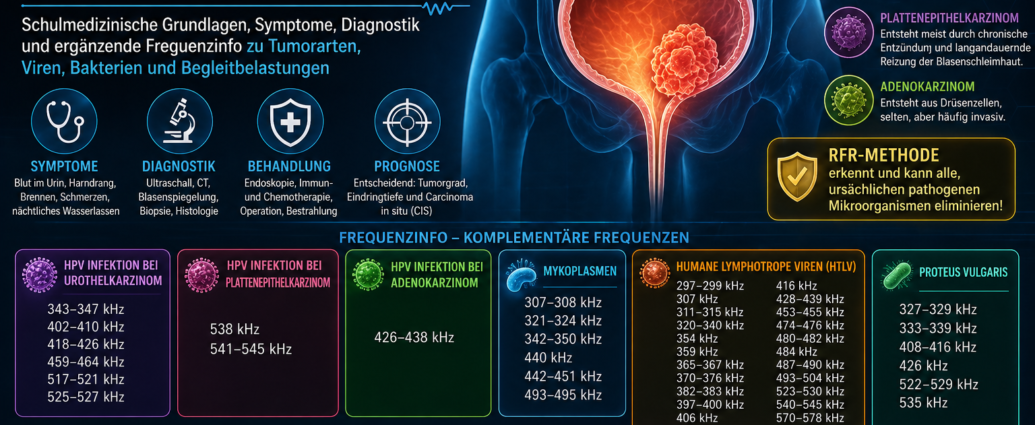
The Frequency therapy for bladder cancer is described in a complementary context as a supplement to conventional medical principles, tumor forms, diagnostics and treatment options. Bladder cancer develops from cells in the bladder, with the inner lining of the bladder wall being particularly frequently affected. As the bladder is made up of different cell types, different types of tumors can develop.
From a conventional medical point of view, a distinction is made between urothelial carcinoma, squamous cell carcinoma and adenocarcinoma of the urinary bladder. These tumor forms differ in their development, their growth behavior and their possible spread. The literature also describes certain resonance frequencies that can be used as complementary therapies in the context of frequency therapy. Frequency info can be considered.
Frequency therapy for bladder cancer: conventional medical overview
The urinary bladder is a storage organ of the urinary tract. Its inner surface is lined with a special mucous membrane, the so-called urothelium. This tissue is not only found in the bladder, but also in the renal pelvis, the ureters and parts of the urethra. It is precisely from this urothelium that the most common malignant tumors of the urinary bladder arise.
Bladder cancer can progress with varying degrees of aggression. Some superficial tumors grow slowly and initially remain limited to the mucous membrane. Other tumors penetrate deeper into the bladder wall, reach the musculature and can spread to neighboring organs, lymph nodes or distant regions of the body.
The exact classification is particularly important in conventional medicine because it determines treatment planning, prognosis and follow-up. Tumor grade, penetration depth, growth pattern and the presence of carcinoma in situ play a central role.
Frequency therapy for bladder cancer and tumor types
Bladder cancer is not a uniform clinical picture. It can arise from different types of cells. The name of the tumor depends on the tissue from which it arises.
Urothelial carcinoma of the urinary bladder
Urothelial carcinoma, formerly often referred to as transitional cell carcinoma, is the most common form of bladder cancer. It develops from the cells of the inner bladder mucosa. These cells can lose their normal control due to various stimuli, genetic changes and chronic stress and begin to multiply unchecked.
Urothelial carcinomas can grow superficially or penetrate deeper into the bladder wall. Superficial forms initially remain limited to the mucous membrane and underlying tissue layers. Invasive forms reach at least the muscle layer of the bladder and are considered much more serious.
Squamous cell carcinoma of the urinary bladder
Squamous cell carcinoma develops from flat, thin cells that can form particularly in the case of prolonged irritation or chronic inflammation. This type of tumor is often associated with months or years of stress on the bladder mucosa.
Chronic inflammation, recurrent infections, irritation caused by foreign bodies or certain parasitic loads can play a role here. In tropical countries, the literature particularly describes schistosome contamination in connection with certain bladder tumors.
Adenocarcinoma of the urinary bladder
Adenocarcinoma develops from glandular cells. Glands are specialized cell structures that can form and release fluids or mucus. Adenocarcinomas of the urinary bladder are rarer than urothelial carcinomas, but often show invasive growth.
In conventional medical evaluation, adenocarcinomas must be clarified particularly carefully, as they must be differentiated from other tumor forms or from tumors of neighboring organs.
Frequency therapy for bladder cancer: tumor grade and growth
Bladder tumors are classified according to their biological behavior. The tumor grade plays an important role. Low-grade tumors usually show fewer cell changes and often grow less aggressively. High-grade tumors exhibit greater cell abnormalities and can have a significantly higher risk of progression, recurrence and spread.
In the literature, bladder tumors are described as low-grade tumors of grades 1 and 2 as well as high-grade tumors of grade 3. The tumor grade indicates the extent to which the cancer cells differ from normal cells.
The growth pattern is also significant. Bladder tumors can grow papillary, broad-based, mixed or nodular. Papillary tumors often grow finger-shaped into the interior of the bladder. Broad-based or nodular forms can be more strongly connected to the bladder wall and, depending on their depth and cell type, are considered to require special clarification.
Carcinoma in situ of the urinary bladder
Carcinoma in situ is a flat, superficial but high-grade cell change in the urothelium. It does not grow like a visible polypous tumor. Tumor into the bladder cavity, but spreads over a large area within the mucous membrane.
Although it is considered non-invasive, it is of particular importance due to its high degree of cellular alteration. It can be associated with an increased risk of progression and is therefore taken very seriously by conventional medicine.
Three factors in particular are decisive for the prognosis of bladder cancer: the tumor grade, the depth of invasion into the bladder wall and the presence of carcinoma in situ.
Superficial and invasive bladder cancer
Bladder cancer is often divided into superficial and invasive forms. This distinction is essential for treatment planning.
Superficial bladder cancer remains limited to the inner layers of the bladder wall. This includes the mucous membrane and the underlying lamina propria. Such tumors can nevertheless recur and must be checked regularly.
Invasive bladder cancer penetrates deeper into the wall of the bladder. As soon as the muscles are affected, the risk of spread increases significantly. Muscle-invasive tumors usually require more intensive treatment planning.
Almost all adenocarcinomas and squamous cell carcinomas of the urinary bladder are described in the literature as frequently invasive. Urothelial carcinomas, on the other hand, can occur both superficially and invasively.
Spread of bladder cancer
Bladder cancer often initially spreads to neighboring structures and regional lymph nodes. Only later can it spread via the bloodstream to distant organs. The lungs, liver, bones and other organs can be particularly affected.
In men, advanced bladder cancer can grow towards the prostate, seminal vesicles or pelvic structures. In women, the uterus, vaginal wall or other pelvic organs may be affected. The exact spread is assessed using imaging techniques and tissue examinations.
The distinction between localized, lymphatic disseminated and distant metastatic disease is crucial for further treatment.
Benign papillary bladder tumors
Not every papillary change in the bladder is malignant. Benign papillomas can grow as small, wart-like or finger-shaped protrusions inside the bladder. In many cases, they can be easily removed.
Nevertheless, such changes can occur again. Therefore, follow-up checks are important, especially if there are recurring complaints or abnormal findings.
In the complementary context of frequency therapy, papillary changes are often also considered from the perspective of mucosal resonance, chronic irritation and possible microbial stress patterns.
Genetic changes in bladder cancer
Various genetic changes associated with bladder cancer have been described in the literature. These include changes in tumor suppressor genes and oncogenes. In a healthy state, tumor suppressor genes act like biological control mechanisms that can slow down uncontrolled cell growth. If they are altered or switched off, cell growth can be derailed.
Mutations in the p53 gene on chromosome 17 are associated with high-grade bladder cancer and carcinoma in situ. Mutations in p15 and p16 on chromosome 9 are more frequently mentioned in the literature in low-grade and superficial tumors.
Changes in the retinoblastoma tumor suppressor gene and increased activity of certain growth factors and oncogenes have also been described in connection with bladder cancer. These include the epidermal growth factor, erb-K1, p21 ras, c-myc and c-jun.
Frequency therapy for bladder cancer and possible concomitant stresses
The literature mentions various accompanying microbial strains in bladder cancer. These include mycoplasmas, human papillomaviruses, human lymphotropic Viruses, Cytomegalovirus, Epstein-Barr virus, herpes simplex viruses, Coxsackieviruses, adenoviruses, Proteus bacteria, Candida species, Escherichia coli, Gardnerella, Shigella, nanobacteria, ureaplasma and, in tropical countries, schistosomes.
In the complementary understanding of frequency therapy, such details are not considered in isolation, but as part of a comprehensive environment. Chronic inflammation, mucosal irritation, immune stress and impaired regulatory capacity can play a role in frequency therapy.
Viral and bacterial resonance patterns are repeatedly described in the literature, particularly in tumors of the urogenital tract. These frequency ranges can be documented and individually examined as part of the supplementary frequency information.
Possible symptoms of bladder cancer
Bladder cancer can manifest itself through various symptoms. A common warning sign is blood in the urine. This may be visible or only detected in the laboratory. Blood in the urine does not necessarily mean cancer, but should always be carefully investigated.
Other possible symptoms include a burning sensation when urinating, a frequent urge to urinate, urinating at night, a feeling of pressure in the lower abdomen, pain in the pelvic area or recurring symptoms reminiscent of cystitis.
With advanced disease, pain, weight loss, fatigue, reduced performance, flank pain or discomfort caused by Metastases may occur. If ureteral drainage or kidney function is impaired, additional problems may arise.
Frequency therapy for bladder cancer and conventional medical diagnostics
Bladder cancer is diagnosed by conventional medicine using a combination of medical history, physical examination, laboratory values, imaging procedures and direct examination of the bladder.
The most important examinations include ultrasound, computer tomography, intravenous imaging of the urinary tract, cystoscopy, tissue sampling and histological examination. Cystoscopy is particularly important because suspicious changes can be seen directly and removed or biopsied if necessary.
The histological examination determines the type of tumor, tumor grade and depth of penetration. This is the basis for further treatment planning. In addition, imaging procedures can help to assess lymph nodes, neighboring organs and possible metastases.
Conventional medical treatment options for bladder cancer
Treatment depends on the type of tumor, tumor grade, depth of penetration, spread and general condition of the patient. Superficial tumors can often be removed endoscopically. This can be followed by local treatment in the bladder.
Intravesical procedures include local immunotherapy and local chemotherapy. In these procedures, active substances are injected directly into the bladder. Methotrexate, vinblastine, adriamycin and cisplatin, among others, are mentioned in the literature in connection with chemotherapeutic approaches, often in combinations.
Radical surgery may be necessary for muscle-invasive or advanced bladder cancer. In men, this may involve radical removal of the bladder and prostate. In women, an anterior pelvic exenteration may be necessary. In certain cases, external radiotherapy, systemic therapies or combined treatment concepts are also used.
Frequency therapy for bladder cancer in a complementary context
Frequency therapy looks at biological processes from the point of view of vibration, Resonance and regulatory capacity. Frequency lists can serve as additional orientation, especially if certain resonance ranges are repeatedly mentioned in the literature with tumor forms, viruses, bacteria or mucosal stress.
In bladder cancer, various frequency patterns are described in the literature that relate to human papillomaviruses, mycoplasmas, human lymphotropic viruses and Proteus bacteria. These frequencies are not used in the complementary application as isolated Information but in connection with the overall condition of the urogenital tract, the mucous membranes, the immune situation and possible chronic stress patterns.
Frequency therapy can form a supplementary level of observation. Of particular interest are overlaps between tumor form, infection patterns and chronic inflammation. Such frequency patterns can be documented and taken into account in a holistic concept.
Frequency therapy and cancer in an expanded view
Cancers are caused by complex changes in cell control, tissue environment, immune regulation and biological communication. In the case of bladder cancer, the mucous membrane of the urinary bladder is in constant contact with excretory substances, possible inflammatory stimuli and microbial contamination.
Frequency therapy views cancer in a broader sense as an expression of disturbed order, altered Cell communication and stressed regulatory systems. This includes not only the tumor itself, but also the surrounding environment, possible chronic inflammation, viral and bacterial resonance patterns and the energetic load on the entire organism.
This consideration can be particularly interesting in the case of bladder cancer because many tumors arise from mucosal tissue and numerous accompanying microbial factors are mentioned in the literature. The supplementary frequency information provides a structured overview.
Frequency info: Urothelial carcinoma of the urinary bladder
The following frequencies are mentioned in the literature in connection with HPV exposure in urothelial carcinoma of the urinary bladder. They are regarded as resonance ranges in the complementary context of frequency therapy.
Frequency therapy for urothelial carcinoma
343-347 kHz,
402-410 kHz,
418-426 kHz,
459-464 kHz,
517-521 kHz,
525-527 kHz.
These frequencies are described in connection with HPV resonances in urothelial carcinoma. In the context of frequency therapy, they can serve as additional orientation for documentation and individual consideration.
Frequency info: Squamous cell carcinoma of the urinary bladder
In the literature, squamous cell carcinoma of the urinary bladder is often associated with chronic irritation and inflammation. HPV resonances are also mentioned, which are considered in this context.
Frequency therapy for squamous cell carcinoma
538 kHz,
541-545 kHz.
These frequencies are described in the literature in connection with HPV exposure in squamous cell carcinoma of the urinary bladder. They can be considered in the complementary frequency context.
Frequency information: Adenocarcinoma of the urinary bladder
Adenocarcinoma of the urinary bladder develops from glandular cells. A specific HPV resonance range is also mentioned in the literature.
Frequency therapy for adenocarcinoma
426-438 kHz.
This frequency range is described in connection with HPV resonances in adenocarcinoma of the urinary bladder and can be used as supplementary information in complementary frequency therapy.
Frequency info: Mycoplasma
Mycoplasmas are described in the literature as a possible concomitant burden in bladder carcinomas. Particular mention is made of Mycoplasma fermentans, Mycoplasma penetrans, Mycoplasma genitalium and, rarely, Mycoplasma pneumoniae.
Frequency therapy for mycoplasma
307-308 kHz,
321-324 kHz,
342-350 kHz,
440 kHz,
442-451 kHz,
493-495 kHz.
These resonance areas are mentioned in connection with mycoplasmas. In a complementary context, they can be documented particularly in cases of chronic urogenital stress, mucosal irritation and recurring complaints.
Frequency info: Human lymphotropic viruses
Human lymphotropic viruses are also mentioned in the literature as possible accompanying factors in bladder carcinomas. The specified frequency ranges are widely spread and can be regarded as supplementary resonance information in frequency therapy.
Frequency therapy for human lymphotropic viruses
297-299 kHz,
307 kHz,
311-315 kHz,
320-340 kHz,
354 kHz,
359 kHz,
365-367 kHz,
370-376 kHz,
382-383 kHz,
397-400 kHz,
406 kHz,
416 kHz,
428-439 kHz,
453-455 kHz,
474-476 kHz,
480-482 kHz,
484 kHz,
487-490 kHz,
493-504 kHz,
523-530 kHz,
540-545 kHz,
570-578 kHz.
This frequency list shows a variety of possible resonance ranges. In complementary applications, it can serve as a comprehensive guide for frequency therapy considerations.
Frequency info: Proteus vulgaris
Proteus bacteria are repeatedly mentioned in the literature in cases of urogenital stress. Proteus vulgaris can be considered in connection with chronic urinary tract stress, bladder milieu and inflammatory processes.
Frequency therapy for Proteus vulgaris
327-329 kHz,
333-339 kHz,
408-416 kHz,
426 kHz,
522-529 kHz,
535 kHz.
These frequencies are described in the literature as frequent resonance ranges of Proteus vulgaris. In frequency therapy, they can be of particular interest for recurring urogenital stress patterns.
Frequency therapy for bladder cancer: comparison of frequency patterns
When comparing the frequency lists, it is noticeable that some ranges are repeated or are close to each other. Particularly noticeable are resonance ranges around 402-410 kHz, 418-426 kHz, 426-438 kHz, 428-439 kHz and 540-545 kHz. These ranges are mentioned in the literature for various viral and bacterial strains.
This overlap is interesting for complementary frequency therapy because it can indicate recurring resonance fields in connection with the mucous membrane, urogenital tract, viral patterns and chronic stress.
The frequency lists are therefore not considered in isolation, but are integrated into an overall picture. This includes the type of tumor, conventional medical findings, tissue type, inflammatory tendency, immune stress and individual regulatory situation.
Frequency therapy for bladder cancer: Summary
Bladder cancer can develop from various cell types in the bladder. The most common is urothelial carcinoma, but there are also squamous cell carcinomas and adenocarcinomas. The progression ranges from superficial, slow-growing tumors to high-grade, invasive and potentially life-threatening forms of the disease.
In conventional medicine, tumor grade, depth of invasion, growth pattern and the presence of a carcinoma in situ are decisive. The diagnosis is made using ultrasound, computer tomography, intravenous urinary tract imaging and cystoscopy, Biopsy and histologic examination. Treatment can range from endoscopic removal, local immunotherapy or chemotherapy to radical surgery, radiotherapy and systemic therapies.
Frequency therapy offers a supplementary level of observation. Resonance frequencies for HPV exposure in urothelial carcinoma, squamous cell carcinoma and adenocarcinoma as well as for mycoplasma, human lymphotropic viruses and Proteus vulgaris are mentioned in the literature. These frequency lists can be used in a complementary context for documentation, resonance observation and individual frequency therapy work.


Comments are closed, but trackbacks and pingbacks are open.