





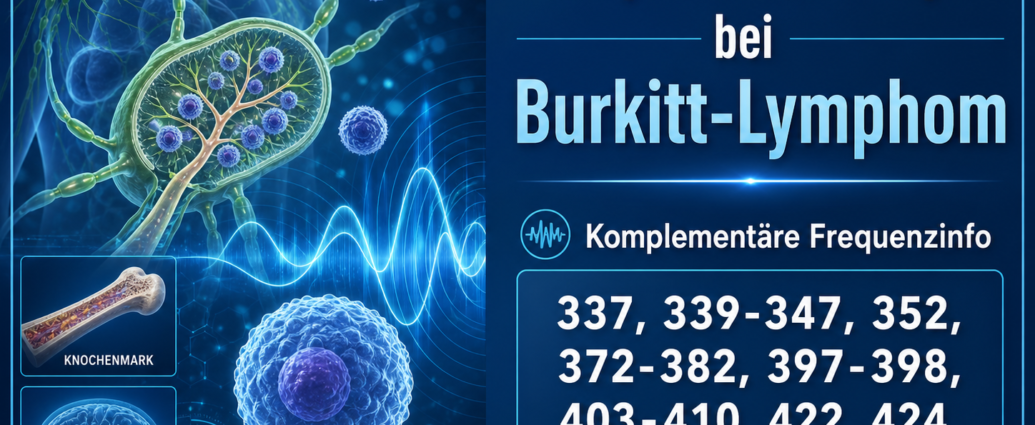
The Frequency therapy in Burkitt's lymphoma is described in the complementary context as a supplementary perspective on the fundamentals, spread, symptoms, diagnosis, treatment, and possible resonance patterns of conventional medicine. Burkitt lymphoma is a very high-grade Non-Hodgkin lymphoma, which arises from B lymphocytes and is characterized by rapid growth.
From a conventional medical perspective, Burkitt’s lymphoma is considered one of the most aggressive forms of lymphoma. It can spread rapidly beyond the traditional lymphatic system and affect the bone marrow, blood, central nervous system, and cerebrospinal fluid. The literature also describes a link to the Epstein-Barr virus. At the end of this article, the frequencies cited in the literature are presented as complementary Frequency info listed.
Frequency Therapy for Burkitt Lymphoma: An Overview of Conventional Medicine
Burkitt lymphoma is a malignant disease of the lymphatic system. It originates in B lymphocytes, which are immune cells normally involved in antibody production. When these cells become malignant, they can multiply very rapidly and form large tumor masses.
The term „high-grade“ describes aggressive biological behavior. High-grade lymphomas grow rapidly, can spread quickly, and require prompt conventional medical evaluation and treatment. Burkitt lymphoma is one of the fastest-growing forms of lymphoma.
Although it belongs to the group of non-Hodgkin lymphomas, it has distinctive characteristics. These include very rapid cell growth, a B-cell origin, and a tendency to spread to areas outside the lymph nodes.
Frequency therapy for Burkitt's lymphoma and B lymphocytes
B lymphocytes are an important part of the immune system. They can develop into plasma cells and produce antibodies. In this way, they help the body recognize and fight pathogens.
In Burkitt lymphoma, B lymphocytes become malignant. These cells lose their normal growth control and divide at an unusually rapid rate. As a result, a significant tumor mass can develop within a short period of time.
Because B lymphocytes are part of the lymphatic system and can travel throughout the body, the disease is not always confined to a single area. It can affect lymph nodes, bone marrow, blood, and other organs.
Burkitt lymphoma as a type of non-Hodgkin lymphoma
Non-Hodgkin lymphomas are a diverse group of malignant diseases of the lymphatic system. They differ in terms of cell type, growth rate, spread, and response to treatment.
Burkitt lymphoma is a highly malignant, rapidly growing form of non-Hodgkin lymphoma. Biologically speaking, it is at the aggressive end of the spectrum. Without timely treatment, the disease can progress rapidly.
Unlike slow-growing lymphomas, prompt diagnosis is particularly important in Burkitt lymphoma. The high rate of tumor cell division can lead to rapid disease progression and significant systemic effects.
Frequency Therapy for Burkitt Lymphoma and Epstein-Barr Virus
In the literature, Burkitt's lymphoma is associated with the Epstein-Barr virus. This Virus is also known as a possible cause of Pfeiffer's glandular fever, which is medically referred to as infectious mononucleosis.
The Epstein-Barr virus belongs to the herpesvirus family and can infect B lymphocytes. Since Burkitt’s lymphoma arises from B lymphocytes, this association is particularly significant in the literature.
In the complementary context of frequency therapy, the EBV connection is viewed as a possible resonance pattern. In this context, it is not only the Tumor not only the primary focus, but also the interplay between viral load, immune regulation, the lymphatic system, bone marrow, and individual regulatory capacity.
Burkitt's Lymphoma and Immunodeficiency
The literature indicates that Burkitt lymphoma frequently occurs in people with AIDS. This highlights the importance of the immune system in controlling lymphatic tumor processes.
When the immune system is weakened, viral infections, abnormal cells, and impaired lymphocyte regulation can more easily play a role. In the case of lymphomas in particular, there is a particularly close link between the state of the immune system and tumor development.
In complementary frequency-based thinking, therefore, the focus is not limited to the individual tumor cell. The immune environment, viral resonance fields, lymph flow, bone marrow, and systemic stressors are also considered as a whole.
Spread of Burkitt's lymphoma
Burkitt lymphoma tends to spread rapidly to areas outside the lymphatic system. The literature specifically mentions the bone marrow, blood, central nervous system, and cerebrospinal fluid.
This spread is particularly significant from a clinical standpoint. If the bone marrow is affected, normal blood formation can be disrupted. If the central nervous system or the cerebrospinal fluid are involved, neurological symptoms may develop.
This rapid spread explains why comprehensive staging and treatment are necessary. In conventional medicine, Burkitt lymphoma is considered a systemic disease.
Possible symptoms of Burkitt lymphoma
Symptoms depend on which parts of the body are affected. Because of the rapid growth, symptoms can worsen quickly. Lymph nodes or other tissues can swell within a short period of time.
Possible symptoms are
- rapidly growing swollen lymph nodes
- palpable tumor masses
- Fever
- Night sweats
- Weight loss
- Tiredness
- Power reduction
- Stomachache
- Feeling of pressure
- Bone marrow problems
- Changes in blood counts
- neurological symptoms
- Headache
- Nausea or vomiting associated with central nervous system involvement
- Susceptibility to infection
- general weakness
Because Burkitt lymphoma grows very quickly, symptoms can become significantly more severe within a short period of time.
Bone marrow and blood in Burkitt's lymphoma
If the bone marrow is affected, normal blood production may be disrupted. This can lead to anemia, increased susceptibility to infections, and a tendency to bleed.
Anemia can cause fatigue, paleness, and shortness of breath. A decrease in functional white blood cells can make you more susceptible to infections. A decrease in platelets can cause bleeding or bruising.
The presence of lymphoma cells in the blood indicates systemic involvement. For this reason, blood tests and bone marrow examinations are important components of conventional medical diagnosis.
Central Nervous System and Cerebrospinal Fluid
Burkitt lymphoma can affect the central nervous system and the cerebrospinal fluid. Cerebrospinal fluid, also known as CSF, surrounds the brain and spinal cord.
If the central nervous system is affected, neurological symptoms may occur. These include headaches, vomiting, visual disturbances, weakness, paresthesia, seizures, or other abnormalities.
An analysis of the cerebrospinal fluid may be necessary to determine the extent of involvement. This assessment is particularly important for treatment planning and monitoring progress.
Frequency Therapy for Burkitt Lymphoma and Diagnosis
Conventional medical diagnosis of Burkitt lymphoma involves the examination of tissue, blood, bone marrow, and, if necessary, cerebrospinal fluid. A Biopsy of an affected lymph node or tumor tissue is crucial.
The cell type is determined under a microscope. In addition, immunohistochemical and molecular tests may be used to confirm the B-cell origin and typical characteristics of the tumor.
Imaging tests are used to determine how far the disease has spread in the body. Blood tests, bone marrow findings, and evidence of central nervous system involvement are used to help determine the stage of the disease.
Conventional medical treatment of Burkitt lymphoma
Treatment follows conventional medical protocols and involves intensive combination chemotherapy. The literature refers to a combination regimen known as CMVDCy.
Because Burkitt lymphoma grows rapidly, treatment is aimed at quickly and thoroughly controlling the tumor cells. The treatment plan also takes into account the risk of involvement of the central nervous system and the bone marrow.
Supportive care is important for managing changes in blood counts, infections, metabolic stress, and general complications. The specific treatment plan is determined based on the extent of the disease, the patient’s age, general condition, and risk profile.
Frequency Therapy for Burkitt Lymphoma in a Complementary Care Setting
Frequency therapy looks at biological processes from the point of view of vibration, Resonance and regulation. In Burkitt lymphoma, the complementary focus is on B lymphocytes, the lymphatic system, the Epstein-Barr virus, bone marrow, blood, the central nervous system, and the immune status.
The literature cites specific resonance frequencies associated with Burkitt lymphoma. These frequencies can be documented as supplementary frequency information and considered within a complementary context.
In this context, frequencies are not considered in isolation. They are evaluated in conjunction with conventional medical diagnosis, the spread of the condition, organ involvement, the immune status, and the individual’s ability to regulate their own body.
Frequency Therapy and Lymphoma: A Broader Perspective
Lymphomas are cancers of the immune system. They arise from cells that are normally involved in defense, surveillance, and communication within the body. In Burkitt lymphoma, this involves B lymphocytes.
Frequency therapy views such conditions, in a broader sense, as manifestations of disrupted biological order and altered Cell communication. In Burkitt lymphoma, this process is particularly dynamic, as the tumor cells grow very quickly and can spread rapidly.
The interplay between EBV, the immune system, the lymphatic system, bone marrow, and systemic stress constitutes an important area of complementary consideration.
Frequency Information: Burkitt Lymphoma
The following frequencies are cited in the literature in connection with Burkitt lymphoma. In the complementary context of frequency therapy, they are regarded as supplementary resonance ranges.
Frequency therapy for Burkitt lymphoma
337 kHz,
339–347 kHz,
352 kHz,
372–382 kHz,
397–398 kHz,
403–410 kHz,
422 kHz,
424 kHz,
476 kHz,
491 kHz,
516 kHz,
518 kHz,
528 kHz,
560 kHz.
These frequencies are described in the literature as common resonances associated with Burkitt lymphoma. In the context of frequency therapy, they can be used as a supplementary guide for documentation, resonance analysis, and individualized treatment.
Frequency information: EBV reference
Since Burkitt lymphoma is associated with the Epstein-Barr virus in the literature, the frequencies mentioned can also be viewed in a complementary context from the perspective of viral resonance patterns.
Frequency Therapy for EBV Resonance Fields
337 kHz,
339–347 kHz,
372–382 kHz,
397–398 kHz,
403–410 kHz.
These areas can be documented in relation to EBV infection, B lymphocytes, immune status, and the lymphatic system.
Frequency information: higher resonance ranges
In addition to the mid-frequency ranges, the literature also cites several higher individual values.
Frequency therapy for higher resonances
476 kHz,
491 kHz,
516 kHz,
518 kHz,
528 kHz,
560 kHz.
These frequencies complement the resonance pattern observed in Burkitt lymphoma and can be considered additional resonance points in a complementary context.
Frequency Therapy for Burkitt Lymphoma: Comparison of Frequency Patterns
When comparing the frequency list, several groups stand out. Particularly noticeable are 339–347 kHz, 372–382 kHz, and 403–410 kHz. These ranges form broader resonance fields that can be considered in connection with the lymphatic system, EBV-related factors, and B-cell processes.
Individual frequencies such as 337 kHz, 352 kHz, 422 kHz, 424 kHz, 476 kHz, 491 kHz, 516 kHz, 518 kHz, 528 kHz, and 560 kHz complete this pattern.
The frequency lists are always considered in conjunction with the conventional medical diagnosis, the stage of the disease, its spread to the bone marrow, blood, or central nervous system, and the individual’s regulatory status.
Frequency Therapy for Burkitt Lymphoma: Summary
Burkitt lymphoma is a very high-grade B-cell non-Hodgkin lymphoma. It grows rapidly and can spread outside the lymphatic system, particularly to the bone marrow, blood, central nervous system, and cerebrospinal fluid. The literature describes the Epstein-Barr virus as a significant factor.
In conventional medicine, the focus is on rapid diagnosis, tissue examination, cell typing, blood and bone marrow tests, staging, and intensive combination chemotherapy. Burkitt lymphoma is a rapidly progressing disease and requires a clear medical classification.
Frequency therapy offers a complementary perspective. In the literature, resonance frequencies such as 337 kHz, 339–347 kHz, 352 kHz, 372–382 kHz, 397–398 kHz, 403–410 kHz, 422 kHz, 424 kHz, 476 kHz, 491 kHz, 516 kHz, 518 kHz, 528 kHz, and 560 kHz. These frequency lists can be used in a complementary context for documentation, resonance analysis, and individual frequency therapy work.

Comments are closed, but trackbacks and pingbacks are open.