







rTMS for Headaches Following a Concussion is the subject of a new controlled study from Denmark. Can repetitive transcranial magnetic stimulation alleviate persistent symptoms? The study, published in November 2026, provides a possible indication of efficacy, but not yet a reliable answer. Herbert Eder explains the study’s findings, its limitations, and its implications for the classification of frequency therapy.
Herbert Eder – in high demand internationally Frequency expert
Research and Studies · Fact-checked on November 14, 2026 · Reading time: about 12 minutes
What is rTMS, and why is it being studied for headaches?
The abbreviation rTMS stands for repetitive transcranial magnetic stimulation. A coil placed outside the head generates repeated magnetic pulses that can be used to stimulate nerve cells in the cerebral cortex. The procedure is a form of medical neuromodulation. It is being studied using specific devices, target regions, and treatment parameters. [4]
This precise description is essential for understanding a study: Frequency alone does not determine the treatment. Coil type, intensity, number of pulses, positioning, and number of sessions also influence which protocol is actually being tested. Anyone discussing frequency therapy and research should highlight these technical differences.
This article contextualizes the new study alongside earlier human studies. The available data consists primarily of original abstracts and bibliographic references. The full new publisher’s text was not accessible during the research. Any information that would first need to be verified from that text is expressly left open. The methodological classification is an editorial analysis and not an individual treatment recommendation.
rTMS After a Concussion: An Overview of the 2026 Study
Nygaard and colleagues published their work on November 5, 2026 in Headache. The study included 62 adults with persistent post-traumatic headaches and significant additional symptoms four to five months after a mild traumatic brain injury. After random assignment, 30 participants received active rTMS, and 32 received a sham treatment. The study was single-blind. Five sessions at 10 Hz, each consisting of 2,000 pulses, targeted the left dorsolateral prefrontal cortex. Daily headache diaries recorded the primary endpoint: the change in the number of days per month with moderate-to-severe headaches. [1]
| Analysis | Adjusted difference compared to the sham treatment | 95% confidence interval |
|---|---|---|
| Intention-to-treat analysis, 62 participants | −1.55 headache days per month | −3.10 to −0.01; p = 0.049 |
| Modified analysis, 61 people | −1.08 days per month | −2.60 to +0.45; p = 0.166 |
No statistically significant difference was found between the groups with regard to the secondary endpoints. Both groups showed improvement over time. The authors therefore assess the benefit with caution. [1]
How robust is the effect of rTMS on the number of days with headaches?
The two analyses answer a similar question under different analytical conditions. From an editorial perspective, this suggests that the conclusion here depends significantly on which analysis is considered. That is one reason to read the first figure in conjunction with the second. A headline that focuses exclusively on the p-value of 0.049 would obscure this uncertainty.
The 0.05 threshold is not a biological boundary between an effective and an ineffective treatment. A value just below it does not suddenly provide certainty. Similarly, a value above it does not prove that no benefit is possible at all. It is more meaningful to consider the estimated difference, the margin of uncertainty, the study design, and the consistency of different analyses together.
In the first interval, the upper limit is nearly zero. In the second, the range of uncertainty also includes the possibility of no difference. In editorial terms, this means: The data are of limited use but do not provide a reliable answer regarding their actual magnitude. The variation in sample size alone does not explain why the results differ. To do so, the grounds for exclusion, the model, and the handling of missing data would need to be examined in the full text.
What a day and a half less might mean in everyday life
A group average is not a personal prediction. A calculated benefit of about one and a half days may be of interest to someone suffering from severe headaches. Whether it justifies a specific treatment, however, also depends on the patient’s initial condition, the effort required, and the duration of any potential effect. Without this information, it would be premature to describe the difference as either insignificant or a major breakthrough.
Furthermore, this value should not be interpreted as a success rate. An average difference does not indicate how many people benefited significantly, nor how many remained unchanged. Nor does it indicate the number of treatments required to achieve one additional successful outcome. To determine that, predefined individual success criteria and the corresponding group sizes would be necessary.
The point of reference is also important: a difference between groups is not the same as an improvement within a group. If symptoms change in both groups during the study period, the overall improvement in the group receiving active treatment cannot be attributed solely to the stimulation. This is precisely why controlled studies are scientifically valuable.
A Comparison of rTMS Studies Following Concussion
One Pilot study A study involving 20 participants examined stimulation of the left prefrontal cortex ten times as early as 2019. It found Changes over time and individual favorable signals; however, the authors themselves emphasized that the findings fell below clinical significance thresholds. The small sample size limited the reliability of the results. The corresponding registry entry is NCT03691272; it serves as documentation of the study and does not constitute additional independent evidence of efficacy. [2]
Another randomized, double-blind study by Campbell et al. was published online on April 12, 2026, and in the November issue of the Journal of Neurotrauma. The study included 91 adults with persistent symptoms following a concussion. Twenty active or sham treatments showed no significant difference between the groups at the primary questionnaire endpoint—neither immediately afterward nor at the one- and three-month follow-ups. Both groups showed improvement. [3]
These studies are not identical: The new study focuses on headache days, while the other focuses on the overall persistent symptom burden. Therefore, a simple „positive versus negative“ vote count would be of little help. To arrive at a reliable overall conclusion, comparable endpoints, patient groups, and protocols would need to be systematically combined.
What Blinding and the Control Group Must Achieve
A sham treatment is intended, as far as possible, to prevent Expectations skew the comparison. This includes not only the visible procedures but also perceptible differences during treatment. The available summary does not provide sufficient information to assess how convincingly the sham condition was implemented here or whether participants guessed their group assignment.
Single-blind and double-blind refer to different protective measures against bias. Ultimately, what matters is who actually administered the treatment, reported the results, and analyzed the data without knowing the assignment. A diary is useful for describing the personal course of symptoms; however, its accuracy depends on regular and, as far as possible, comparable entries. For full-text analysis, completeness and predefined evaluation rules would be essential.
Side Effects and Safety of rTMS
The available abstract of the new study does not provide any reliable absolute frequencies of adverse events. Therefore, this article cannot specify a study-specific adverse event rate. The absence of such data does not constitute evidence that no adverse events occurred.
The international TMS safety recommendations address, among other things, pain and discomfort in the Scalp, headaches, hearing protection, the rare risk of a triggered seizure, and possible interactions with implants. The risk assessment depends on the individual, the device, and the protocol. Qualified medical screening, informed consent, and monitoring are therefore part of clinical use. [4] These general notes do not replace the pending review of the safety data for this specific new examination.
rTMS and Frequency Therapy: Which Findings Are Applicable?
rTMS refers to targeted transcranial magnetic stimulation. The safety guideline explains why, among other things, the coil, positioning, field distribution, and pulse parameters are relevant. [4] Therefore, the specification „10 Hz“ alone does not adequately describe the treatment.
A comparison with PEMF, electrical stimulation, NMRT, MBST, or HIFEM would require separate technical and clinical evidence in each case. The same applies to bioresonance and any devices with frequency programs. From an editorial standpoint, this means that a study can only support the procedure that was actually tested under the conditions examined. A shared term in the product name or the use of the same unit (hertz) does not establish medical equivalence. The available human studies are not cell or animal studies; conversely, laboratory findings cannot replace clinical comparisons.
What Questions a Larger Study Should Address
A pre-registered, sufficiently large-scale study with a clearly defined headache profile, a convincing sham treatment, and transparent handling of missing data would be particularly helpful. In addition to headache days, it should comprehensively capture daily life, quality of life, and adverse events. For those affected, it is crucial that any potential benefit be sustained and not merely appear in a single follow-up measurement.
The frequency of visits, additional treatments, and differences among participants should also be reported in a transparent manner. A longer follow-up period could clarify whether repeated treatments would be necessary. Costs and the time required are subsequently taken into account when assessing the practical benefits, even if a statistical effect were confirmed.
Herbert Eder's Conclusion: What Does the rTMS Study Mean for Those Affected?
The new job is worth it Attention, because it systematically investigates a specific clinical question and sheds light on an uncertain finding. The cautious conclusion is: There is a possible, small signal, but no robustly confirmed benefit of this protocol for persistent headaches following a concussion. This provides a basis for further research, not a basis for making general claims of a cure.
To ensure a balanced presentation, positive estimates and conflicting analyses must be presented side by side. Likewise, the lack of full-text references must remain visible. No definitive recommendation regarding routine use can be derived from this research. Personal diagnoses and treatment decisions should be made within the context of qualified medical care.
Frequently Asked Questions About rTMS for Headaches
Does rTMS help relieve headaches after a concussion?
There is currently no robust evidence of a benefit. The new study suggests a small potential benefit, which was not confirmed in a sensitivity analysis. Further research is needed to make a reliable assessment. [1]
What does the value "10 Hz" mean in the rTMS study?
10 Hz refers to ten stimulation pulses per second. This specification is only one component of the protocol under study; the target region, intensity, number of pulses, and number of sessions are also included. It is not intended as a guide for self-administration. [1, 4]
Is rTMS the same as other forms of frequency therapy?
rTMS is a targeted form of medical brain stimulation using magnetic pulses. A result related to this procedure does not prove any Effectiveness other frequency devices, bioresonance methods, or audio frequencies. Each method requires its own clinical evidence.
Should I change my treatment because of this study?
The examination does not justify changing the course of treatment on its own. If symptoms persist after a concussion, further diagnostic tests and treatment should be discussed with the treating physician.
Further Information on Frequency Therapy and Research
You can find additional works that have been critically evaluated in the category Research and Studies. Learn more about Herbert Eder and his professional background Learn about or discover more topics in the Blog on Frequency Therapy and Information Medicine.
Sources on rTMS Research and Study Evaluation
- Nygaard C et al. Post-traumatic headache: A two-arm, parallel-group, randomized, single-blind, sham-controlled clinical superiority trial evaluating repetitive transcranial magnetic stimulation as a novel treatment modality. Headache. Online, November 5, 2026. DOI: 10.1111/head.70263; PMID: 42985924. Original abstract and bibliographic information verified; full publisher's text not available.
- Stilling, J., et al. Treatment of Persistent Post-Traumatic Headache and Post-Concussion Symptoms Using Repetitive Transcranial Magnetic Stimulation: A Pilot, Double-Blind, Randomized Controlled Trial. Journal of Neurotrauma. 2020;37:312–323 (published online in 2019). DOI: 10.1089/neu.2019.6692; PMID: 31530227, Original abstract; Registration Number: NCT03691272.
- Campbell C et al. Treatment of Persistent Symptoms Following Concussion Using Repetitive Transcranial Magnetic Stimulation: A Double-Blind, Randomized, Controlled Trial. Journal of Neurotrauma. 2026;43:1749–1762; published online April 12, 2026. DOI: 10.1177/08977151261440773; PMID: 41968688. Original abstract reviewed.
- Rossi S et al. Safety and Recommendations for TMS Use in Healthy Subjects and Patient Populations, with Updates on Training, Ethical, and Regulatory Issues: Expert Guidelines. Clinical Neurophysiology. 2021;132:269–306. DOI: 10.1016/j.clinph.2020.10.003; PMID: 33243615; Unedited original text.
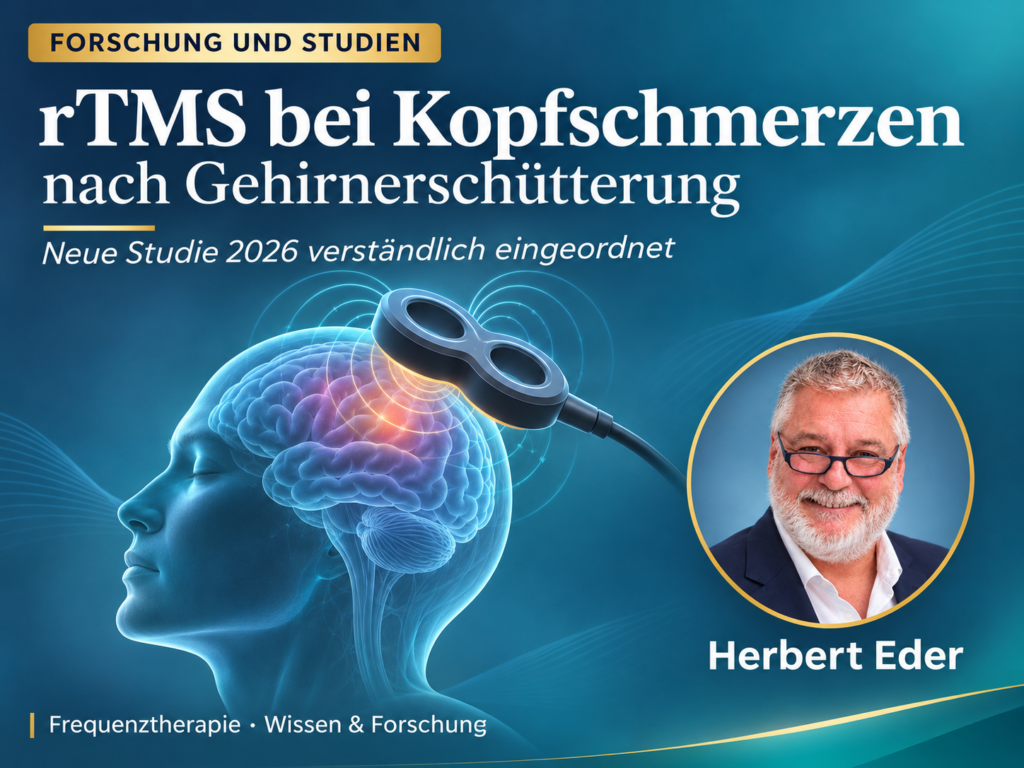
Date of publication: November 14, 2026. The new study was evaluated based on the original abstract and bibliographic information; the full text published by the publisher was not available. The methodological evaluation is based on editorial analysis. The cover image is an AI-generated editorial illustration featuring a portrait of the author and depicts neither study participants nor a documented treatment process. This article serves to Information and is not a substitute for a medical diagnosis, consultation, or treatment.