





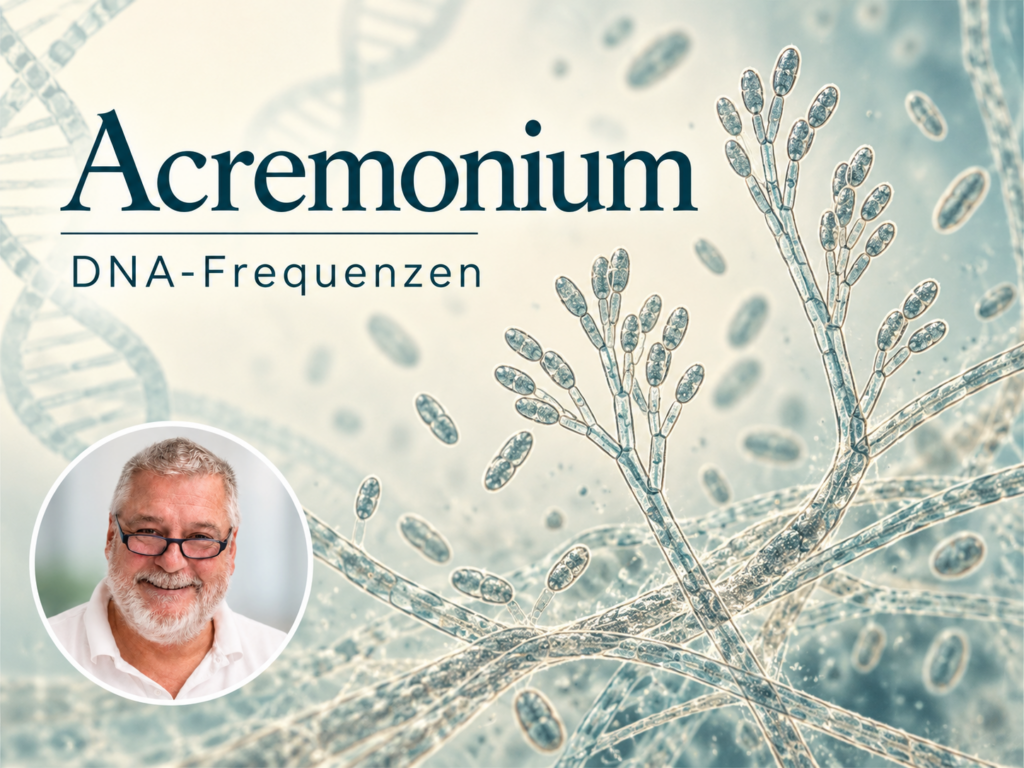
Herbert Eder – an internationally sought-after frequency expert
For the Acremonium DNA Frequencies The DNA frequency database used lists two values: 10,624 Hz and 11,792 Hz. The entries are labeled „Acremonium 1“ and „Acremonium 2.“ Both are shown together in this profile because they share the same genus name. This does not yet mean that the two numbers correspond to different fungal species.
What does Acremonium refer to?
Acremonium is a genus of fungi comprising numerous species. Many species feed on dead plant material and are found in soil. Certain species—or fungi formerly classified under this name—can cause infections under suitable conditions. The detection of an environmental fungus must therefore always be evaluated in the context of the material being examined and the clinical presentation.
Medical mycology has subdivided this group more precisely through molecular analyses. Several species formerly classified as Acremonium are now assigned to other genera, including Sarocladium. An older genus designation and a current species identification must therefore be carefully compared.
Why Accurate Mushroom Identification Is Important
Similar-looking fungal structures can provide an initial guide, but are not always sufficient for reliable species identification. Studies of clinical isolates have demonstrated the importance of combining morphological and molecular methods. A general entry for „Acremonium“ does not provide this detailed information.
With regard to frequency data, this means that the values 10,624 and 11,792 Hz cannot be retroactively assigned to a modern species or a newly named taxon as long as the original assignment is not documented. A similar name is no substitute for this association. This applies in particular to older and newer names that might refer to the same organism.
What medical associations are known?
Infections of the cornea, nails, skin, and subcutaneous tissue, among others, have been described in association with the Acremonium group. In cases of severely compromised immune function, invasive fungal infections may rarely occur. These clinical presentations do not apply to every species in the genus and cannot be determined from the numbers in a frequency list.
A published case of peritonitis in a patient undergoing peritoneal dialysis illustrates the importance of diagnostic diligence: The fungus was repeatedly isolated from the dialysis fluid and additionally identified through sequencing of a genetic region. The species was then known as Acremonium kiliense; today, it is classified as Sarocladium kiliense. This case does not demonstrate any effect of the frequencies listed here.
Diagnosis and Established Treatment
Depending on the affected area, appropriate samples, microscopic examinations, fungal cultures, and, if necessary, molecular testing may be used for diagnosis. Accurate identification is particularly important in cases of invasive infections. Simply selecting a name from a general list is no substitute for examining an actual sample.
Treatment depends on the type of fungus, the site of infection, and the patient’s overall health. Antifungal medications and, if necessary, additional measures targeting the affected tissue or medical access points are selected by a specialist. No uniform treatment regimen for all possible infections can be derived from the collective term “Acremonium.”.
DNA Frequencies for Acremonium: Documented Values
| Name in the database | Frequency in Hz |
|---|---|
| Acremonium 1 | 10,624 Hz |
| Acremonium 2 | 11,792 Hz |
The numbers are presented unchanged in Hertz. The suffixes 1 and 2 are retained to identify the two database entries. Unless otherwise specified, they should not be interpreted as designations for a first and second fungal species, a disease stage, or a therapeutic sequence.
Nor can a hierarchy of values be inferred. A higher numerical value here does not indicate a more dangerous mushroom or a more potent use. The entry simply lists two classifications under a common name. This straightforward observation is particularly helpful when comparing this data with other frequency collections.
What can be inferred from DNA frequencies?
The DNA frequency database used does not provide any sequence references or a verifiable derivation of the figures for these two entries. Likewise, no clinical evidence of efficacy is documented there. The term “DNA frequency” is therefore used to describe the database assignment. On its own, it does not confirm any measured, species-specific Resonance.
For a more in-depth scientific evaluation, at a minimum, the exact identity of the material under investigation, the method of calculation or measurement, and reproducible results would be required. As long as this information is missing, both values remain correctly documented database entries whose biological significance remains unclear. This classification preserves the content of the database while also highlighting which information is still needed to make a reliable conclusion.
Note
The DNA frequencies shown are database assignments. They do not constitute evidence of diagnostic or therapeutic efficacy. Frequency therapy is not recognized by conventional medicine and is not a substitute for a medical diagnosis or treatment.