








Last edited: October 30, 2026
The desire for gentle, additional support is understandable. As Herbert Eder, I would like to Frequency droplets but know exactly what's in the bottle and what results are promised. Personal attention and a claimed medical effect require different forms of evaluation.
A cancer diagnosis can intensify the desire to make a difference. Perhaps you’re seeking more peace of mind, a better way to cope with fatigue, or the feeling of being seen as a whole person. These desires are understandable and deserve Attention. However, they do not have to be linked to a product claim whose effectiveness remains unclear.
Frequency drops are often described as liquids to which specific information or vibrational patterns are said to have been transferred. For the sources reviewed here, there is no reliable evidence that such drops treat cancer or reliably alleviate specific side effects. Anyone considering this as a complementary therapy should therefore discuss the specific product and the specific goal with their oncology team.
Support and tumor treatment have different goals
The DKFZ Cancer Information Service distinguishes between complementary therapies and methods used in place of standard oncological treatment. It emphasizes that a potential benefit for symptoms should not be equated with an effect against the tumor. Complementary options should be evaluated together with the treatment team to assess their benefits and potential risks. This applies even when a product is marketed as natural or gentle. [1]
It helps to be specific when you're having this conversation. Would you like to communicate better with Fear How should you deal with it? Is nausea the biggest problem? Or were you promised that it would have an effect on the cancer itself? These questions should be answered separately. A comforting ritual can have personal value without necessarily fighting tumor cells or demonstrably altering the course of the disease.
The word „supportive“ should not be left ambiguous either. It can describe friendly assistance, but it can also mask a specific medical claim. Therefore, ask the provider to explain exactly what result is expected and what this is based on. Expectation is based on. An honest answer acknowledges uncertainty rather than grouping several very different goals under a single, positive umbrella term.
"Individually selected" does not automatically mean medically appropriate
A personalized selection may be based on a consultation, a questionnaire, or an assessment using medical devices. It primarily shows how the treatment plan is put together. Whether the selection is medically appropriate for your condition must be substantiated separately. A screen displaying organ names or alleged stressors does not, in and of itself, constitute proof that the tumor or its treatment has been reliably assessed.
In particular, ask whether a so-called NLS or frequency analysis is intended to provide a medical diagnosis or is merely part of the treatment plan being offered. For any diagnostic claim, corresponding independent comparative data would be necessary. The term „individualized“ does not replace this evaluation or the assessment of your actual findings by the appropriate team of specialists.
If a finding from the device evaluation contradicts your current treatment plan, you should not use it on your own as the basis for changing your treatment. Take the complete documentation with you and ask for clarification on exactly what is being claimed. A discrepancy between two reports is, first and foremost, a matter for professional evaluation—not a reason to prematurely abandon proven treatment approaches.
The ingredients must be known
With a liquid product, what’s actually in the bottle is important. Ask for the ingredients, concentrations, manufacturer, and intended use in writing. Whether it’s water, Alcohol, whether they contain plant components or other substances cannot be inferred from the term “frequency drops.” Nor does the alleged transmission of information make this information unnecessary.
The U.S. National Cancer Institute explains that certain dietary supplements can affect the absorption, metabolism, or excretion of cancer medications. This can alter their effectiveness. The possibility of an interaction depends on the specific ingredient and the specific treatment. Therefore, it makes more sense to evaluate the actual product than to make a blanket assurance that drops can always be combined without any problems. [2]
If possible, bring the packaging or a clear photo of all the information with you to the appointment. Also mention any other supplements, teas, and products you use. If the ingredients aren't listed in full, they should be Information must be procured first. A reliable assessment cannot be replaced by a presumed formulation.
Exhaustion needs to be specifically categorized
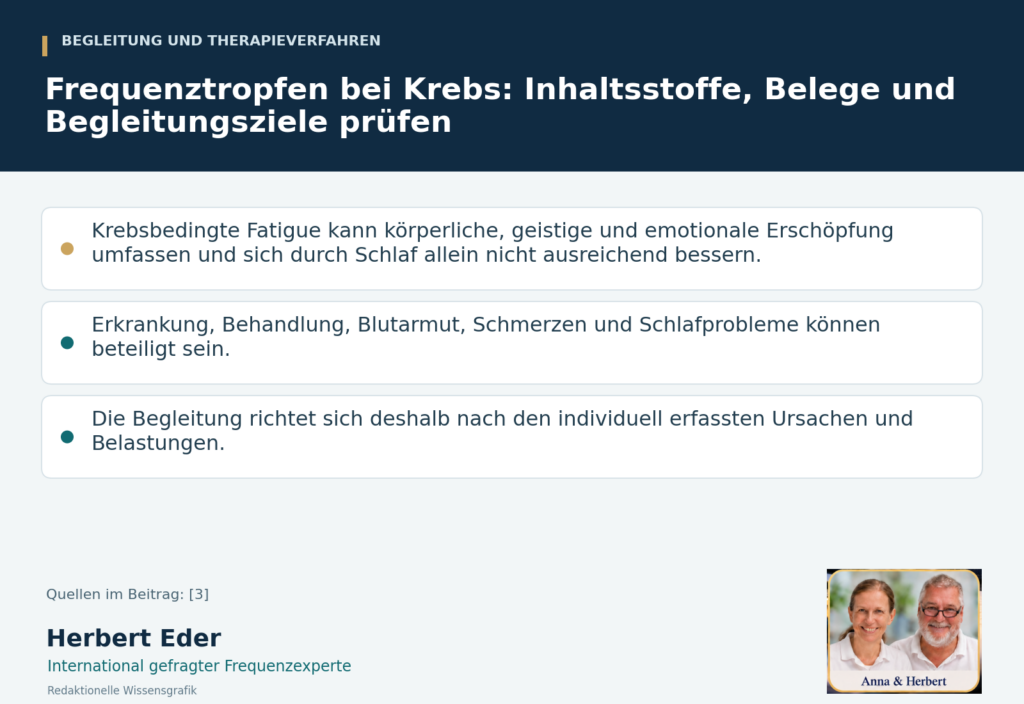
Cancer-related fatigue is more than just ordinary tiredness and does not always go away completely with rest or sleep. The NCI lists various possible contributing factors, including the disease itself, treatments, Anemia, pain, sleep problems, and other stressors. The support provided is therefore tailored to individual circumstances. A general explanation involving an energy imbalance cannot replace this assessment. [3]
For a consultation, you may want to note down how long you’ve been feeling exhausted and which activities are particularly difficult for you. What has changed since you began treatment? What kind of support would be important to you in your daily life? Specific details like these help us discuss the actual issue at hand. Simply stating that a homeopathic remedy regimen should „Energy “give," on the other hand, remains difficult to verify.
When considering additional offers, agree on a realistic goal and a time to review progress. If the goal is not achieved, the explanation should remain open-ended. A lack of improvement is not evidence that you lack confidence, have the wrong attitude, or are experiencing a specific internal block. The responsibility for a promise of results lies with the person who makes it.
Targeting Nausea and Other Side Effects
The NCI describes preventive and treatment medications for treatment-related nausea and vomiting as an important part of care. The choice of medication and the timing of administration depend on the specific cancer treatment and the individual’s situation. A complementary range of drops should not replace such measures. If symptoms occur or worsen, this is a reason to review the existing plan with the treatment team. [4]
It may be helpful to provide a brief description of when the symptoms occur and what you are still able to eat or drink at that time. Also mention any medications you have already taken and their effects. This information allows healthcare professionals to determine more targeted next steps than they could from a general list of treatments. If you experience new or severe symptoms, follow the contact and emergency instructions provided by your treating facility.
A worsening of symptoms should not automatically be interpreted as a desired detoxification reaction or as a sign that the treatment is beginning to take effect. Such an interpretation would replace a professional assessment, even though there may be another cause. It makes more sense to, Changes It is better to describe and evaluate them first than to reinterpret them in a positive light without sufficient grounds.
Emotional support is an integral part of good care
The Cancer Information Service describes psycho-oncological support as assistance in coping with the stress caused by illness and treatment. It can range from individual counseling sessions to long-term psychotherapeutic support. Among other things, its goal is to help patients cope and improve their quality of life. There is no evidence that psychotherapy directly cures cancer, and reputable providers do not make such promises. [5]
If the desire for frequency drops stems primarily from a need for peace of mind, reassurance, or a safe space for conversation, it’s okay to articulate that need directly. You don’t need an additional biological explanation for this. It can be a relief to work together to find a form of support that suits you and whose purpose remains clear.
In Austria, Austrian Cancer Aid offers free counseling—which can be anonymous upon request—to patients and their families. The services provided include psycho-oncological support as well as information on medical, social, and nutritional issues. The appropriate counseling center can help you find the right people to talk to and other sources of support. [6]
How to Prepare for a Discussion About the Additional Services
First, write down the exact product name and your main goal. Note what the provider has promised and what evidence they cite to support it. Also note how long the treatment is expected to last and what the total cost is expected to be. With this information, the conversation can stay focused rather than getting sidetracked into a general discussion of alternative methods.
Next, ask what known or unknown risks are associated with your current treatment. What information is still missing? Are there better-studied options for achieving your desired goal? And how would you know if the additional treatment offers a benefit that is relevant to you? Questions like these support shared decision-making and allow room for your personal preferences.
It may be helpful to bring a trusted person along to the meeting or to briefly jot down the answers. The goal here is not to gather as many offers as possible all at once. The goal is to create a manageable plan where you understand which measure serves which purpose. An additional app should help you stay on track, not create new uncertainty or constantly add more obligations.
Hope Doesn't Need a Guarantee
An offer can be particularly persuasive when it is linked to a personal success story. However, such a story should not replace verifiable data. Even a truthfully reported favorable outcome does not automatically explain what caused it. Verifiable information about the benefits, limitations, and the specific treatment situation is more reliable for making a decision.
You are free to seek support while also asking critical questions. Likewise, you are free to decline an offer without forfeiting your chance to receive help. Your personal decision should not be influenced by the promise that only a specific additional method can restore balance to your body and mind. Good support respects your freedom and your existing resources.
When it comes to alternative therapies related to cancer, the mechanism of action and clinical benefits of a specific treatment remain unclear as long as there is a lack of appropriate evidence. Responsible care therefore focuses on your actual symptoms, your wishes, and the available treatment information. This can lead to a viable support plan without having to assume an unproven effect.
My take: The nature of the complaint should determine the course of action
When experiencing exhaustion, it’s worth identifying the underlying causes, taking into account factors such as anemia, sleep, pain, diet, and treatment. A general statement about an “energetic imbalance” does not answer these questions. I would start by describing which daily activities are difficult and what verifiable improvements are desired. [3]
In the case of drops, the composition must also be known. Only then can it be determined whether any ingredients might interfere with cancer medication. A claimed frequency transmission is no substitute for this product information or clinical evidence. At the same time, the need for peace of mind or a trustworthy conversation can be addressed directly; psycho-oncological support does not require a promise of a cure to provide this. [2] [5]
I explain how experience and causal attribution can be distinguished under Placebo Effects and Treatment Expectations.
For specific questions about goals, documentation, and costs, please refer to my post on Clear Communication with Patients The preparation.
Sources and Further Information
- DKFZ Cancer Information Service: Alternative and Complementary Medicine for Cancer. Retrieved October 29, 2026.
- NCI: Cancer Therapy Interactions With Foods and Dietary Supplements (PDQ), Patient Version. Retrieved October 29, 2026.
- NCI: Fatigue and Cancer. Retrieved October 29, 2026.
- NCI: Nausea, Vomiting, and Cancer. Retrieved October 29, 2026.
- DKFZ Cancer Information Service: Psycho-Oncology – Psychological Support for Cancer Patients. Retrieved October 29, 2026.
- Austrian Cancer Aid: Information on Counseling Centers. Retrieved October 29, 2026.
Topic Overview: Support and Therapeutic Approaches.